| Style | Hot Yoga (Hatha-based, heated room) |
| Level | All levels – beginner through advanced poses included |
| Room Temperature | 90°F to 105°F (32°C to 40°C) with added humidity |
| Props Needed | Yoga mat, grip towel, water bottle |
| Best Time | Morning or early afternoon – avoid practicing on a full stomach |
| Avoid If | Pregnancy, heat sensitivity, cardiovascular conditions, recent fever – consult your doctor if unsure |
| Disclaimer: This article is for informational and educational purposes only. It does not constitute medical advice. Always consult a qualified healthcare provider before starting a new exercise or wellness program, particularly one involving heat exposure. |
What Hot Yoga Poses Actually Ask of You
Hot yoga poses work your body differently than a regular yoga class. The room runs between 90°F and 105°F, humidity is added in most styles, and the heat is not background detail – it is part of the practice from the first breath to the last.
I started teaching hot yoga over a decade ago, and the students who struggle most in those early classes are almost never unfit. They are underprepared for what the heat actually does: it speeds your heart rate, loosens the connective tissue faster than it would in a cold room, and makes the mental demand of staying present significantly harder. That combination is also exactly what makes the practice so effective when you understand it.
This guide covers 34 hot yoga poses across four categories – standing, balance, floor, and strength – organized from beginner through advanced within each. It also covers the real history behind the heat, the benefits that are specific to a heated practice, and the safety habits that make the difference between a great class and a rough one.
Hot Yoga: What the Heat Actually Does
The deliberate use of heat in yoga is not a modern invention. The ancient concept of tapas – the Sanskrit term for internal fire generated through disciplined practice – sits at the center of classical Hatha yoga philosophy. Old texts treated heat as a purifying force, something that clears the body and sharpens the mind. Practicing in external heat was understood to amplify that process.
In physiological terms, that philosophy maps onto something measurable. A heated room accelerates muscle warm-up, reduces the viscosity of connective tissue, and keeps the cardiovascular system engaged throughout the session in a way that a room-temperature class does not.
Research published in the Journal of Strength and Conditioning Research has noted that heated environments can increase core temperature and heart rate response, making demands on the cardiovascular system comparable to moderate aerobic exercise even during poses that look static from the outside.
The modern version of hot yoga is most often associated with Bikram Choudhury, who built a globally franchised sequence of 26 poses practiced at 105°F. When serious misconduct allegations against Choudhury surfaced and were legally pursued, most studios quietly dropped his name.
Many kept the sequence; very few kept the philosophy. What remains worth practicing – and what this guide is built around – is the tradition underneath the franchise: heat as a deliberate tool, not a gimmick.
| Instructor’s Note: The heat will feel like too much in your first two or three classes. That is normal and fully expected. Your body’s thermoregulatory system adapts faster than most people expect – usually by the third session. The challenge becomes manageable. The depth of the practice opens up from there. |
Standing Hot Yoga Poses

Standing poses build the foundation of every hot yoga practice. In a heated room, they demand grounded strength and a level of mental presence that makes them harder than their names suggest. Work through these before moving to balance or floor work – your body will be warm, but not yet fully extended.
1. Mountain Pose (Tadasana)
Mountain Pose teaches you to stand with complete intention: spine long, weight evenly distributed across the four corners of each foot, breath steady and deliberate. In a heated room, sustaining that quality of awareness for more than a minute is genuinely challenging and more valuable than most beginners expect. The physical demand is low. The mental demand is the point.
- Level: Beginner
- Works: Postural muscles, feet, ankles, breath awareness
2. Half Moon Pose (Ardha Chandrasana)
A lateral bend and gentle backbend combined into one continuous movement, extending the full length of the body from heel to fingertips while opening the spine sideways. The heat makes the side body more available here than in a cool room – use that advantage and let the pose open gradually rather than forcing depth.
- Level: Beginner
- Works: Spine, obliques, hip flexors, shoulders
3. Wide-Legged Forward Fold (Prasarita Padottanasana)
A grounding forward fold in a wide stance that takes pressure off the legs while deeply lengthening the inner thighs and decompressing the spine. In a heated class, this pose offers a genuine recovery window between more demanding sequences. Use it intentionally rather than rushing through it.
- Level: Beginner
- Works: Inner thighs, hamstrings, spine, shoulders
4. Warrior I (Virabhadrasana I)
One of the most foundational poses in the entire yoga tradition. The back foot roots at 45 degrees, the front knee bends to 90 degrees, and both arms lift overhead as the chest opens forward. In a heated room, Warrior I teaches you to stay powerful and present when your cardiovascular system is already working hard. That combination – physical demand plus mental steadiness – is exactly what this practice builds.
- Level: Beginner
- Works: Quads, hip flexors, glutes, shoulders
5. Warrior II (Virabhadrasana II)
Where Warrior I turns inward, Warrior II opens outward. Arms extend wide to both sides, hips open to face the side of the room, and the gaze holds steady over the front fingers. This pose builds real leg endurance – the quads of the front leg are under continuous load – and teaches you to stay open and grounded even when the room is testing your energy reserves.
- Level: Beginner
- Works: Quads, inner thighs, core, shoulder stability
6. Triangle Pose (Trikonasana)
A full-body stretch that works the legs, opens the hips, and lengthens the side body simultaneously. The heat makes the hamstrings more cooperative in this pose than they will ever be in a cool class. Let that work for you, moving into the lateral extension gradually rather than reaching straight to maximum depth.
- Level: Intermediate
- Works: Hamstrings, hips, obliques, thoracic spine
7. Extended Side Angle (Utthita Parsvakonasana)
Triangle Pose taken further: a deep lateral extension with significant core engagement added. The bottom hand reaches toward the floor while the top arm extends long over the ear, creating one continuous diagonal line from the outer edge of the back foot to the top fingertips. Deceptively demanding in the heat, this pose builds real stamina across the lateral chain over consistent practice.
- Level: Intermediate
- Works: Legs, lateral core, hip flexors, shoulders
8. Revolved Triangle (Parivrtta Trikonasana)
A standing spinal twist that targets the spine, hamstrings, and balance simultaneously. It requires more focus and flexibility than the standard Triangle, and the rotational demand on the thoracic spine is significant. The heat helps the spine rotate more freely, but take time entering this one – rushing the twist is where most people get into difficulty.
- Level: Intermediate
- Works: Thoracic spine rotation, hamstrings, glutes, balance
9. Warrior III (Virabhadrasana III)
The most demanding of the Warrior family. The body forms a T-shape with one leg grounded and the entire posterior chain working to hold the other leg extended behind at hip height, arms reaching forward. It demands core strength, sharp proprioception, and sustained concentration. The heat makes this pose noticeably harder to hold with good form – which also makes it more effective when you do.
- Level: Advanced
- Works: Posterior chain, core, balance, full body integration
Balance Hot Yoga Poses

Warm muscles respond faster and recover quicker, which means heat genuinely helps with balance once your body has adapted. These poses test how steady you can remain when mental focus is already being taxed by the room temperature. The physical challenge is real. The mental challenge is often harder.
10. Tree Pose (Vrksasana)
One foot roots into the floor, the other presses into the inner thigh or calf – never against the knee joint, which risks lateral pressure on a non-weight-bearing structure. In a heated room, staying genuinely still in this pose for 30 to 60 seconds is a real mental task. The postural muscles of the standing leg are working harder than they appear to from the outside.
- Level: Beginner
- Works: Ankles, standing leg, hip opening, concentration
11. Eagle Pose (Garurasana)
Arms and legs wrap fully around each other in a whole-body compression that is awkward at first and deeply effective once it clicks. The wrapping compresses the shoulder and hip joints and then releases them as you come out, flushing tension from areas that most other poses cannot reach. The heat amplifies both the compression and the release.
- Level: Beginner
- Works: Shoulders, hips, ankles, focus
12. Standing Bow Pulling Pose (Dandayamana Dhanurasana)
A standing backbend that asks balance, strength, and flexibility to work simultaneously. The back leg kicks upward while the front arm extends forward, creating a counterbalancing tension that both opens the chest and stabilizes the pose. The heat makes the chest and shoulder opening more accessible here than in any floor backbend equivalent.
- Level: Intermediate
- Works: Spine, shoulders, quads, full body balance
13. Balancing Stick (Tuladandasana)
Held for approximately ten seconds, those ten seconds work the entire body simultaneously: arms extend forward, one leg extends back, and the body holds a straight horizontal line parallel to the floor. Heart rate peaks sharply right here. This is one of the most cardiovascularly demanding single poses in a hot yoga class, and the heat makes every second of it count.
- Level: Intermediate
- Works: Core, posterior chain, shoulders, cardiovascular system
14. Dancer’s Pose (Natarajasana)
One hand holds the lifted foot from behind while the other arm reaches forward, creating a standing backbend that tests patience as much as it tests flexibility. The heat makes the quadriceps and chest stretch more accessible than they would be in a cool room. The balance still demands complete, unbroken focus – that part the heat does not simplify.
- Level: Intermediate
- Works: Quads, hip flexors, chest, standing leg strength
15. Standing Hand to Big Toe (Utthita Hasta Padangusthasana)
One leg extends forward, held at the big toe by two fingers in a yogi grip. The heat allows the hamstrings to open further than they ordinarily would. Over time, this pose becomes one of the clearest indicators of actual hamstring and hip progress in your practice – the incremental changes are visible from session to session.
- Level: Intermediate
- Works: Hamstrings, hip stability, core, balance
16. Toe Stand (Padangustasana)
One leg is in a lotus position, and the entire body balances on the toes of the standing foot. This is the full expression of balance work in hot yoga – it requires months of consistent preparation to access safely. The heat helps by keeping the ankle joint warm and responsive, but patience matters more than anything else here. Attempting this before your ankles and feet have built the necessary strength is the fastest route to injury in the balance sequence.
- Level: Advanced
- Works: Ankles, feet, deep hip flexors, full body concentration
Floor Hot Yoga Poses

By the time you reach the floor sequence, your body is completely warmed through. This is where hot yoga becomes genuinely restorative. Deep spinal work, hip opening, and back strengthening are all more accessible now than they would be at the start of any session – and more accessible than they will ever be in a cool room.
17. Child’s Pose (Balasana)
Always available. Never something to feel guilty about using. Child’s Pose is where you return to your breath when the heat becomes too much: hips sink toward heels, forehead rests on the mat, arms either extended forward or resting alongside the body. This is part of the practice, not an exit from it. Come here freely – it is not a modification for beginners. It is a tool every practitioner at every level should use without hesitation.
- Level: Beginner
- Works: Hips, lower back, breath reset, nervous system
18. Cobra Pose (Bhujangasana)
A foundational backbend that warms the spine from the inside out. The chest lifts while the elbows stay soft and bent, the hands press lightly rather than pushing, and the hips stay grounded. In the heat, Cobra feels more accessible than usual – the erector spinae and multifidus muscles along the spine are already warm, allowing the extension to happen with less effort and more length.
- Level: Beginner
- Works: Spine extensors, chest, shoulders, abdominals
19. Bridge Pose (Setu Bandhasana)
Hips lift off the floor as the chest opens toward the chin, the glutes and hamstrings contracting to maintain the elevation. A gentle backbend that builds posterior chain strength while opening the entire front body. In a heated class, Bridge sits somewhere between effort and recovery – it works, but it also gives back. One of the most consistently useful floor poses across all experience levels.
- Level: Beginner
- Works: Glutes, hamstrings, spine, chest
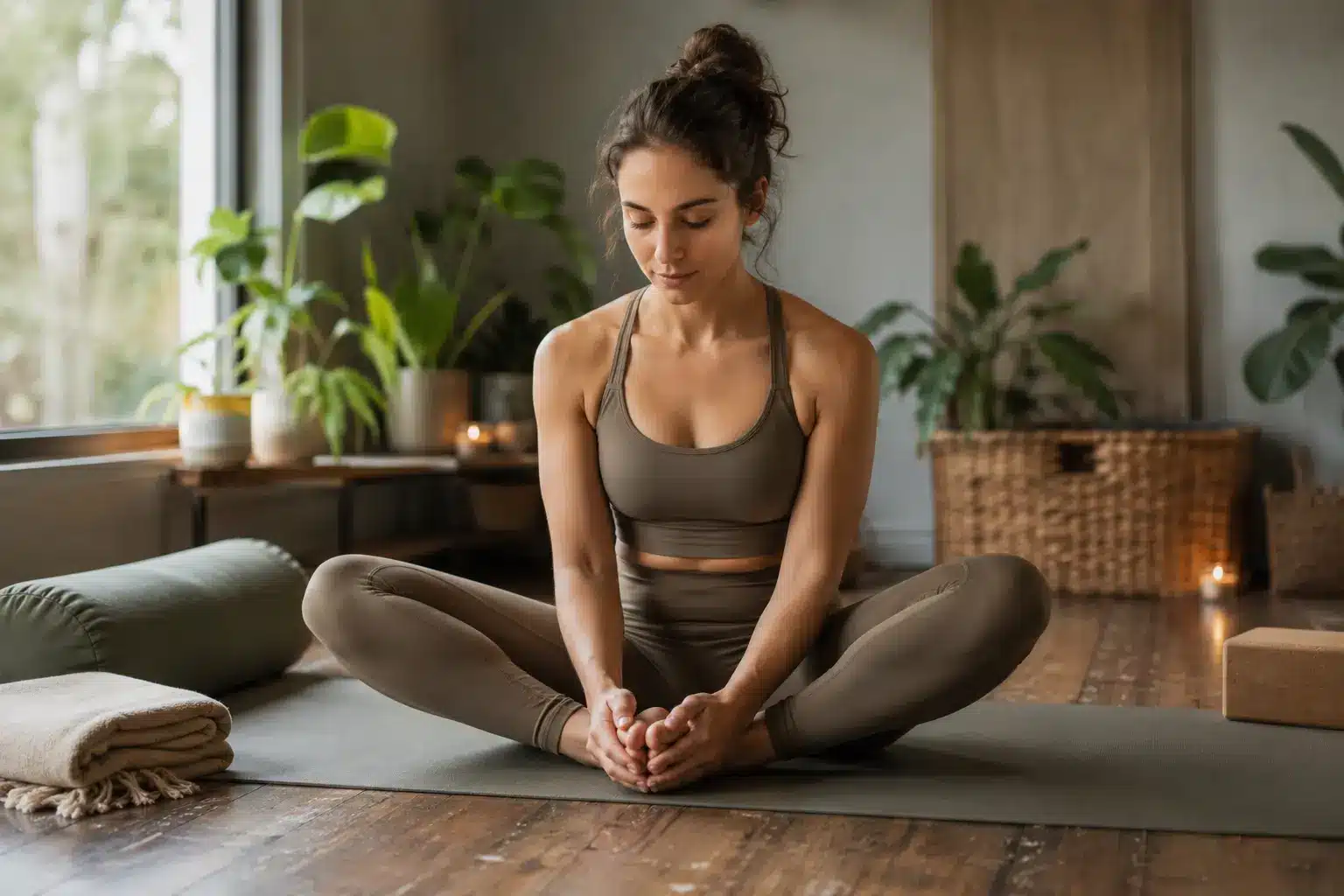
20. Seated Forward Fold (Paschimottanasana)
Legs extended straight, torso folding forward over them, hands reaching toward the feet. Simple in concept, genuinely effective with consistent practice. The heat allows the hamstrings and posterior fascia to release further than they would in a cool class. This pose compounds over time – the more regularly you practice it, the more significant the opening becomes. Sit with it rather than rushing the fold.
- Level: Beginner
- Works: Hamstrings, lumbar spine, calves, nervous system
21. Locust Pose (Salabhasana)
Lying face down, legs lift off the floor using only the posterior chain – lower back, glutes, and hamstrings working without any ground assistance. It looks simple and feels genuinely demanding. The heat intensifies the muscular load significantly. Start with one leg at a time and build the back strength deliberately before attempting the full bilateral variation.
- Level: Intermediate
- Works: Lower back, glutes, hamstrings, posterior chain
22. Bow Pose (Dhanurasana)
Ankles held from behind, chest and legs lifting simultaneously to form a complete bow shape. It opens the entire front body – chest, hip flexors, abdominals, and quadriceps – in one movement and demands real back strength to hold with control. The heat makes the spine more willing to extend here than at almost any other point in the practice. Maintain the lift through muscular engagement rather than gravity.
- Level: Intermediate
- Works: Full spine, chest, hip flexors, core
23. Supine Twist (Supta Matsyendrasana)
Lying on the back with knees dropping to one side while the upper body stays long and open, shoulders grounded to the mat. One of the most effective spinal releases in the entire floor sequence. The heat makes the rotational movement smoother and the decompression noticeably deeper than it would be in a cold room. Go slowly, never force this one, and breathe into the rotation rather than using the breath to push further.
- Level: Intermediate
- Works: Thoracic and lumbar rotation, lower back, hips, digestive organs
24. Camel Pose (Ustrasana)
A deep kneeling backbend that opens the chest, throat, and hip flexors fully and simultaneously, with the hands reaching back to rest on the heels. This pose is well documented for provoking unexpected emotional responses – that is physiologically normal, not a cause for alarm; it relates to the sustained compression and release of the thoracic region and solar plexus. The heat makes the front body more pliable and also more vulnerable. Respect both sides of that reality.
- Level: Advanced
- Works: Thoracic spine, chest, hip flexors, throat, quadriceps
25. Rabbit Pose (Sasangasana)
The direct counterpose to Camel. The spine rounds fully forward, forehead toward the knees, hands holding the heels from the outside. It decompresses everything Camel compressed. Do not skip this after any deep backbend – your spine depends on this balance to recover correctly. The contrast between the two poses is not optional; it is structural to the practice.
- Level: Advanced
- Works: Entire back body, spinal flexion, shoulders, cervical spine
26. Pigeon Pose (Eka Pada Rajakapotasana)
One shin crosses forward, the other leg extends back, and the body settles into the floor in a deep hip and glute stretch. The heat makes the hip flexors and piriformis more willing to release here than they ever would in a cool room – that increased tissue pliability is one of the clearest arguments for practicing hip openers specifically in a heated environment. Use the warmth to move into the pose deliberately rather than forcing depth.
- Level: Advanced
- Works: Hip flexors, glutes, IT band, lower back
Strength Hot Yoga Poses

These poses build the functional strength that supports everything else in the practice. The heat increases cardiovascular demand during holds that would feel purely muscular in a cool room, turning strength poses into compound work that challenges the aerobic system at the same time. That difficulty is not incidental – it is the mechanism.
27. Plank (Phalakasana)
Arms straight, body in one long line from head to heel, core braced, hips level. The foundation of upper body strength in yoga. In a heated class, holding a quality plank for more than 30 seconds becomes genuinely cardiovascular – the muscles fatigue faster and the heart rate climbs in a way that does not happen at room temperature. This is a simple pose that quietly compounds with consistency.
- Level: Beginner
- Works: Core, arms, shoulders, full body stability
28. Chair Pose (Utkatasana)
Feet together, knees bent as deeply as flexibility allows, arms lifted overhead. The quadriceps, glutes, and ankle stabilizers all work under sustained load, and the heat makes every additional second feel noticeably longer than it actually is. Chair Pose builds the lower body strength that makes every standing pose and balance pose more sustainable over time – it is one of the best investments in the strength sequence.
- Level: Beginner
- Works: Quads, glutes, core, ankles
29. Dolphin Pose (Ardha Pincha Mayurasana)
Forearms grounded, hips lifted, body forming an inverted V shape. This pose builds the shoulder girdle and upper back strength that prepares the body for deeper inversions. In the heat, the upper body warms quickly here, making Dolphin one of the most effective preparatory poses for arm balances. Hold for 5 to 10 breaths and work toward keeping the heels moving toward the floor.
- Level: Beginner
- Works: Shoulders, upper back, core, hamstrings
30. Chaturanga (Four-Limbed Staff Pose)
A low hover with the body parallel to the floor, elbows tracking close to the ribs rather than flaring outward. This is the pose most commonly done incorrectly in yoga – the elbows flare, the hips drop, or the body collapses rather than holding the hover. In the heat, muscles fatigue faster than usual, which makes correct form matter more, not less. Reduce to one repetition done well rather than repeating with compromised alignment.
- Level: Intermediate
- Works: Triceps, chest, core, wrist stability
| Safety Note: If you experience dizziness, nausea, or a sudden sense of weakness during any strength pose, sit down immediately and rest in Child’s Pose. These are clear physiological signals, not indicators of weakness. Listen to them. |
31. Boat Pose (Navasana)
Balanced on the sitting bones with legs and torso lifted to form a V shape, the deep core and hip flexors working together to sustain the position. The core has nowhere to hide in this pose. The heat makes sustaining it significantly more demanding than it is in a cool room. Begin with knees bent and shins parallel to the floor, then extend the legs over weeks of consistent practice rather than forcing the full expression immediately.
- Level: Intermediate
- Works: Deep core, hip flexors, spine stabilizers
32. Forearm Plank (Phalakasana II)
Forearms grounded instead of hands, body held in a long, still line. The lower base of support means the deep stabilizers of the spine – the transverse abdominis and multifidus – have to work harder than in a standard plank. This pose quietly builds the foundational stability that every other pose in the practice depends on, and it is harder to sustain in the heat than it looks from the outside.
- Level: Intermediate
- Works: Deep core, shoulders, spinal stabilizers, endurance
33. Side Plank (Vasisthasana)
Body balanced on one hand and the outer edge of one foot, forming a strong diagonal line with the opposite arm reaching skyward. Lateral core strength – specifically the obliques and quadratus lumborum – is one of the most consistently undertrained areas in standard yoga practice. Side Plank addresses it directly. The heat makes holding the alignment genuinely challenging across the full duration. Modify to a forearm or bent-knee variation until the strength is there to hold the full position.
- Level: Intermediate
- Works: Lateral core, obliques, shoulder stability, balance
34. Crow Pose (Bakasana)
Both hands on the floor with knees resting on the backs of the upper arms, feet lifting off the ground. The first arm balance most students encounter in yoga, and one that requires as much mental commitment as it does physical strength. The heat warms the wrists and shoulder girdle in a way that genuinely reduces injury risk during the learning phase. Start with toes barely off the floor and hold for one breath before building duration.
- Level: Advanced
- Works: Core, arm strength, wrist stability, mental focus
Benefits of Hot Yoga Poses
The heat is not just discomfort – it is doing something specific every time you step onto the mat. Here is what the research and consistent practice actually support:
| Benefit | What It Comes From | Poses Where You’ll Notice It Most |
|---|---|---|
| Deeper flexibility and safer range of motion | Heat reduces connective tissue viscosity, allowing greater extensibility at lower force | Pigeon, Camel, Seated Forward Fold |
| Cardiovascular conditioning without running | Elevated core temperature sustains elevated heart rate across the full session | Balancing Stick, Warrior III, Chair Pose |
| Functional strength | Isometric loads in heat fatigue muscle fibers faster, producing greater strength adaptation over time | Crow Pose, Chaturanga, Boat Pose |
| Forced mental presence | Sustained heat exposure demands moment-to-moment attentional control in a way comfortable environments do not | Dancer’s Pose, Toe Stand, Warrior III |
| Spinal health and mobility | Warm spinal muscles allow both deeper extension and safer rotation across the thoracic and lumbar regions | Cobra, Rabbit, Supine Twist |
| Nervous system regulation | The contrast between peak exertion and deliberate rest (Child’s Pose, Forward Fold) trains the autonomic system | Child’s Pose, Seated Forward Fold |
Most students start noticing measurable shifts in flexibility, stamina, and focus around the six-to-eight-week mark of consistent attendance. Not before, and rarely much later than that when practice is regular.
Safety Tips for Hot Yoga
The heat changes the physical parameters of this practice in ways that matter for safety. These are the habits that distinguish a sustainable long-term practice from a series of difficult experiences:
- Hydrate in the hours before class: Drink at least 500ml of water in the two hours before practice. Do not try to compensate by drinking heavily right before you walk through the door – by the time you need that hydration, it will not yet be available to your tissues.
- Eat light: A heavy meal two to three hours before class in that level of heat is uncomfortable at best and nauseating at worst. A light snack 60 to 90 minutes before is manageable for most people.
- Tell your teacher before your first class: A good instructor will note where you are, give you genuine permission to pace yourself, and keep an eye on you without making it obvious.
- Child’s Pose is always available: At any point in any class. No explanation needed. No permission required. No guilt attached. This is how experienced practitioners manage the heat.
- Take dizziness seriously: Sit down, breathe, and do not push through it. Dizziness in a heated room is your thermoregulatory system asking you to stop. That is not a character test. It is physiology.
- Wear minimal, breathable clothing: Less fabric means less overheating. In this particular environment, there is a direct relationship between how much clothing you wear and how hot you feel.
- Bring a grip towel: Your mat will become slippery within the first 20 minutes of class. A towel over the mat surface is not optional for floor poses – it is a basic safety measure.
- Stop comparing yourself to others in the room: Everyone’s heat tolerance is different, and that variance has nothing to do with fitness or experience. Your tolerance will build on its own timeline.
Your first hot yoga class will probably feel like too much. That is completely normal. Show up for a second class before deciding anything about whether this practice is for you. The difference between class one and class three is significant.
Frequently Asked Questions About Hot Yoga Poses
These are the questions I hear most often from students before their first class and during the early months of consistent practice.
What is hot yoga and how is it different from regular yoga?
Hot yoga is yoga practiced in a deliberately heated room, typically between 90°F and 105°F with added humidity. The heat is not ambient background – it is an active component of the practice that warms muscles faster, allows deeper range of motion, and sustains cardiovascular demand throughout the class. Regular yoga at room temperature does not produce the same physiological response, even using identical poses and sequences.
Can beginners do hot yoga poses safely?
Yes, with preparation. The key adjustments are: tell your instructor before class, hydrate well in the two hours before you arrive, give yourself permission to use Child’s Pose freely, and do not try to keep pace with experienced practitioners in your first several classes. The heat is the most demanding aspect for new students, not the poses themselves. Your body adapts to the heat faster than most people expect – usually within three to five sessions.
How many hot yoga poses are there?
It depends on the style and the teacher. The original Bikram sequence is fixed at 26 poses plus two breathing exercises. Other hot yoga formats are teacher-led and vary widely, typically covering 20 to 40 poses in a 60 to 90 minute class depending on format and the instructor’s sequencing approach.
What hot yoga poses should beginners avoid?
Deep inversions and full backbends like Wheel Pose are genuinely risky for beginners in extreme heat – blood pressure shifts under inversion are amplified by elevated core temperature. Crow Pose and Toe Stand also require specific strength and heat tolerance before they can be practiced safely. In the first several weeks, focus on standing poses, basic balance poses, and the earlier floor poses in this guide. Build the strength and heat tolerance before approaching the advanced variations.
How often should you practice hot yoga?
Two to three sessions per week is a strong starting frequency for most people. Your body needs real recovery time between heated sessions, both for muscular recovery and for the cardiovascular system to adapt to repeated heat exposure. Daily practice is possible for experienced practitioners, but beginning at that frequency significantly increases the risk of overheating and overuse issues.
Where did hot yoga originally come from?
Hot yoga is rooted in the ancient concept of tapas from classical Hatha yoga – the deliberate generation of internal heat through disciplined practice, documented in texts that predate modern yoga by thousands of years. The modern studio format was largely shaped by Bikram Choudhury’s sequenced approach in the late 20th century, though that commercialized version has been widely separated from the philosophical tradition beneath it. The practice of using external heat to amplify yoga’s physical and mental effects is far older than any studio brand.
What should I wear to hot yoga?
As little as you are comfortable in. For women, a sports bra and fitted shorts or a short-sleeve top with minimal fabric is standard. For men, shorts without a shirt or with a lightweight tank. The goal is to minimize the insulating layer between your body and the air so the room’s cooling mechanisms – primarily sweat evaporation – can function as they should. Loose cotton holds moisture and increases overheating risk significantly.
Final Verdict: Are Hot Yoga Poses Worth Practicing?
Hot yoga poses are worth practicing if you understand what they are actually asking of you. The heat is not the difficulty on top of the yoga – it is the practice itself.
Warrior III held at 105°F with your heart rate elevated is a different physical and mental event than Warrior III at room temperature, and that difference is where the real adaptation happens.
The poses in this guide build real flexibility, functional posterior chain strength, and the kind of sustained mental focus that transfers outside the studio. Start with Mountain Pose, Eagle, and Child’s Pose in your first class.
Use the heat, pace yourself honestly, and come back for the second session before drawing any conclusions. That is where this practice actually begins.