| Style | Chair Yoga (Seated / Supported) |
| Level | Beginner to all levels |
| Duration | 10 to 20 minutes per session / 28 days |
| Props Needed | One sturdy, armless chair (optional: yoga strap, light weights) |
| Best Time | Morning or any consistent daily window |
| Avoid If | Recent surgery, severe osteoporosis, uncontrolled high blood pressure (consult your doctor first) |
I found the 28-day chair yoga challenge when I needed movement that actually fit into a packed schedule. Using only a chair, I built flexibility, steadier balance, and a daily routine that finally stuck.
If you have been putting off exercise because you feel like you need more time, more space, or more experience, this challenge was designed for exactly where you are right now.
The sessions run just 10 to 20 minutes a day. You do not need to get down on the floor. You do not need previous yoga experience. You need a chair and the willingness to show up each day for four weeks.
| Disclaimer: This article is for informational and educational purposes only. It does not constitute medical advice. Always consult a qualified healthcare provider before starting a new exercise or wellness program, especially if you have a chronic health condition, recent injury, or take medications that affect balance. |
Why the 28-Day Chair Yoga Challenge Works
Consistency beats intensity every time, especially when you are building a new movement habit from scratch. A 28-day chair yoga challenge gives your body enough time to actually adapt.
\Flexibility improves gradually over weeks, not after a single session, and the same is true for balance and posture. Short, daily sessions are also far easier to protect in a busy schedule than longer workouts you keep rescheduling.
The research backs this up. A 2019 systematic review published in the International Journal of Behavioral Nutrition and Physical Activity found that regular yoga practice improves physical strength, flexibility, and health-related quality of life in older adults.
A smaller 2023 study of 85 women with knee osteoarthritis found that chair yoga specifically improved functional fitness with no adverse effects. And a 2012 study of older adults with a median age of 88 found that eight weeks of chair yoga reduced fear of falling and improved mobility.
What makes the chair yoga format particularly valuable is the seated base. It removes the balance risk of standing poses and the floor access required by mat yoga, which means people with joint pain, limited mobility, or recovering from injury can participate without anxiety about modification.
The chair is not a crutch. It is a tool that keeps your practice safe enough to continue every day.
| Instructor Tip: Choose one specific time of day for your practice and treat it like an appointment. Morning works well because your schedule has not yet filled up. Even 10 minutes at the same time each day builds the habit faster than longer sessions done irregularly. |
What You Will Need Before You Start
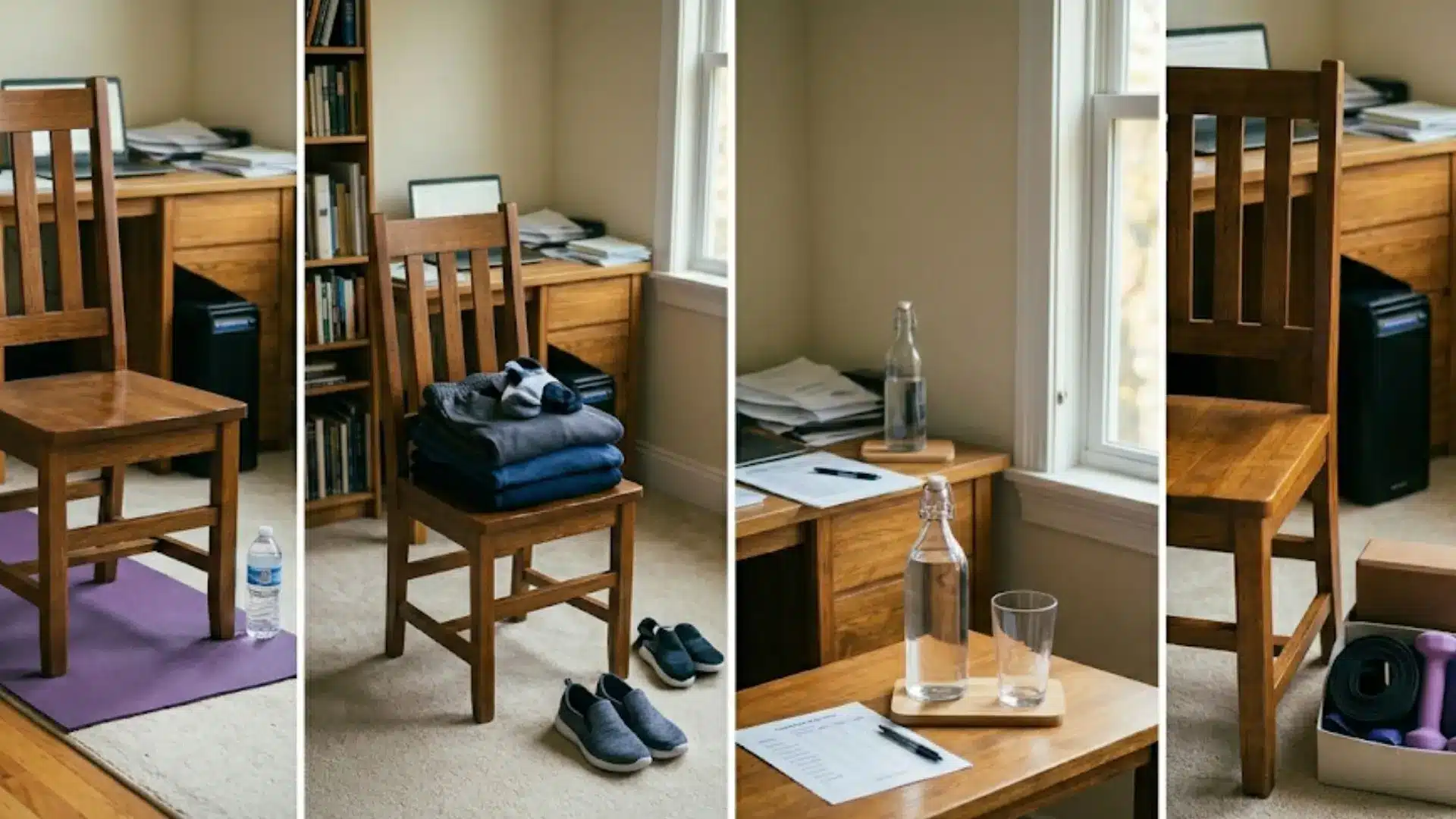
The equipment list is short. A sturdy chair with four legs, no wheels, and a firm seat is the only essential item.
Armless chairs work best because they give your shoulders and arms a full range of motion during lateral stretches and twists. If your chair slides on hardwood or tile, place it on a non-slip mat before each session.
Wear comfortable clothing that does not restrict your hips or shoulders. Keep water nearby. Optional props that add variety in weeks three and four include a yoga strap for stretches and light hand weights (1-3 pounds) for seated strength work. Neither is required to complete the challenge.
How the 28 Day Chair Yoga Challenge Is Structured
The four-week structure follows a deliberate progression. Each week builds on what came before it, so by the time you reach the flowing sequences of week four, the individual poses feel familiar, and the breath awareness feels natural. Here is how the sessions scale across the challenge:
| Days | Session Focus | Duration | Key Activities |
|---|---|---|---|
| Day 1 to 7 | Foundation Building | 10 to 15 minutes | Basic posture setup, diaphragmatic breathing, gentle warm-ups |
| Day 8 to 14 | Flexibility Focus | 15 to 18 minutes | Hip openers, shoulder stretches, spinal mobility sequences |
| Day 15 to 21 | Strength Development | 18 to 20 minutes | Core activation, leg strengthening, balance challenges |
| Day 22 to 28 | Flow and Integration | 15 to 20 minutes | Linked sequences, breath meditation, progress assessment |
Duration is a guideline, not a rule. On lower-energy days, a shorter session still counts. Consistency matters more than hitting exact times. What the table above shows is that the challenge asks less of you at the start, earns your trust over two weeks, and then gently extends the sessions once the movements feel second nature.
Week-by-Week Breakdown
To make the 28-day chair yoga challenge easier to follow, here’s a simple weekly guide. Each week builds on the last so you can progress step by step without feeling overwhelmed:
Week 1: Building Foundations (Days 1 to 7)
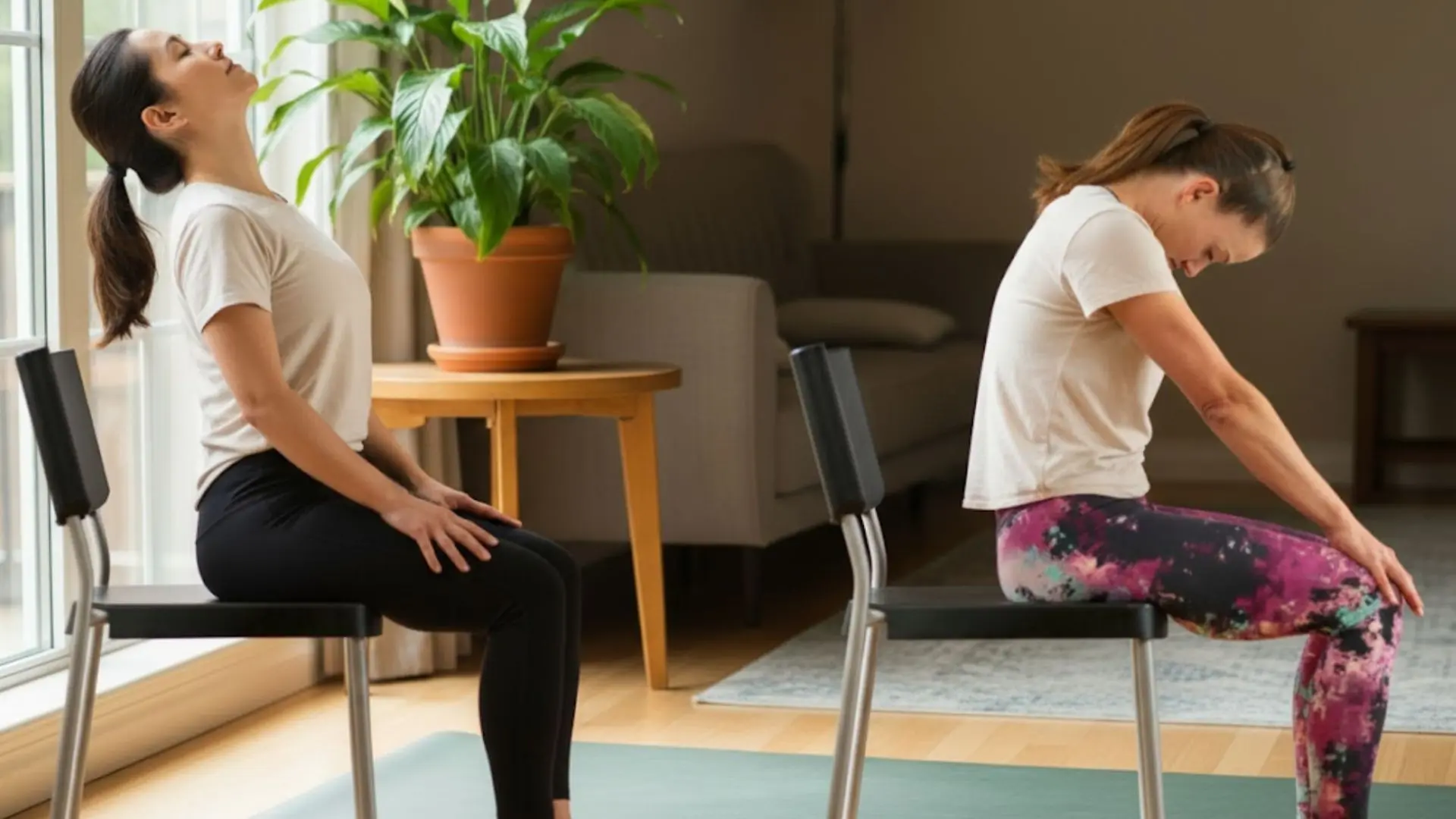
Your first week focuses on two things: proper posture and breath awareness. Most people sit with a rounded lower back and a collapsed chest for most of the day. The seated mountain pose alone, held with deliberate spinal length and relaxed shoulders, will feel like work if you have never paid attention to alignment before. That is a good sign.
Sessions in week one are short on purpose. Your muscles and joints need time to adjust to new movement patterns without becoming sore enough to skip the next day. The goal this week is not flexibility. It is showing up.
Poses to practice in week one:
- Seated mountain pose: Sit near the front of your chair with feet flat, spine tall, and hands resting on your thighs. Hold for 5 to 8 breaths, focusing on lengthening upward through the crown of your head.
- Gentle neck rolls: Drop your right ear toward your right shoulder, pause, then slowly roll your chin toward your chest and bring your left ear toward your left shoulder. Reverse. Keep the movement slow and continuous.
- Seated forward fold: Sit tall, inhale to lengthen, then exhale as you hinge forward at the hips (not the waist) and let your hands rest on your shins or the floor. Hold for 5 breaths to stretch the hamstrings and decompress the lower back.
| Safety Note: If you feel any sharp pain or pinching in the neck during neck rolls, reduce your range of motion. Move only through the range that feels like a gentle stretch, not a strain. |
Week 2: Improving Flexibility (Days 8 to 14)
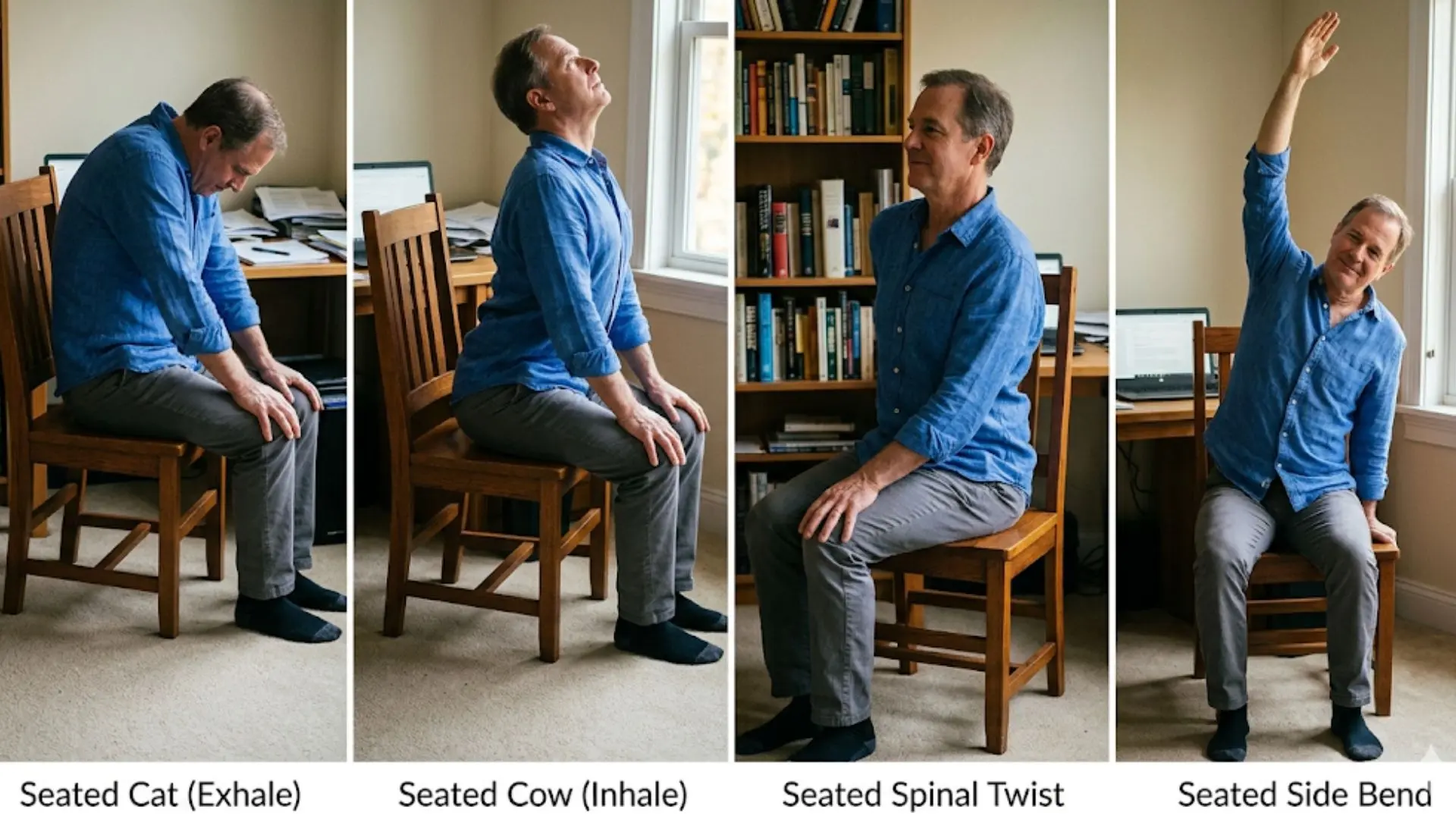
By day eight, sitting tall should already feel slightly more natural. This week, you build on that foundation by targeting the areas that accumulate the most tension from daily sitting: the hips, the thoracic spine, and the shoulders. Sessions extend to 15 to 18 minutes, and the stretches hold a little longer.
The spinal twist introduced this week is particularly effective. Rotation through the thoracic spine is one of the first movements people lose as they age, and it affects everything from how freely you can turn to look over your shoulder to how easily you can reach across your body.
Poses to practice in week two:
- Seated cat-cow: Place both hands on your knees. On an inhale, arch your back, lift your chest, and look slightly upward (cow). On an exhale, round your spine, drop your chin toward your chest, and press your hands into your knees (cat). Move slowly through 8 to 10 rounds.
- Seated spinal twist: Sit sideways near the edge of your chair. Place your right hand on the chair back and your left hand on your right knee. Inhale to lengthen your spine, then exhale and rotate gently to the right. Hold for 5 breaths, then repeat on the left side.
- Seated side bend: Sit tall with both feet flat. Raise your right arm overhead, exhale, and lean gently to the left, feeling the stretch along your right ribs. Hold for 3 to 5 breaths and repeat on the other side.
Week 3: Strength and Balance (Days 15 to 21)
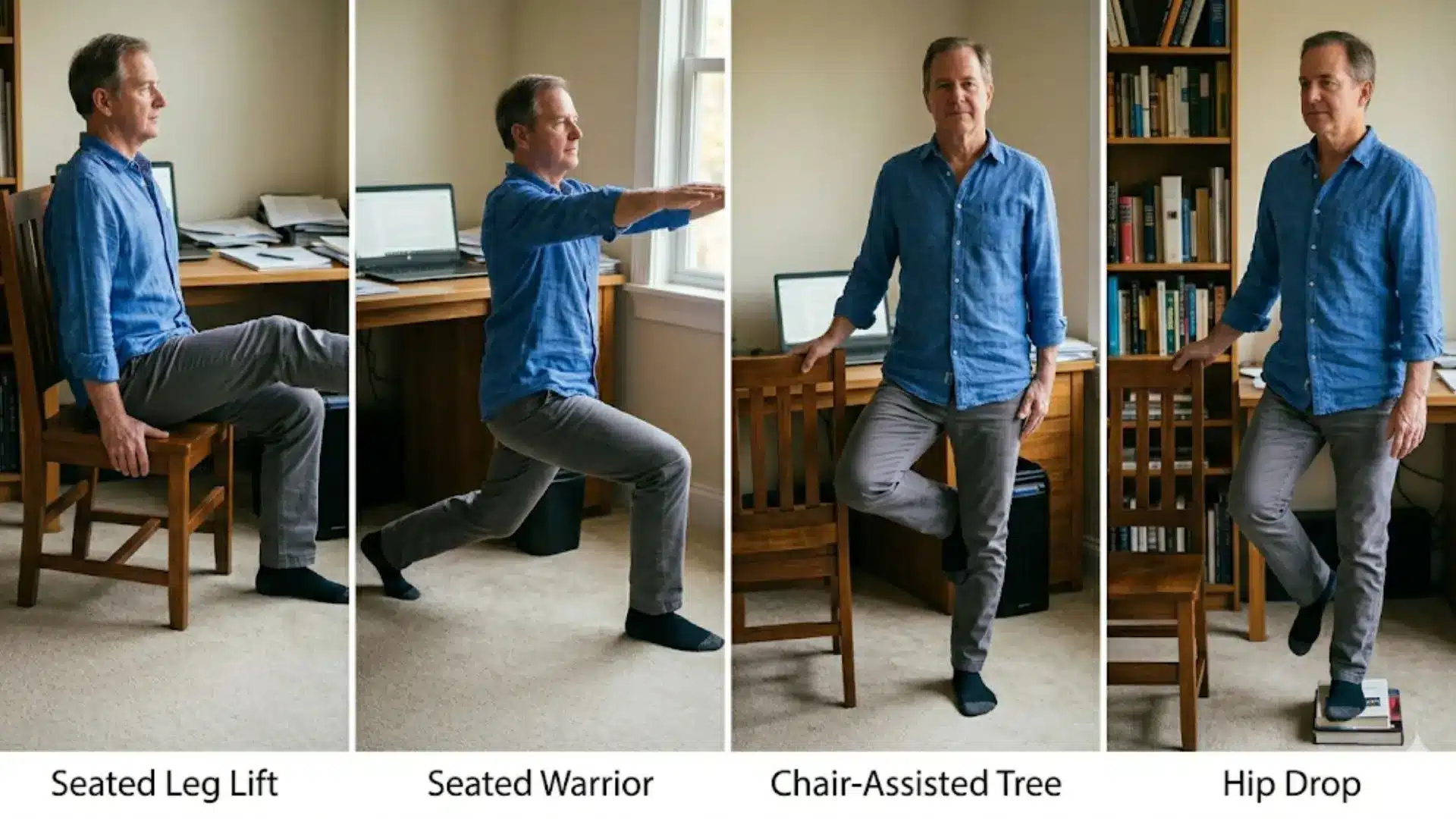
This is where the challenge earns its name. Week three shifts from passive stretching into active strength work. You will feel your core engage during seated leg lifts, your hip flexors work during standing variations, and your concentration sharpen during the balance poses. Sessions run up to 20 minutes.
The chair-assisted tree pose is a good example of how the challenge layers safely. You use the chair back for light fingertip support, which means your stabilizing muscles still work hard while the risk of a full balance loss is removed. The hip drop exercise works the same lateral hip stabilizers and pairs well with this week if you want to extend your session.
Poses to practice in week three:
- Seated leg lifts: Sit tall with your hands on the sides of your chair for stability. Slowly lift your right leg until it is parallel to the floor, hold for 2 to 3 seconds, then lower with control. Repeat 10 times per side. This works the hip flexors and lower abdominals.
- Seated warrior variation: Sit sideways on the chair with your right leg extended behind you and your left knee bent at 90 degrees. Square your hips and extend both arms, one forward and one back. Hold for 5 breaths and switch sides. This builds leg strength and hip stability.
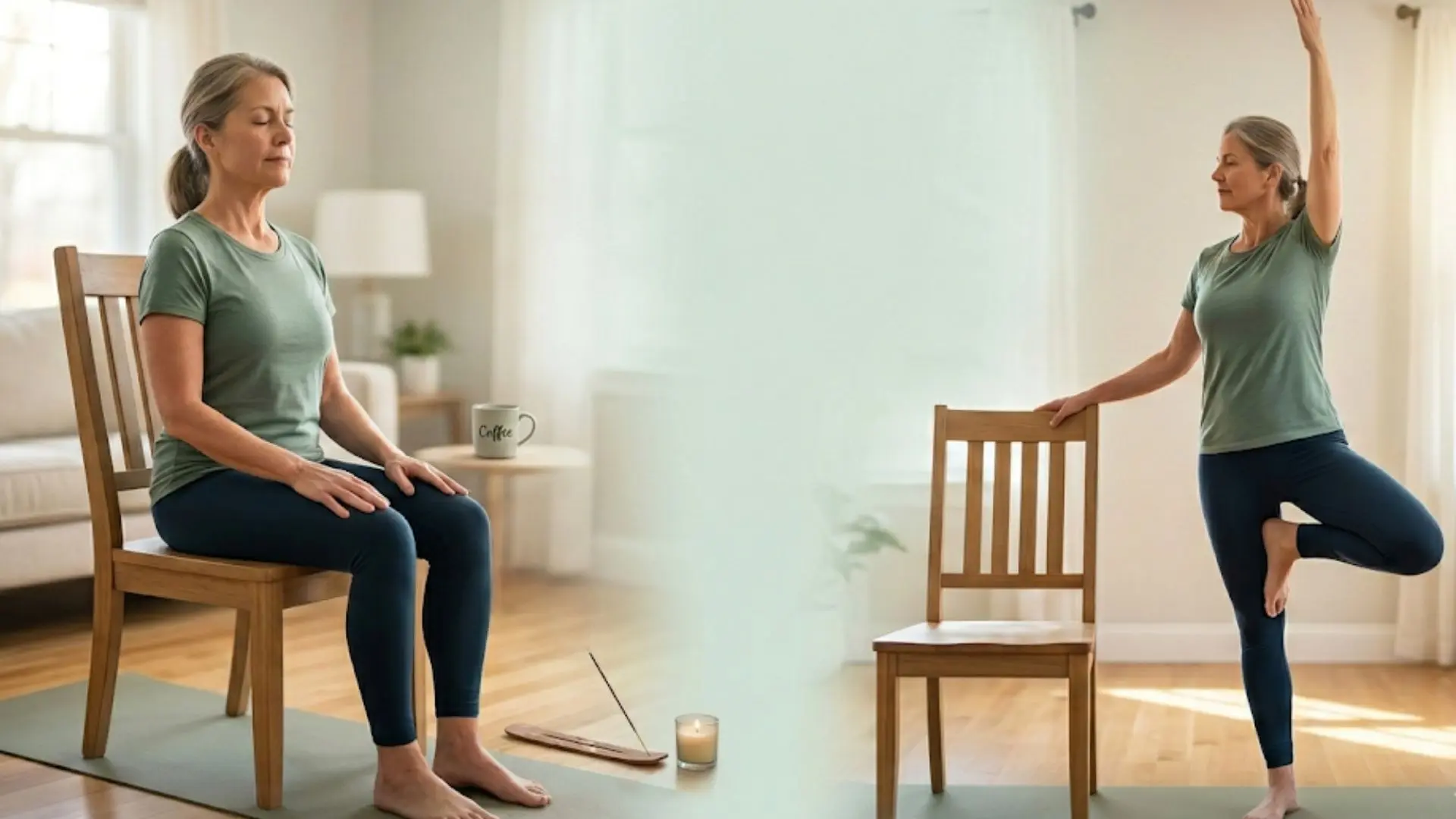
- Chair-assisted tree pose: Stand beside your chair with your right hand resting lightly on the chair back. Shift your weight onto your left foot and place the sole of your right foot against your inner left ankle or calf (not the knee). Hold for 5 breaths, then switch. As balance improves, try reducing your grip on the chair.
Week 4: Flow and Mindfulness (Days 22 to 28)
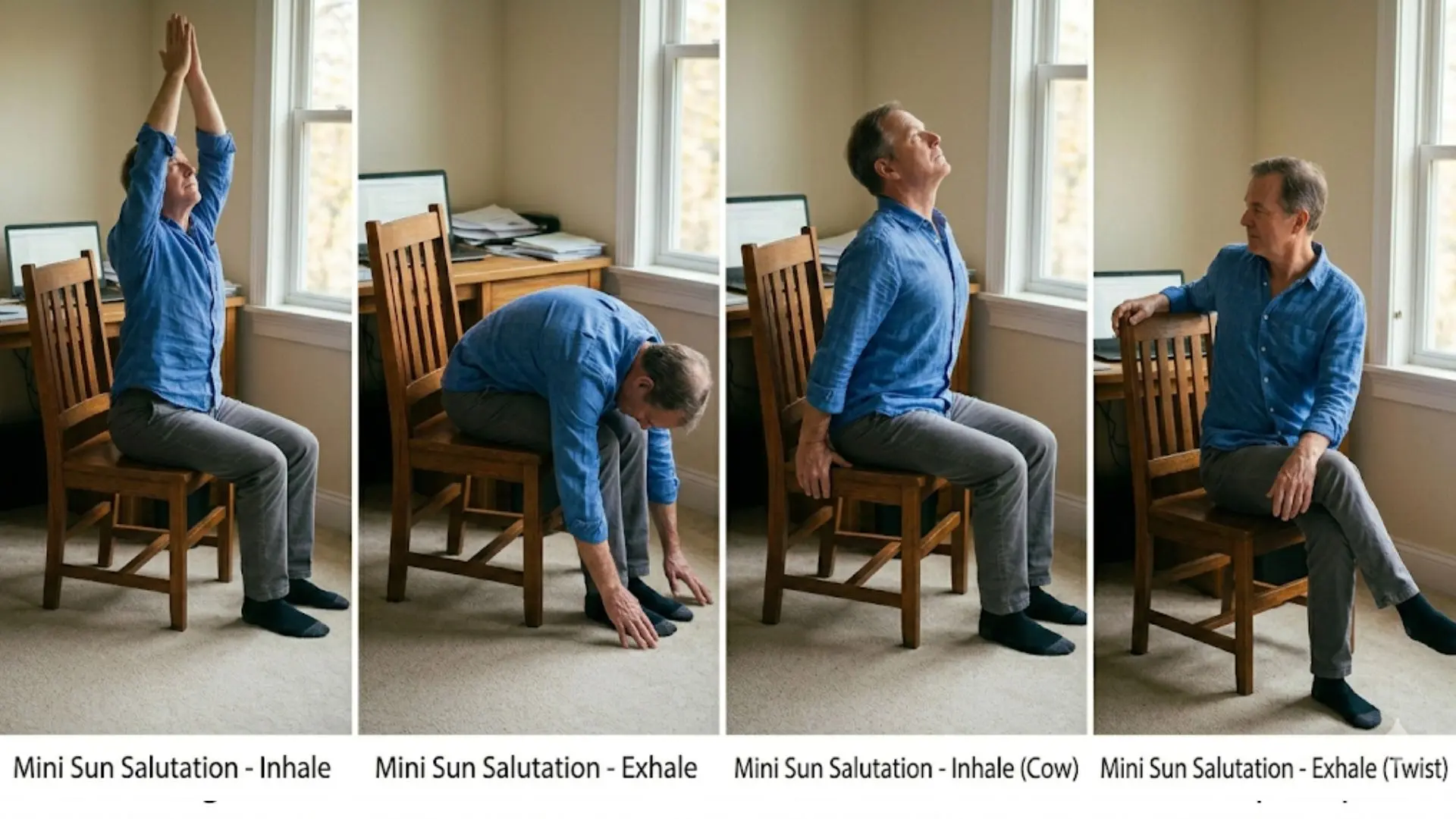
The final week brings everything together. Instead of practicing individual poses in isolation, you link them into short sequences timed to your breath. The sessions feel less like exercise and more like a moving meditation, which is intentional. Breath-linked movement activates the parasympathetic nervous system, reducing cortisol and calming the mind in ways that isolated stretching alone does not.
This week also includes guided relaxation and breathing exercises at the end of each session. These are not optional cooldowns. They are the part of the practice most likely to carry over into how you handle stress for the rest of your day.
Practices to focus on in week four:
- Mini seated sun salutation: Link seated mountain pose, forward fold, cat-cow, and a gentle spinal twist into one continuous sequence timed to your breath. Move on each inhale and exhale rather than holding each pose for a count.
- Guided body scan relaxation: Sit tall or rest your back against the chair. Close your eyes and move your attention slowly from the soles of your feet to the crown of your head, releasing tension in each area as you go. Three to five minutes is enough.
- Box breathing: Inhale for a count of four, hold for four, exhale for four, hold for four. Repeat for five cycles. This breathing pattern has measurable effects on heart rate variability and anxiety reduction.
Modifications for Limited Mobility
The 28-day chair yoga challenge is designed to be accessible, but every body is different. Here is how to adapt the three most common situations:
Limited hip flexibility: If you cannot sit near the front of your chair without rounding your lower back, place a folded blanket under your seat to tilt your pelvis slightly forward. This small adjustment makes upright posture significantly easier and more comfortable.
Shoulder or wrist pain: During poses that involve raising your arms, keep your elbows soft and only lift to the range that feels comfortable. For seated forward folds, let your hands rest on your thighs instead of reaching toward the floor. Avoid weight-bearing on the wrists entirely if you have an active flare.
Knee osteoarthritis: A 2023 study found that chair yoga improved functional fitness in women with knee osteoarthritis. For the warrior variation in week three, reduce the depth of the lunge so your front knee stays comfortably over your ankle and does not travel forward past your toes. Never push into a range that produces sharp or grinding pain.
Best YouTube Channels for the 28-Day Chair Yoga Challenge
These channels offer free, beginner-friendly chair yoga content that pairs well with the structure above. Creating a personal playlist from these sources gives you a ready-made session to follow each day without having to search:
- Bottoms Down: Gentle seated stretches and flows, well-suited to weeks one and two.
- Yoga For Seniors: A full 28-day simple chair yoga program for older adults.
- Yoga with Adriene: Simple, gentle chair yoga with clear instructions for beginners.
- SeniorShape Fitness: Accessible routines designed for older adults and office workers.
- Yoga ETC: Chair yoga tailored to seniors and beginners to improve strength and mobility.
Build your playlist before day one so there is no searching required when you sit down for your session. Friction is one of the biggest reasons people skip. Remove it in advance.
How to Stay Consistent for All 28 Days
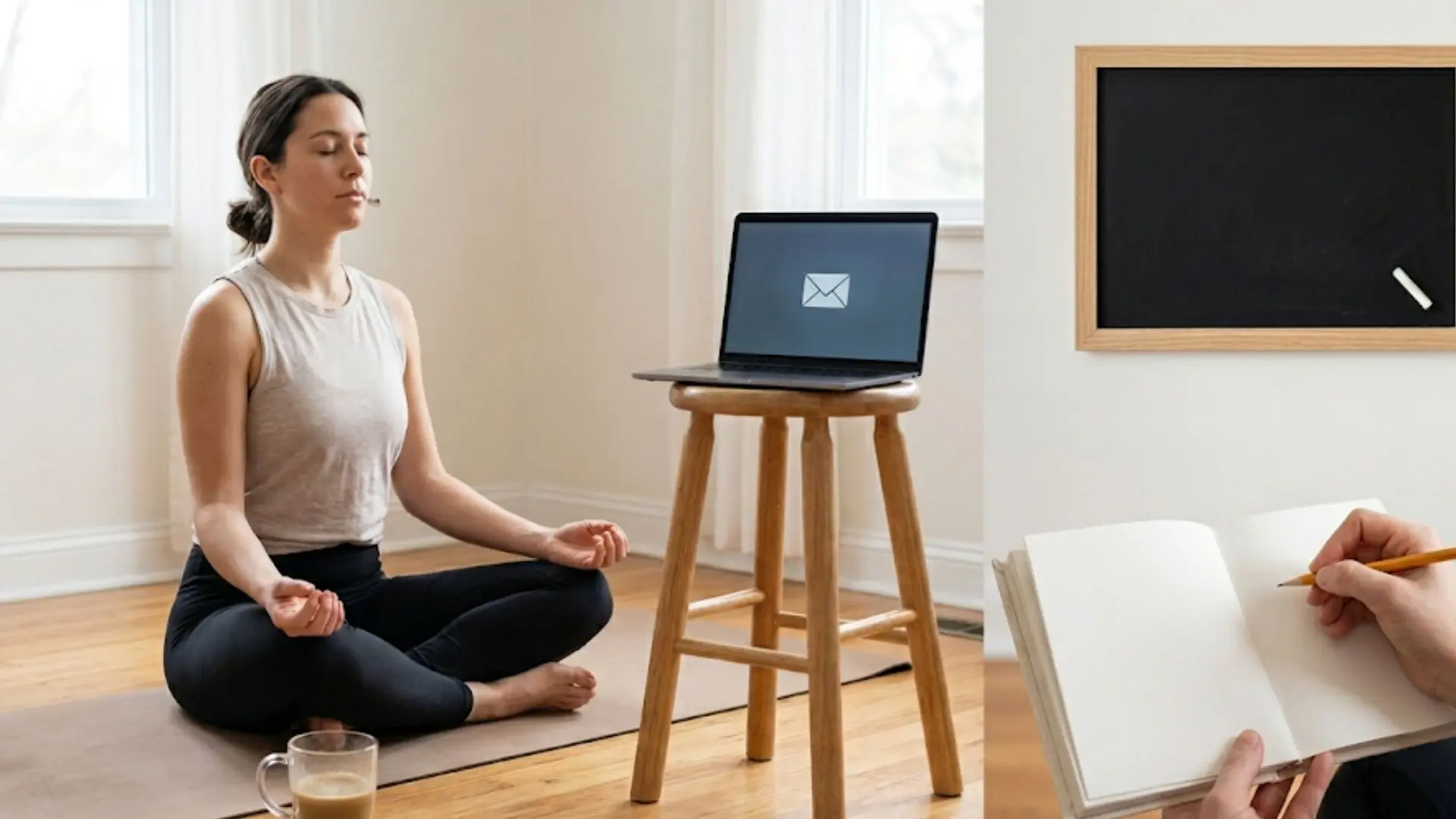
The challenge is not the movements. The challenge is showing up on day 12 when the novelty has worn off, and you have a full inbox. These four strategies make a meaningful difference:
- Same time, same place: Practice at the same time each day so your brain stops treating it as a decision. A consistent cue, such as immediately after your morning coffee, anchors the habit to something already automatic.
- Modify, do not skip: On low-energy days, do five minutes of seated breathing instead of the full session. That still counts. A shortened practice beats no practice every time.
- Keep a simple journal: After each session, write one sentence about how your body feels. Over 28 days, reading back through those notes gives you tangible evidence of progress that motivation alone cannot provide.
- Acknowledge weekly wins: At the end of each week, note one specific improvement: a longer hold, a deeper fold, or a balance pose that no longer requires a tight grip on the chair back. Small markers of progress sustain the commitment more reliably than broad goals.
Safe Practices for Chair Yoga
Safety is straightforward once you know what to check. Before every session, verify that your chair is stable on the floor with no wobble and no wheels.
Sit toward the front of the chair so you can place both feet flat on the floor with your knees at roughly 90 degrees. If your feet do not reach the floor, place a folded blanket beneath them.
Stop immediately and rest if you feel sharp pain, dizziness, or shortness of breath. These are not signs to push through. They are signals to slow down, modify the pose, or end the session. Mild muscle fatigue and a gentle stretching sensation are normal. Pain is not.
If you have had recent surgery, a herniated disc, severe osteoporosis, or uncontrolled high blood pressure, speak with your doctor before starting this or any exercise program. Pregnancy is also a reason to seek medical clearance before beginning chair yoga, as certain twisting and compression poses are contraindicated.
What to Expect After Completing the Challenge
By day 28, you will likely notice several changes: less morning stiffness, a steadier gait, easier transitions from sitting to standing, and a calmer baseline mood. These are not dramatic transformations. They are the accumulated result of 28 short, consistent sessions working on the same systems each day.
After the challenge, three paths work well. You can repeat the entire 28-day program with heightened attention to alignment in poses that felt shaky the first time.
You can join an online chair yoga class to access fresh sequences and community accountability. Or you can build your own ongoing practice by selecting your six or seven favorite poses and cycling through them daily for maintenance.
Adding light resistance to week-three poses is a natural next step for building strength. A pair of 1-pound hand weights during seated leg lifts or warrior variations adds load without compromising joint safety. Start with the lightest weight available and focus on form before increasing resistance.
If you want a related challenge with a different physical focus, the 28-day wall Pilates challenge for beginners pairs well with chair yoga as a complementary program for core and postural strength.
For broader yoga practice beyond the seated format, the yoga for mobility routines on this site offer a natural progression once your flexibility and balance have improved.
You might also explore the best yoga challenge programs to try at home for options that build on what this four-week commitment started.
Frequently Asked Questions
Can beginners do a chair yoga challenge?
Yes. A chair yoga challenge is beginner-friendly because the chair gives support during stretches, twists, and balance work. You do not need prior yoga experience or floor poses. Start with short sessions, move slowly, and focus on breathing, posture, and comfort before trying harder variations.
What should I wear for chair yoga?
Wear soft, comfortable clothing that lets your hips, shoulders, and spine move freely. Avoid tight waistbands, stiff jeans, or slippery socks. Bare feet or grip socks work best if you are standing beside the chair for balance poses later in the challenge.
Can chair yoga help with stiffness?
Yes. Chair yoga can help reduce stiffness by gently moving the spine, hips, shoulders, and legs through controlled ranges. Daily practice may be especially helpful if you sit for long periods. The key is consistency, not forcing deeper stretches before your body is ready.
Is chair yoga good for office workers?
Yes. Chair yoga works well for office workers because many poses can be done in a small space without changing clothes. Seated cat-cow, side bends, twists, and breathing exercises can reduce desk-related tightness and help you reset during long workdays.
Should I warm up before chair yoga?
Yes, a short warm-up helps your joints and muscles feel safer during practice. Start with seated breathing, shoulder rolls, ankle circles, and gentle neck movement. This prepares your body for deeper stretches and lowers the chance of feeling tight or strained.
Can I do chair yoga with knee pain?
Often, yes, but it depends on the cause and severity of your knee pain. Seated poses usually reduce pressure on the knees, but standing chair-supported poses may need changes. Keep movements pain-free and ask your doctor or physical therapist if knee pain is persistent.
What if I miss a day in the challenge?
Missing one day does not ruin the challenge. Continue with the next session instead of quitting or doubling up. The goal is building a sustainable habit over 28 days. One skipped day matters less than returning to the chair and staying consistent.
Can chair yoga improve posture?
Yes. Chair yoga can support better posture by strengthening body awareness and gently opening the chest, shoulders, and upper back. Seated mountain pose, cat-cow, side bends, and twists teach you how to sit taller and notice when your body collapses forward.
Conclusion
The 28-day chair yoga challenge is about building consistency with small, simple steps. I’ve seen how a few minutes each day can boost strength, improve posture, and bring more calm into daily life.
It doesn’t have to be complicated; you just need a chair and the willingness to begin.
Think about what you’ve learned here and how it can fit into your routine. Start with a few moves, stay steady, and let the progress build over time.
Remember, little habits add up to big change. If this post helped, keep scouring. Check out my other blogs for more easy tips on movement, health, and creating routines you’ll actually enjoy!