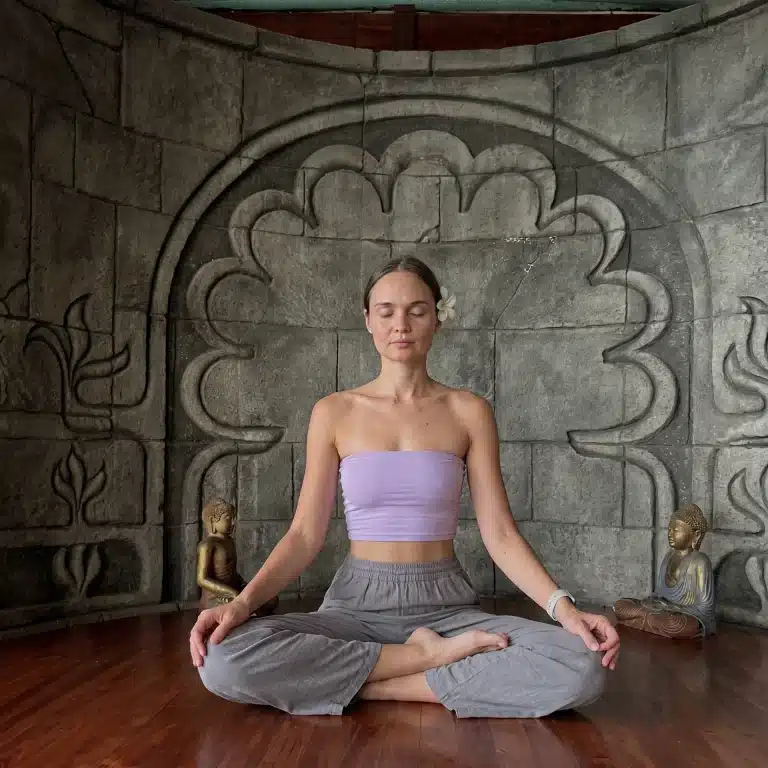
| Style | Hatha / Ashtanga / Advanced Vinyasa |
| Level | Intermediate to Advanced |
| Duration | 30–60 minutes per focused session |
| Props Needed | Yoga strap, blocks, wall space, bolster (optional) |
| Best Time | Morning or early afternoon when energy is highest |
| Avoid If | Wrist injuries, recent shoulder surgery, unmanaged high blood pressure, pregnancy (most inversions) |
| Disclaimer: This article is for informational and educational purposes only. It does not constitute medical advice. Advanced yoga poses carry real injury risk. Always consult a qualified healthcare provider or certified yoga instructor before attempting any pose beyond your current level. |
I used to push for harder yoga poses without asking whether my body was actually ready. Scorpion, Handstand Press, One-Arm Handstand, they looked extraordinary, and I wanted them.
What I got instead were sore wrists, a frustrated mind, and a practice that wasn’t getting anywhere. It wasn’t until I learned to screen my readiness, train in specific preparatory drills, and build toward advanced poses with intention that the hardest yoga poses became possible, not just theoretical.
The truth about the most difficult yoga poses is that they aren’t won through willpower or raw flexibility alone. They require smart, layered preparation: the right strength baselines, honest readiness tests, and a clear understanding of what each pose actually demands from your body.
Below, I’ve organized the hardest yoga poses by category: inversions, arm balances, backbends, and deep-flexibility shapes, with readiness screens, step-by-step progressions, and the most common mistakes I see. Use this guide to find where you actually are, and build from there.
What Makes a Yoga Pose the Hardest?
The most honest answer is: it depends on your body. There is no single hardest yoga pose that is universally most difficult. What breaks one practitioner, say, extreme hip compression in Yoganidrasana, might be another’s most natural shape, while a basic wrist-bearing position in Peacock Pose might be impossible for someone with limited wrist range.
That said, the poses in this guide all sit at the advanced end of the spectrum for most practitioners. They typically demand at least one, and usually several, of the following:
- Strength: Not general fitness, but position-specific strength: wrist extension capacity for arm balances, shoulder flexion for inversions, hip flexor compression for press handstands.
- Flexibility: Often in unusual ranges: deep thoracic extension for Scorpion, extreme hip external rotation for Kandāsana, hamstring length under load for Flying Warrior.
- Balance and proprioception: Especially in single-contact poses like One-Arm Handstand or King Dancer, where the nervous system must make constant micro-corrections.
- Breath control under load: Advanced poses are almost always broken first by breath holding, not by physical failure. If you can’t breathe steadily in a pose, you haven’t earned the full shape yet.
Start by honestly assessing which of these four areas is your limiting factor. The readiness tests before each of the poses below are designed to tell you exactly that.
| Marissa’s Tip: Before attempting any pose on this list, spend at least ten minutes on dynamic joint preparation, not passive stretching. Wrist circles, shoulder CARs, hip 90/90 transitions, and spinal segmentation are the warm-up language your body needs before asking it to do something extraordinary. |
Hardest Yoga Poses: Inversions and Overhead Balances
Inversions place your center of mass above your base of support while demanding overhead strength and structural alignment. They are among the hardest yoga poses to learn because failure doesn’t mean losing the shape, it means falling. Build these in stages, always using the wall until your holds are quiet, controlled, and consistently repeatable.
1. Scorpion (Vrschikasana)

Risk Areas: Shoulders, upper back, spine, wrists, lower back
Readiness Test: Stand facing a wall, arms overhead, palms pressed flat. Keep ribs pulled in. If your ribs flare outward or your lower back arches sharply before your palms can press flat, your shoulder and upper-back extension need more work before attempting this pose.
Scorpion is the benchmark advanced inversion; it combines a forearm stand with a deep spinal backbend, demanding shoulder mobility, thoracic extension, and active core control all simultaneously. Most practitioners who can enter a decent forearm stand still take months to reach a true Scorpion arc safely.
- Begin with dolphin drills at the wall. Forearms on the mat, shoulders stacked, ribs drawn in. If you can’t hold 30 seconds with a controlled, still body, stop here and build this first.
- Walk feet up the wall slowly. Press forearms down and lengthen the front body. Keep glutes lightly engaged to protect the lower back.
- Hold the wall-supported shape and breathe evenly. If your shoulders begin to collapse or your stack wobbles, come down and rest.
- Move one foot off the wall at a time, only when the forearm stand stack feels completely steady.
- Gradually deepen the backbend arc in small increments over multiple sessions. Come down carefully to Child’s Pose or Sphinx to neutralize the spine.
Common Mistakes: Ribs popping forward during the readiness test or in the pose itself; collapsing into shoulders or elbows instead of pressing forearms firmly down; arching the lower back without engaging glutes and core; kicking up or attempting both feet off the wall before the hold is rock-solid; holding the breath or rushing the exit.
2. Handstand Scorpion (Taraksvasana)

Risk Areas: Shoulders, upper back, spine, wrists, lower back
Readiness Test: A solid, controlled handstand held for at least 15 seconds, plus arms overhead against a wall without ribs flaring or the lower back overarching.
Handstand Scorpion takes everything Vrschikasana demands and adds a straight-arm load through the wrists. This is widely considered one of the most difficult yoga poses in any tradition, it requires years of preparatory handstand work before the deep backbend portion is even approachable.
- Build a freestanding handstand first. Do not begin Handstand Scorpion work until wall handstands are consistent and boring.
- From a wall handstand, begin gently arching the back, letting one foot touch the wall at shoulder height. No deeper than this initially.
- Keep pressing actively through the palms; do not allow the wrists to dump or the elbows to bend.
- Gradually work the feet closer to the head over many months, always exiting with control.
Common Mistakes: Ribs flaring or lower back overarching; collapsing into the shoulders or bending the elbows; attempting both feet off the wall simultaneously before full control is established; holding the breath during any phase of the pose.
3. Forearm Stand (Pincha Mayurasana)

Risk Areas: Shoulders, upper back, wrists
Readiness Test: Hold a chest-to-wall forearm stand for 30 seconds with ribs drawn in and breath steady throughout.
Pincha is many practitioners’ first true inversion challenge. Unlike a headstand, there is no triangular base — the balance is entirely through two parallel forearm lines, which demands both shoulder stability and active hollow-body core engagement. If the shoulders feel compressed or restricted, wall angels for shoulder mobility are a reliable prep to add between sessions.
- Place forearms and hands firmly on the mat, gaze slightly forward (not straight down).
- Walk feet up the wall and practice small toe pulls away from the wall to start finding independent balance.
- Maintain a hollow-rib position throughout. If the shoulders slide behind the elbows, reset closer to the wall.
- Build short, steady holds, three to five sets of five to ten seconds, rather than chasing one long, sloppy attempt.
Common Mistakes: Letting ribs flare or lower back overarch; shoulders drifting behind the elbows instead of staying vertically stacked; looking straight down and breaking the alignment line; kicking aggressively instead of floating or pressing into position; squeezing hands together instead of pressing evenly through both forearms and palms; holding the breath or tensing the jaw.
4. Handstand Press (Adho Mukha Vrksasana)

Risk Areas: Wrists, shoulders, hamstrings, spine
Readiness Test: A tight pike fold where the ribs meet the thighs without strain, plus the ability to hold a hollow-body handstand at the wall for at least 20 seconds.
The press handstand is the standard by which serious hand-balancers measure their hip flexor compression and active hamstring flexibility. It is different from a kick-up handstand because there is no momentum; the lift is entirely created by compressing into the floor through active leg and core engagement.
- Begin with stall-bar leans or blocks under hands to raise the floor and reduce the compression needed.
- Shift shoulders slightly forward over hands, lift hips high, and drag toes along the floor as lightly as possible.
- Keep elbows fully locked and lats actively engaged throughout the entire lift.
- If a jump sneaks in at any point, reset and reduce the range. A true press has zero momentum.
- Practice negatives (controlled lowering from handstand back to the floor) to groove the exact pathway in both directions.
Common Mistakes: Bending elbows or allowing lats to go passive; kicking or hopping instead of pressing through active compression; rushing to full lift before the lower-range compression is controlled; balance point too far forward or too far back; ribs flaring or belly sagging; not engaging hip flexors and inner thighs; practicing too many reps in a row, allowing form to degrade.
5. One-Arm Handstand (Eka Hasta Adho Mukha Vrksasana)

Risk Areas: Wrists, shoulders, lateral spine
Readiness Test: Ten-second fingertip handstands with hips stacked, repeated consistently on both sides.
This is one of the rarest advanced yoga poses to achieve. The one-arm handstand requires not only a refined two-arm handstand foundation, but the neurological capacity to manage lateral balance through a single contact point, the palm and spread fingers of one hand.
- Begin with block leans, canes, or wall drills that shift the majority of weight progressively to one side.
- Pull ribs in, squeeze legs together, and keep the supporting shoulder firmly packed, not collapsed.
- Add gentle toe taps on the free side for neuromuscular feedback without full commitment.
- Train in short, frequent sets. Stop completely if the alignment line breaks. Quality over duration, always.
Common Mistakes: Over-rotating the torso or twisting the pelvis; holding sets too long and accumulating fatigue; collapsing the supporting shoulder under load; shifting to one arm too quickly instead of a gradual, progressive weight transfer; letting the free arm or leg flail uncontrolled; holding the breath or locking the jaw.
Hardest Yoga Poses: Arm Balances
Arm balances differ from inversions in that the body stays roughly horizontal rather than vertical overhead. They demand wrist resilience, specific hip geometry, and a willingness to shift your center of mass forward over your hands, which is psychologically harder for most people than it is physically.
6. Eight-Angle Pose (Astavakrasana)

Risk Areas: Wrists, elbows, hips
Readiness Test: A seated 90/90 position with smooth, pain-free transitions between both sides.
- Clamp leg above the elbow without lifting feet. Hold here and breathe for at least 10 seconds before proceeding.
- Press hands into the floor, squeeze thighs against the upper arm, keep chest reaching forward.
- Shift weight slowly to lift feet; do not dump into the wrists.
- Place blocks under hands if elbows flare or the clamping action weakens.
Common Mistakes: Extending legs before the clamp is fully secure; collapsing into wrists or locking them at a painful angle; elbows drifting outward or shoulders rounding forward; swinging into the pose with momentum; hips sagging or feet dropping; forgetting to maintain even breathing during the hold.
7. Firefly Pose (Tittibhasana)

Risk Areas: Hamstrings, wrists
Readiness Test: Palms flat on the floor with knees slightly bent; work progressively toward straighter legs without wrist pain.
- Begin with crow-to-tiptoe transitions to develop the forward lean weight shift.
- Squeeze upper arms with thighs, lift through the chest, and aim heels reaching forward and up.
- Use blocks under the hands to raise the floor if wrists feel cranked or the angle is uncomfortable.
- Practice short, frequent holds and add leg extension incrementally over weeks, not sessions.
Common Mistakes: Hips dropping or chest sinking; rushing to full leg extension before the shoulder position is locked; shoulders falling behind the wrists.
8. Peacock Pose (Mayurasana)

Risk Areas: Wrists, elbows, trunk
Readiness Test: Tabletop rocks reaching at least 70 degrees of wrist extension range without pain.
- Start with knee-on-elbow holds to feel the chest lift and balance point.
- Keep elbows close to midline; press hands into the floor and lift shoulders away from the ears.
- Engage glutes and inner thighs actively to prevent the lower back from sagging.
- Use wedges or parallettes if the wrists give feedback; build strength gradually over weeks.
Common Mistakes: Elbows drifting wide and destabilizing the base; chest collapsing toward the floor; ignoring wrist pain or tingling; loading weight straight down instead of shifting forward into the chest; legs hanging heavy instead of actively squeezed; holding the breath; attempting a full lift before the knee-on-elbow prep can be held steadily.
9. Hurdler (Eka Pada Koundinyasana II)

Risk Areas: Hamstrings, wrists, spine
Readiness Test: A lunge hamstring test with the front leg close to straight without strain or discomfort.
- Start with blocks under the hands to create clearance from the floor.
- Stack shoulders over wrists, clamp front thigh high on the triceps.
- Extend the front leg slowly while keeping the back leg firm and lifted.
- If hips drop, shorten both levers by bending knees until control improves.
Common Mistakes: Shoulders drifting behind wrists; back leg dangling or losing tension; overstretching the front hamstring before it’s prepared; hips dropping too low; swinging into the pose; forgetting to engage core and inner thighs; holding the breath and tensing the neck.
10. Twisted One-Legged Arm Balance I (Eka Pada Koundinyasana I)

Risk Areas: Twisting spine, wrists, hips
Readiness Test: A revolved lunge with full reach while keeping the front heel heavy and breath steady.
- Practice the knee-shelf drill across the upper arm; begin with tiny toe lifts, not a full entry.
- Press down evenly through both hands, keep chest reaching forward, let the back leg trail long and active.
- Use dry skin or light grip tape if slipping is occurring on the upper arm.
- Build time in the twisted shelf before attempting to straighten the back leg.
Common Mistakes: Twisting from a collapsed chest instead of a lengthened spine; forcing leg extension too early before the shelf is secure; losing hand grip during the hold; over-rotating the pelvis and unbalancing the arms; back leg sagging; holding the breath.
11. Flying Pigeon (Eka Pada Galavāsana)

Risk Areas: Hips, knees, wrists, shoulders
Readiness Test: Seated figure-four feels steady and pain-free on both sides.
- Set the shin across the upper triceps; place hands shoulder-width apart.
- Hug the front shin inward; bend elbows slightly and keep them firm.
- Shift weight forward until the back foot feels light. Stop here if the shelf wobbles.
- Float the back foot; keep chest reaching forward and ribs drawn in.
- Hold small lifts before reaching the back leg long.
Common Mistakes: Forcing external hip rotation and stressing the knee; lifting the back foot before a solid shin-to-arm shelf is established; dropping the chest instead of leaning forward; elbows flaring wide; dumping weight into wrists without pressing through fingertips; kicking the back leg to gain air; holding breath or clenching the jaw.
12. Dragonfly (Maksikanāgāsana)

Risk Areas: Wrists, adductors, shoulders, low back
Readiness Test: Comfortable side-split range and smooth, controlled side-crow entry.
- Enter side-crow with ribs forward and shoulders protracted.
- Hook the bottom leg for support; press hands firmly into the floor.
- Slide the top leg out in short steps; stop immediately if wrist pressure spikes.
- Keep chest reaching forward as the leg span gradually increases over multiple sets.
- Build partial extension holds before aiming for the full spread.
Common Mistakes: Jumping to full extension immediately; shoulders leaning back behind the wrists; bottom leg losing its supportive hook; over-rotating the torso and collapsing the side body; fingers pointing straight forward when the wrist angle is uncomfortable; hips sagging; rushing reps without adequate wrist recovery.
13. Grasshopper (Pārśva Bhujā Daṇḍāsana)

Risk Areas: Twisting spine, hips, wrists
Readiness Test: A tall, pain-free seated twist that keeps the chest lifted throughout the full range.
- Hook heel across the triceps; plant hands shoulder-width apart.
- Press down through hands; spread shoulder blades; gaze forward, not down.
- Test small floats; if the foot slips, adjust the contact point higher on the arm.
- Stop and stabilize until lifts are consistently repeatable.
- Extend the hooked leg in short pulses while keeping the pelvis level.
- Maintain steady breath and firm core throughout.
Common Mistakes: Chest collapsing during the twist; foot positioned too low on the arm causing slipping; over-twisting the pelvis and losing balance; dumping weight unevenly into one wrist; locking or flaring elbows; rushing to full leg extension before a stable base; looking down and losing forward projection.
14. Shoulder-Pressing Pose (Bhujapīdāsana)

Risk Areas: Wrists, shoulders, inner thighs, low back
Readiness Test: Arms can slide behind calves with feet grounded; a strap squeeze around the thighs feels strong and stable.
The strap plays a practical double role here; it is both a readiness testing tool and an early training aid. Practitioners already familiar with yoga strap techniques will find the bind approximation in step three comes more naturally.
- Sit deep; thread both shoulders and upper arms high behind the calves; place hands on the floor.
- Clamp thighs high on the arms; press the floor to shift the center of mass forward.
- When toes feel light, cross the ankles. Stop here and stabilize your breath before going further.
- If wrists give feedback, elevate hands on blocks immediately.
- Build consistent static holds before practicing any dynamic jump-through exits.
Common Mistakes: Clamping too low on the arms; shoulders rounding and elbows splaying outward; rushing the ankle cross before balance is established; hips dropping behind the wrists; overloading wrists without using blocks; breath-holding and neck tension; attempting jump-throughs before static control is reliable.
15. Lotus Arm Balance (Urdhva Kukkutasana)

Risk Areas: Knees, ankles, wrists, shoulders
Readiness Test: A calm tripod headstand and comfortable lotus position without any knee pinching.
- Enter an easy lotus; place knees high on the upper arms; hands shoulder-width apart.
- Squeeze forearms with the knees; practice small toe lifts first.
- Press down through hands to float; keep the head light or completely off the floor.
- Maintain a tall chest and steady breath; stop immediately if the knee feels any stress.
- Lower with full control and recheck lotus comfort before repeating.
Common Mistakes: Forcing the lotus and stressing the knee or ankle; knees positioned too low on the arms; elbows flaring and collapsing the base; dumping weight into the head and neck; rushing to full lift without building stable squeezes first; rounding the chest; ignoring wrist pain or numbness.
Hardest Yoga Poses: Deep Backbends
Deep backbends demand thoracic and lumbar spine extension that most people have never trained systematically. The tendency is to collapse into the lowest part of the range — almost always the lumbar spine — while the thoracic remains stiff. Safe backbend progression means learning to move the upper back first, protecting the lower back with active glute and core engagement throughout.
16. Pigeon Pose (Kapotāsana)

Risk Areas: Quads, spine, shoulders, low back
Readiness Test: A 60-second couch stretch per side without grimacing or breath restriction.
- Start at the wall with quad openers and blocks under hands for support.
- Lift chest and drive hips forward while keeping glutes lightly but continuously engaged.
- Hold this shape; reach for the feet only when the range feels completely calm and open.
- Exit slowly and recover with neutral work (Sphinx or prone press-ups) whenever breath becomes shallow.
Common Mistakes: Forcing hands to feet before the quad length is genuinely ready; lower back pinching instead of using glutes; collapsing the ribs and chest; shallow breathing and accumulated tension; dropping props before they’re actually unnecessary; exiting quickly without spinal neutralization.
17. King Pigeon IV (Eka Pāda Rāja Kapotāsana)

Risk Areas: Quads, shoulders, low back, knees
Readiness Test: Strap catch in Dancer Pose with ribs staying down throughout.
- Begin at the wall with a strap catch; knee cushioned on a folded blanket.
- Lift the chest, press the front shin into the floor, and reach back only as far as the quad genuinely allows.
- Keep the neck long and breathe steadily throughout.
- Replace strap tension with a direct hand catch only when the range feels calm and repeatable without effort.
Common Mistakes: Grabbing the foot too soon without strap progression; forcing a quad stretch and stressing the knee; ribs flaring or chest dropping; lower back pinching instead of hips opening; pulling the head forward to reach the foot; rushing progression and abandoning props prematurely.
18. King Dancer (Naṭarājāsana)

Risk Areas: Shoulders, hip flexors, single-leg balance
Readiness Test: Smooth shoulder wall slides plus a steady single-leg stance held for 30 seconds.
- Stand next to the wall; loop a strap overhead to find the correct line without yanking the lower back.
- Kick back gently through the strap, pull up, and keep ribs quiet.
- Train next to the wall if balance wobbles, this is smart, not weak.
- Build holds in small increments and shorten the strap progressively as mobility improves.
Common Mistakes: Pulling the strap aggressively and compressing the lower back; ribs popping or chest collapsing; abandoning wall support before single-leg balance is truly steady; holding breath while kicking back; dropping the lifted arm or elbow outward; forcing the heel higher before the balance is established.
19. Dropbacks (Deep Ūrdhva Dhanurāsana)

Risk Areas: Spine, shoulders, knees, wrists
Readiness Test: A steady 60-second bridge hold with calm, even breathing throughout.
- Practice wall walk-downs thoroughly to learn the path and safe exit before attempting a free dropback.
- Keep knees tracking over toes throughout; press through the feet; reach for length before depth.
- If hands miss the wall, reset closer and reduce the arc range.
- Add partial drills and spotter support until both the arc and the landing feel smooth and controlled.
Common Mistakes: Dropping into depth without spinal control; knees splaying outward; missing the wall and collapsing backward; skipping partial drills or spotter support; holding breath under the load; ignoring shoulder or wrist feedback.
20. Inverted Staff (Viparīta Daṇḍāsana)

Risk Areas: Shoulders, spine, forearms, low back
Readiness Test: Stable forearm bridge holds for 20 seconds.
- Place a block under the head initially to find height and ease entry.
- Press forearms down actively, lift the chest, and keep ribs from flaring.
- Reduce depth if the shoulders jam; add thoracic preparation work between sessions.
- Build sets with calm breaths; lower the block height gradually as control develops.
Common Mistakes: Entering full depth without shoulder readiness; ribs flaring and chest collapsing; skipping head support when it’s needed; overarching the lower back instead of lengthening; holding the breath; exiting too quickly and straining the shoulders.
21. Ganda Bherundasana (Chin Stand)

Risk Areas: Cervical spine, wrists, shoulders, low back
Readiness Test: A steady 60-second Cobra hold without lower back discomfort.
- Place blocks under the chin for a gentle, cushioned landing point; fingers spread wide under the shoulders.
- Shift forward so the chest carries the weight, not the chin or neck; keep the neck relaxed.
- Engage the entire back line and glutes to lift the legs slowly; maintain a soft gaze.
- Hold briefly with smooth breath; stop and exit at the first sign of neck compression.
- Add front-body strength work between attempts; remove block height only after weeks of consistent comfort.
Common Mistakes: Loading body weight onto the chin and neck; shoulders collapsing or elbows bending under load; lower back overarching without glute support; cranking the head forward to locate the balance point; kicking the legs up aggressively; removing blocks or props too early; holding the breath during the weight shift forward.
Hardest Yoga Poses: Extreme Hip Opening and Flexibility
This category includes the poses that most demand deep connective tissue adaptation — work that cannot be rushed. Hip capsule opening, hamstring length at full range, and spinal neutrality under compression all take time measured in months and years, not weeks. The readiness tests here are particularly important to take seriously.
22. Tortoise (Kurmāsana)

Risk Areas: Hips, knees, hamstrings, low back, shoulders
Readiness Test: A wide-leg forward fold that feels genuinely calm at end range on both sides.
- From a wide-leg forward fold, thread elbows under the knees; lengthen the spine forward (not down).
- Keep breath steady and neck neutral; broaden through the collarbones.
- If the hips resist, sit on a small bolster to tilt the pelvis into a better position.
- Stop increasing depth the moment breath shortens or becomes choppy.
- Hold for time, relaxing gradually into the shape; avoid forcing shoulders behind the legs.
- Exit slowly and neutralize with a gentle extension.
Common Mistakes: Forcing external rotation and stressing the knees; rounding the upper back instead of lengthening forward; pulling shoulders aggressively behind legs; shallow or choppy breath; tilting the pelvis backward; ignoring props; exiting quickly and jolting the lower back.
23. Sleeping Tortoise (Supta Kurmāsana)

Risk Areas: Shoulders, neck, low back, hips, knees
Readiness Test: Hold Kurmāsana for 30 seconds without any strain or breath-holding.
- From Kurmāsana, keep the spine long and breathing even; loop a strap behind the back for a gentle bind approximation.
- Stop immediately if the bind pulls the shoulders forward or shortens the breath.
- Draw shoulders broad and ribs down; use the strap to approximate the bind before any attempt at interlacing the hands.
- Maintain a soft neck and relaxed jaw; take short, calm sets rather than long endurance holds.
- Release the bind slowly; support the head and neck as you exit; neutralize the spine afterward.
Common Mistakes: Forcing the bind and rounding the spine; shoulders collapsing forward and crowding the neck; cranking the head to “hold” the leg in place; holding the breath or clenching the jaw; compressing knees or hips to gain depth; staying in long, fatiguing holds that create numbness; rushing the exit and jolting the neck or lower back.
24. One Leg Behind Head (Eka Pāda Śīrṣāsana)

Risk Areas: Hips, knees, neck, sacrum, low back
Readiness Test: A strong 90/90 hip lift with pain-free hip compression on both sides.
- Lying supine, use a strap to guide the leg toward the position. Keep the pelvis heavy and the spine long.
- Stop immediately if the knee feels sharp or unstable in any direction.
- Adjust the thigh angle and external rotation gradually; avoid any leverage applied to the foot or ankle.
- When the range is calm, sit up slowly while keeping the neck neutral and shoulders broad.
- Hold short sets with easy breathing; exit with full support and recheck knee comfort after each set.
Common Mistakes: Cranking the neck to pin the leg in place; levering on the foot or ankle instead of opening from the hip joint; knee valgus or torsion under load; rounding the lumbar spine to “get it done”; ignoring tingling, numbness, or joint pinch signals; staying too long in early sessions; skipping hip preparation and expecting quick range gains.
25. Two Feet to Head (Dvi Pāda Śīrṣāsana)

Risk Areas: Hips, knees, neck, low back, sacrum
Readiness Test: Both legs placed behind the head smoothly and without pain on each side independently.
- Start supine; place the first leg with breath steady and ribs down. Stop if the lumbar pinches or breath tightens.
- Keep shoulders broad and jaw relaxed; explore the second leg with micro-adjustments — never force.
- Build time in short sets; switch sides often to avoid creating “hot spots” in the sacroiliac joint.
- Exit one leg at a time; re-lengthen the spine and neutralize fully before repeating.
Common Mistakes: Forcing the second leg once the first is placed; neck compression or pushing the head forward; over-flexing the lumbar to compensate for hip limitation; uneven loading through the hips and sacrum; holding breath or bracing the jaw; ignoring sharp joint signals from knees or lower back; rushing the exit.
26. Bulbous Pose (Kandāsana)

Risk Areas: Knees, ankles, hips, low back
Readiness Test: Easy, genuinely pain-free lotus on both sides with no joint pinching at all.
Knee integrity is the hard prerequisite here, and it is non-negotiable. Practitioners who have experienced sharp knee cap pain in the past should get medical clearance and fully resolve that issue before attempting any lotus-based prep for Kandāsana.
- Sit tall; guide the calves toward the thighs using hand support. Keep shins fully supported throughout.
- Stop immediately at the first sign of knee pressure — this is non-negotiable.
- Gradually draw feet in while maintaining a neutral spine and completely steady breath.
- Make micro-adjustments to hip and ankle position; use a strap or folded towel for gentle support.
- Hold brief, calm sets and release slowly; check circulation after each hold.
Common Mistakes: Applying leverage to the knees to gain depth; rounding the spine and tilting the pelvis back; pulling feet without adequate shin and ankle support; ignoring ankle compression or numbness; staying too long in early stages; skipping half-lotus and quad/hip preparation; exiting quickly without joint support.
27. Yogic Sleep Pose (Yoganidrāsana)

Risk Areas: Neck, shoulders, low back, hips, hamstrings
Readiness Test: Smooth hamstring slides and a calm, deep forward fold without neck tension or breath restriction.
- Lie supine with a bolster under the head and shoulders; place legs gradually into the position.
- Stop at the first sign of numbness or sharpness — anywhere in the body.
- Keep breath steady, ribs down, and neck soft; adjust the angle rather than forcing depth.
- Hold gentle ranges for short sets and refine contact points as tissues relax over time.
- Exit slowly, removing supports in stages; neutralize with an easy spinal extension afterward.
Common Mistakes: Forcing depth and compressing the neck; pulling with the arms instead of opening from the hips; rounding or jamming the lumbar spine; ignoring tingling or nerve-type sensations; binding the arms too early and losing shoulder space; shallow, choppy breathing under load; rushing the exit and straining the back or neck.
28. Frog Pose (Bhekāsana)

Risk Areas: Quads, knees, low back, wrists
Readiness Test: Ability to grab feet in a prone position without knee pain of any kind.
- Place a block under the chest to elevate the sternum and create ease.
- Press feet down into hands to open the front body while keeping knees in a comfortable position.
- Back off immediately if the lower back pinches; add more quad preparation work first.
- Hold short sets and exit frequently to keep the tissues and circulation healthy.
Common Mistakes: Forcing knees wider than the hips can support; pulling feet too aggressively without lifting the chest; lower back pinching instead of the stretch distributing across the quads; skipping block support when it’s needed; staying in long holds and losing circulation; ignoring wrist or shoulder discomfort.
Harder Yoga Poses: Side-Body and Twisting Balances
This category covers poses where the body’s center of mass shifts laterally or twists — adding a rotational challenge to the strength and balance demands. These are often underestimated as “easier” versions of arm balances, but the oblique and lateral chain demands are genuinely distinct and require dedicated preparation.
29. Reclining Twist / Chakra Wheel (Viparīta Cakrasana)

Risk Areas: Wrists, shoulders, spine, low back
Readiness Test: A strong bridge plus a clean handstand kick to the wall — both are prerequisites, not suggestions.
- Work spotter-assisted tick-tocks to map the full arc and understand the path.
- Keep eyes open and press through both feet and hands; move slowly through the entire arc.
- Pause and drill each end position independently if the timing or sense of space feels unclear.
- Connect the full arc only when both the starting and ending shapes are individually solid and safe to exit from.
Common Mistakes: Rushing the transition before each individual shape is controlled; dropping the head or closing the eyes mid-movement; overarching the lower back and losing positional control; forgetting to drill each position separately; kicking into the flip with momentum instead of pressing smoothly through the arc; not having a practiced safe exit plan.
30. Partridge Pose (Kapinjālāsana)

Risk Areas: Shoulders, side body, wrists, hips
Readiness Test: A steady Vasisthasana (side plank) hold for 30 seconds.
- From a side plank, strap the top foot and catch it before attempting any freehand lift.
- Press the bottom hand firmly, lift the hips, and open the chest carefully — no rushing.
- Reset and reduce the range if the top shoulder rolls forward at any point.
- Build time in the supported version, then work toward an unassisted foot catch as stability genuinely grows.
Common Mistakes: Attempting to grab the foot without strap preparation; top shoulder rolling forward and closing the chest; hips dropping and losing the side-body support line; overextending the backbend before the balance is established; holding the breath or tightening the jaw; skipping progressive holds and jumping to the full expression.
31. Flying Warrior (Viśvāmitrāsana)

Risk Areas: Hamstrings, lats, wrists, low back
Readiness Test: A Compass reach with the spine long and breath steady.
- Place a block under the lower hand to create space and reduce the immediate hamstring demand.
- Thread the arm under the leg; grip the floor; extend the top arm overhead.
- If the bottom elbow bends at any point, raise the floor height with a higher block.
- Add leg extension gradually while keeping the chest forward and breath steady throughout.
Common Mistakes: Forcing hamstring extension and rounding the back; bottom elbow bending and losing the lateral lift; overreaching the top arm and collapsing the torso; skipping block support before reaching full depth; holding breath during the extension; ignoring lower back warning signals.
32. Leg Hold (Vasiṣṭhāsana II)

Risk Areas: Adductors, side body line, shoulders, wrists
Readiness Test: A 30-second side plank that feels genuinely steady — not effortful or shaky.
- From side plank, use a strap for the leg lift before attempting any freehand hold.
- Stack shoulders and hips with precision; press the bottom hand firmly into the floor.
- Lift the top leg only as high as control genuinely allows — not as high as the strap allows.
- Lower and reset the moment the shoulder begins to slide or the hip drops.
Common Mistakes: Lifting the top leg too high and losing the structural stack; bottom shoulder collapsing under load; hips sagging instead of staying lifted; skipping strap work before the free hold; looking down and destabilizing balance; holding breath or tensing the neck.
33. Compass (Parivrtta Surya Yantrasana)

Risk Areas: Hamstrings, side body, shoulders, low back
Readiness Test: A seated strap lift with the spine staying long and the pelvis not rolling back.
- Sit tall on sit bones; thread the elbow under the knee.
- Hold a strap near the foot; slowly rotate the chest open.
- Keep the jaw relaxed and ribs lifted; maintain a genuinely tall spine throughout.
- Walk the hand up the strap and extend the leg only as far as the spine remains long.
- If the grip slips, use the strap closer to the foot; stop the moment the back rounds or the sit bones lift.
Common Mistakes: Rounding the spine to “reach” for the foot; yanking the leg with the hand instead of opening from the hip; rolling off the sit bones and tucking the pelvis; locking the knee to force length; hiking the shoulder toward the ear and tensing the neck; chest collapsing instead of rotating open; breath-holding during extension.
Harder Yoga Poses: Advanced Lotus Variations
Lotus-based advanced poses combine the knee and hip demands of full lotus with additional loading — either from arm balance, inversion, or backbend. The lotus position itself is a prerequisite that many practitioners underestimate; if your lotus is effortful or uncomfortable, none of the variations in this section are appropriate to attempt.
34. Lotus Peacock (Padma Mayurasana)

Risk Areas: Wrists, elbows, knees, low back
Readiness Test: Short, controlled Mayurasana holds plus a genuinely pain-free seated lotus on both sides.
- Rehearse pressure with a lotus entry on the forearms first to reduce the wrist angle and build familiarity.
- Plant the hands; keep elbows close to the midline; lift the chest forward.
- Squeeze the legs in lotus, engage glutes and inner thighs; float the body forward and up.
- Use wedges or parallettes if the wrists give any feedback; stop immediately if knee discomfort appears.
- Work very short holds with frequent exits to protect all joints involved.
Common Mistakes: Extreme wrist extension without support modifications; elbows drifting wide and the chest dropping; forcing lotus range and stressing the knees; holding long sets too early; lower back sagging instead of trunk engaging; ignoring forearm and hand feedback; breathing shallowly under load.
35. One-Arm Peacock (Pungu Mayurasana)

Risk Areas: Working-arm wrist, elbow, shoulder, low back
Readiness Test: A 20-second stable Peacock hold, plus pain-free wrist extension at full range.
- Set an offset stance so the working arm bears most of the load; keep fingertips of the non-working hand for the lightest possible assist.
- Keep shoulders level and ribs drawn in; press the palm of the working hand firmly into the floor.
- Squeeze legs together and lengthen through the chest.
- Gradually reduce the assistance to fingertips only; stop if any wrist discomfort builds.
- Increase duration by a few seconds per session only; cycle back to two-arm holds as needed for recovery.
Common Mistakes: Tilting the torso and hiking the non-working shoulder; dumping into wrist extension without forearm strength foundation; elbow flaring out from the midline; hips sagging and chest collapsing; progressing duration too quickly; skipping a thorough wrist warm-up and preparation; holding the breath during the lift.
Hardest Yoga Poses: Straddle and Press Variations
36. Press to Straddle Pincha (Pincha Mayurasana Straddle)

Risk Areas: Shoulders, forearms, elbows, hamstrings, core
Readiness Test: A 60-second hollow hold plus a controlled chest-to-wall Pincha Mayurasana.
- Begin with tiny toe-feather lifts; keep the elbows vertical and ribs drawn in throughout.
- Shift shoulders slightly forward over the elbows, pull hips up, and float feet with completely quiet toes.
- Maintain forearm pressure and a long spine; eyes slightly forward, not straight down.
- Stop and fully reset if any hopping motion sneaks in or elbows wander outward.
- Practice slow negatives from Pincha back to the floor to lock the pressing pathway in both directions.
Common Mistakes: Hopping or kicking instead of pressing through active compression; elbows flaring or sliding wide; shoulders drifting behind the elbows; ribs flaring and losing the hollow shape; looking straight down and breaking the line; relying on momentum rather than hip flexor compression; over-repping until form degrades.
37. Press to Headstand (Sirsasana)

Risk Areas: Cervical spine, shoulders, elbows, hamstrings
Readiness Test: Ten slow headstand negatives (controlled lowering from the top back down to the floor) with a comfortable, uncompressed neck throughout.
- Work wall straddle compressions with light toe contact on the wall. Keep forearms rooted throughout.
- Lift hips high and place feet softly; do not dump weight into the neck.
- Keep shoulders stable and elbows in. Breathe evenly through the entire entry and hold.
- Train in small sets with full rest between. Inch away from the wall only when entries are consistently quiet and repeatable.
- Finish every session with controlled negatives to reinforce the pathway.
Common Mistakes: Loading the neck instead of distributing weight through the forearms; elbows sliding outward under pressure; hopping into the pose instead of pressing; rounding the lower back and losing hip height; leaving the wall too soon; skipping eccentric negatives; breath-holding and jaw tension.
When to Pause: Safer Alternatives by Health Condition
Some advanced yoga poses carry specific risks for certain conditions. If any of the following apply to you, the table below identifies which poses to skip and what to work on instead. These swaps are not regressions — they are smart training decisions that keep your practice sustainable.
| Condition | Avoid These | Train These Instead |
|---|---|---|
| Eye issues (glaucoma, retinal conditions) | Headstand, chin stand, breath holds | Legs-up-wall, bridge, dolphin at the wall |
| Neck or cervical spine issues | Press to Headstand, Sleeping Tortoise | Sphinx, supported bridge, wall handstand drills |
| Wrist or hand pain | Mayurasana, press handstand, Eight-Angle | Forearm variations, fist-supported holds, parallettes |
| Shoulder impingement or post-surgery | Pincha, Scorpion, all overhead inversions | Wall slides, pike holds, block presses at 45° |
| Hip or knee sensitivity | Lotus variations, Kandāsana, Kurmāsana | Figure-four, supported pigeon, blocks under hips |
| Chronic low back pain | Kapotasana, deep dropbacks, Urdhva Dhanurasana | Prone press-ups, light bridge, thoracic mobility work |
| High blood pressure (unmanaged) | Long inversions, strong breath retention | Gentle forward folds, side-lying rest, upright mobility |
| Pregnancy | Deep twists, all inversions, prone poses | Wall support, side-lying, hands-and-knees work |
These swaps are not signs of a weaker practice. Every teacher I know returns to simpler shapes when the body needs it — often discovering that more focused foundational work accelerates advanced pose progress far more than forcing through limitation.
What Prevents Progress in Advanced Yoga Poses
In my experience guiding students through this progression, the blocks are almost never physical. There are habitual errors in how practitioners approach their training.
Ego-driven practice over body awareness. Forcing shapes creates compensation patterns and accumulates joint stress. Start where your body actually is, not where you believe it should be for someone at your experience level.
Skipping prerequisite strength work. Advanced poses demand specific strength baselines, not general fitness. Attempting Scorpion without a controlled forearm stand creates failure patterns that are harder to unlearn than they were to avoid.
Cold tissue work. Spend at least ten minutes on dynamic joint preparation — wrist circles, shoulder CARs, spinal segmentation, before attempting anything on this list. Advanced poses demand warm, mobile tissue.
Breath abandonment. This is the most reliable early warning sign. If you cannot maintain smooth, even breath in a pose, you have exceeded your current capacity in that pose. Stop, reduce the shape, and rebuild from a range where breathing remains calm.
Inconsistent practice patterns. Weekend-only sessions cannot build the neuromuscular patterning that advanced poses require. Short, frequent sessions — even 15 to 20 minutes of targeted preparation work daily — produce faster and safer adaptation than two-hour occasional marathon sessions.
Ignoring the body’s specific signals. There is a real and learnable difference between productive end-range discomfort and pain signaling tissue stress or joint compression. Tingling, numbness, sharpness, joint pinching, and breath-holding are all stop signals — not challenges to push through.
Is Chair Yoga Effective for Building Toward Advanced Poses?
Yes, and more practitioners than you might expect use it strategically. Chair yoga is not a beginner-only tool.
It is a targeted training modality that allows you to work alignment, breath engagement, and body awareness without the load demands that make harder yoga poses inaccessible when you’re fatigued, recovering, or rebuilding range after a break.
Specifically, chair yoga is useful for wrist or shoulder loading days off, when you still want to maintain spinal mobility and hip work, and for post-injury re-entry into movement before weight-bearing poses are appropriate.
The practitioners who advance fastest in my classes are often those who use recovery sessions purposefully, and chair yoga routines give those sessions real structure. Think of it as smart training, not easy training.
Frequently Asked Questions About the Hardest Yoga Poses
How long does it take to learn advanced yoga poses?
It depends entirely on your starting point, your training specificity, and how consistently you prepare. A practitioner who already has a strong handstand foundation might reach a basic Scorpion arc within six to twelve months of targeted preparation. Someone beginning from a general yoga practice might need two to four years of systematic preparatory work. The practitioners who progress fastest are those who train the specific readiness prerequisites, not those who simply attempt the target pose more frequently.
Can beginners attempt the hardest yoga poses?
Not safely. Every pose on this list has a readiness test at the top of its section for precisely this reason. The readiness tests are not gatekeeping — they are injury-prevention tools. A beginner who cannot hold a forearm stand for 30 seconds should not attempt Scorpion. The preparatory work is the practice; the advanced pose is the evidence of preparation, not the method of developing it.
What is the hardest arm balance in yoga?
Among the arm balances on this list, One-Arm Handstand (Eka Hasta Adho Mukha Vrksasana) and Dragonfly (Maksikanagasana) are consistently the most difficult for different reasons. One-Arm Handstand requires extraordinary neurological refinement and wrist capacity. Dragonfly requires both the arm-balance foundation and a wide side-split range, which many practitioners spend years developing. Peacock (Mayurasana) is also frequently cited as the most wrist-demanding of all arm balances.
How do I build the wrist strength for advanced yoga poses?
Wrist preparation for advanced poses is more complex than general strengthening. You need both extension strength (the capacity to bear load with the wrist extended) and wrist flexor resilience. Practical preparation: daily wrist circles and joint rotations; tabletop rocks forward and back to build load tolerance at range; push-up progressions with a focus on pressing through all five knuckles evenly; parallette or fist push-ups to reduce the extension demand while building overall pressing strength. Introduce wrist-loading poses gradually over weeks, not sessions.
What yoga poses should I master before attempting inversions?
For forearm inversions (Pincha, Scorpion): a stable Dolphin Pose held for 60 seconds, forearm plank for 60 seconds, and a downward dog with no wrist discomfort. For handstand-based inversions: a solid L-sit hold (15+ seconds), a plank-to-chaturanga that does not dip the hips, and a consistent downward dog kick-up to the wall. For Headstand: a comfortable 30-second tripod position and the shoulder strength to lift the head away from the floor in that tripod.
Are advanced yoga poses bad for your joints?
Not inherently. The risk comes from attempting poses before the supporting strength and mobility are developed, or from ignoring early warning signals when they appear. Wrists, knees, the sacroiliac joint, and the cervical spine are the most commonly stressed structures in advanced yoga. Systematic preparation, honest readiness assessment, and responsive awareness during practice all dramatically reduce injury risk. Most advanced practitioners who train long-term without significant injury share two habits: they use props until props are genuinely unnecessary, and they stop when they feel the wrong kind of discomfort.
Final Verdict
I’ve learned that progress in yoga doesn’t come from pushing harder; it comes from working smarter. I stopped chasing poses just to prove that I too can do the hardest yoga poses. Instead, I began paying attention to how things felt, rather than how they looked. That shift made all the difference.
Now it’s your turn to move with care. Keep your focus on what’s real, better breath, solid form, and safe choices. Don’t force it. Don’t rush it. You don’t need to “win” yoga. You just need to keep showing up, doing your work, and staying honest with yourself.
Your path is yours. Keep it steady. Keep it safe. And if you ever feel stuck, my other blogs are there to help you keep growing!
Sources:
- Iyengar, B.K.S. Light on Yoga. Schocken Books, 1966.
- Jois, Sri K. Pattabhi. Yoga Mala. North Point Press, 2002.
- Lasater, Judith Hanson. Restore and Rebalance. Shambhala, 2017.
- Fishman, L., et al. “Yoga and Bone Health.” Topics in Geriatric Rehabilitation. 2009.
- Cramer, H., et al. “Adverse effects of yoga: a systematic review of published case reports and case series.” PLOS ONE. 2013.