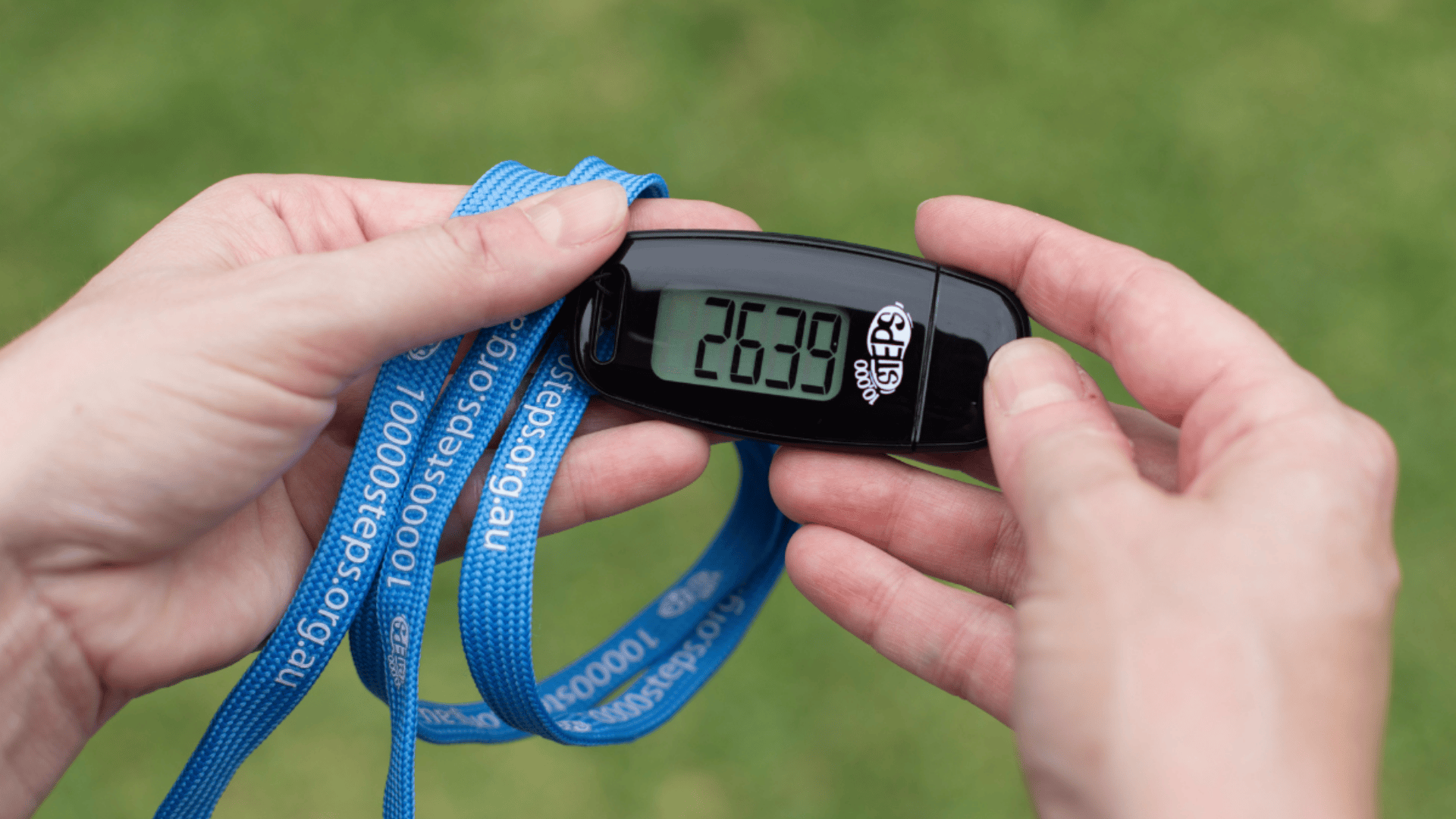
| Medical Clearance Required: Always consult your cardiologist or cardiac rehab team before starting any exercise program after a heart event. These exercises are for informational purposes only and do not replace a personalized care plan. Stop immediately if you experience chest pain, dizziness, unusual shortness of breath, or sudden fatigue, and contact your healthcare provider. |
| Exercise Type | Cardiac Rehabilitation, Aerobic, Strength, Balance, and Breathing |
| Muscles Targeted | Heart (cardiovascular endurance), quadriceps, hamstrings, calves, upper back, chest, core stabilizers |
| Difficulty | Beginner to Intermediate, paced by recovery stage |
| Equipment | Sturdy chair, wall, light resistance band, and stationary bike (optional) |
| Best For | Recovery after a heart attack, stent placement, bypass surgery, or a heart failure episode |
| Avoid If | Not medically cleared; experiencing active chest pain, unstable arrhythmia, or uncontrolled symptoms |
When I first started working with patients returning to movement after a cardiac event, the most common thing I heard was: “I don’t know what’s safe anymore.” That confusion is completely understandable, and it’s exactly what cardiac rehab exercises are designed to resolve.
These are not workout routines. They are structured, medically-informed movements that help rebuild heart function, leg strength, breathing confidence, and daily independence after a heart attack, bypass surgery, stent placement, or heart failure episode.
This guide covers the nine most effective cardiac rehab exercises, how each one works physiologically, how to perform them safely at home, and how to combine them into a 5-day routine.
I also include the movements to avoid until your care team gives the green light, along with the most common recovery mistakes I’ve seen that slow people down.
What Makes Cardiac Rehab Exercises Different from Regular Exercise?
Cardiac rehab exercise is not a fitness program. The goal is not calorie burning, muscle building, or performance improvement — it is safe, progressive recovery of cardiovascular function after a medically significant event.
The physiological target is different, too. After a cardiac event, the heart’s ability to increase output during exertion is temporarily reduced. Peak oxygen uptake (VO2 peak) drops, and the muscles adapt to lower demand.
According to research published in Circulation Research (2025), the mechanisms underlying this exercise intolerance include impairments in cardiac output, vascular function, and skeletal muscle metabolism. Cardiac rehab exercises are specifically designed to address each of these over time, not to push through them.
A personalized cardiac rehab plan depends on your diagnosis, procedure type, symptoms, medications, and current fitness level. The ACSM recommends beginning Phase II outpatient rehab with 2–3 days per week of resistance exercise on non-consecutive days, alongside aerobic work, at 40–60% of 1RM for strength components and a moderate aerobic intensity guided by the Borg Rating of Perceived Exertion scale (11–13). Your care team will set the exact parameters. The exercises below are structured to fit within those safe early-recovery limits.
Best Cardiac Rehab Exercises for Heart Recovery
These nine cardiac rehab exercises give the most useful mix of aerobic endurance, lower-body strength, upper-body support, balance, and breath control. They are not meant to be done all at once.
A beginner may start with two or three. Someone further along in recovery may combine aerobic, strength, and breathing work in one session. Always follow your care team’s limits first.
1. Walking
Walking is one of the most effective cardiac rehab exercises because it trains the cardiovascular system without complicated movement patterns. It supports circulation, aerobic capacity, leg strength, and confidence with daily activity, and it is easy to adjust by changing pace, time, distance, route, or rest breaks. In early recovery, even a few slow minutes can produce measurable circulatory benefit.
Step 1: Choose a flat, safe walking space, a hallway, driveway, quiet sidewalk, or treadmill with support nearby.
Step 2: Start at a pace that lets you speak in short sentences without gasping or forcing your breath.
Step 3: Keep your shoulders relaxed, look forward, and let your arms swing naturally.
Step 4: Walk only for the time your care team allows, even if that means stopping after a few minutes.
Step 5: Add time before speed. Longer, steadier walking is safer than walking faster too soon.
| Trainer Tip: Use the talk test throughout. If speaking feels difficult, if you cannot finish a short sentence without stopping to breathe, slow your pace, pause, or end the walk. This is a clinical guideline, not just advice. |
2. Seated Marching
Seated marching is the most appropriate starting point when standing exercise feels unsafe, tiring, or too early in recovery. It gently activates the hip flexors, quadriceps, and lower-body circulation while keeping the body fully supported, which is why it’s especially useful in the first days after hospital discharge, during low-energy recovery days, or as a warm-up before a short walk.
Step 1: Sit in a sturdy chair that does not roll, both feet flat on the floor.
Step 2: Sit tall, relax your shoulders, and place your hands on the chair arms or thighs.
Step 3: Lift one knee a few inches from the floor without leaning backward or holding your breath.
Step 4: Lower the foot slowly, then lift the other knee with the same controlled pace.
Step 5: Keep the rhythm slow and even. Stop if you feel dizzy, breathless, or unusually tired.
| Trainer Tip: Keep both hands on the chair throughout if balance, posture, or fatigue becomes a concern. Seated marching done well for 3–5 minutes is a genuine cardiovascular stimulus during early recovery. |
3. Stationary Cycling
Stationary cycling provides a steady aerobic stimulus while keeping joint impact on the knees, hips, and ankles low. It is particularly useful when walking feels uncomfortable, when balance is uncertain, or when the goal is sustained cardiovascular work at a controlled pace. The bike makes it easier to regulate intensity than most other aerobic options, which matters during early cardiac recovery.
Step 1: Adjust the seat so your knee stays slightly bent when the pedal reaches the lowest point.
Step 2: Begin with very low resistance; your legs should move smoothly without pushing hard through the pedals.
Step 3: Pedal slowly for a short, comfortable time while keeping your breathing steady and relaxed.
Step 4: Stay seated throughout. Avoid standing on the pedals, sprinting, or sudden bursts of effort.
Step 5: Increase time or resistance only when the current level feels easy, and your care team approves.
| Safety Note: Stop immediately if you feel chest pressure, dizziness, unusual breathlessness, or sudden heavy fatigue during cycling. These are not discomforts to push through; they are signals to rest and report to your care team. |
4. Chair Squats
Chair squats are among the most practical cardiac rehab strength exercises because they directly train the sit-to-stand transition, a movement required for chairs, toilets, beds, and cars. They build quadriceps and glute strength, hip control, and the balance confidence that makes daily independence feel safer. The movement should feel slow, steady, and controlled, not rushed or breathless.
Step 1: Stand in front of a sturdy chair with feet hip-width apart and toes mostly forward.
Step 2: Keep your chest relaxed, look forward, and use a counter or chair arms for balance if needed.
Step 3: Bend your hips and knees slowly, as if lowering toward the seat.
Step 4: Lightly touch the chair with your hips without dropping heavily or losing control.
Step 5: Press through your feet and stand back up while exhaling gently.
| Safety Note: Never hold your breath during the standing phase. Breath-holding during resistance movements increases intrathoracic pressure, a pattern well-documented as creating unnecessary cardiovascular strain during early recovery. |
5. Wall Push-Ups
Wall push-ups build upper-body strength, specifically in the chest, shoulders, and triceps, with significantly less load than floor push-ups. They can help with light daily tasks such as pushing doors, supporting movement from furniture, or household activities.
Because the wall supports a large portion of body weight, the effort level is easier to control and easier to stop safely. If you have had chest surgery, bypass surgery, or a sternotomy, wall push-ups require specific clearance from your care team before starting.
Step 1: Stand facing a wall, feet a comfortable distance away.
Step 2: Place both hands on the wall at shoulder height, slightly wider than shoulder-width.
Step 3: Bend your elbows slowly and let your chest move gently toward the wall.
Step 4: Keep your body straight, do not let your hips sag or your shoulders rise toward your ears.
Step 5: Press back to the start while breathing out, keeping the movement smooth throughout.
| Safety Note: Stop if you feel chest pulling, incision discomfort, pressure, or pain in the sternum area. Post-sternotomy patients should wait for explicit clearance before any pushing movement that loads the chest. |
6. Seated Leg Extensions
Seated leg extensions rebuild quadriceps strength without placing full body weight through the legs, which makes them ideal when repeated chair squats feel too demanding. Stronger quadriceps directly improve walking mechanics, stair negotiation, and the ability to stand from low surfaces. This exercise gives beginners a safe, controlled way to strengthen the legs while seated and fully supported.
Step 1: Sit tall in a sturdy chair, both feet flat on the floor.
Step 2: Hold the sides of the chair lightly for balance and support.
Step 3: Slowly straighten one knee until the leg is mostly straight, not locked hard at the joint.
Step 4: Pause briefly at the top while keeping your breathing calm and your shoulders relaxed.
Step 5: Lower the foot back to the floor slowly, then repeat with the other leg.
| Trainer Tip: Control both directions equally. Dropping the foot quickly removes the eccentric load and reduces the exercise’s effectiveness, the same principle that makes eccentric quad training so effective for rebuilding leg strength after periods of inactivity. Both the raising and the lowering phase should take roughly the same amount of time. |
7. Calf Raises
Calf raises strengthen the gastrocnemius and soleus, the two muscles responsible for ankle push-off during walking and for venous return from the lower legs.
Stronger calves support better circulation (the calves are often called the “second heart” for their role in pumping blood back up from the legs), improve balance, and make standing and walking feel steadier during recovery. This exercise may look small, but it is often more challenging than expected in early recovery.
Step 1: Stand behind a sturdy chair or counter, holding it lightly for balance.
Step 2: Keep feet hip-width apart, knees soft rather than locked.
Step 3: Slowly lift both heels off the floor and rise onto the balls of your feet.
Step 4: Pause briefly at the top while keeping your shoulders relaxed.
Step 5: Lower your heels slowly until both feet are flat on the floor again.
| Safety Note: Sit down and rest immediately if you feel dizzy, shaky, or unable to control your balance. Orthostatic blood pressure changes are common during cardiac recovery and can cause sudden lightheadedness when standing. |
8. Resistance Band Rows
Resistance band rows target the rhomboids, middle trapezius, and rear deltoids, the muscles responsible for pulling shoulder blades together and maintaining an upright posture. After prolonged periods of sitting, resting, or guarded movement post-surgery, these muscles weaken quickly.
In my experience working with recovering patients, better upper back strength makes walking feel less effortful and breathing feel more open because poor posture compresses the thoracic cavity. Use a lighter band than you think you need; control and full range of motion matter more than resistance here.
Step 1: Sit or stand tall with a light resistance band held securely in both hands.
Step 2: Keep your shoulders relaxed, elbows near your sides, and chest comfortable before pulling.
Step 3: Pull your elbows backward gently, as if drawing your shoulder blades slightly together.
Step 4: Avoid arching your back, shrugging your shoulders, or pulling with sudden force.
Step 5: Slowly return your arms forward, controlling the band rather than letting it snap back.
| Trainer Tip: The ACSM recommends starting resistance training in cardiac rehabilitation at 40–60% of 1RM. For band rows, this means the band should feel light enough to complete 8–10 reps with full control and steady breathing throughout, not a hard pull challenge. |
9. Deep Breathing
Deep breathing exercises are not cardio or strength training, but they play a specific clinical role in cardiac rehabilitation. Slow, diaphragmatic breathing activates the parasympathetic nervous system, reducing resting heart rate and blood pressure, and helping the body shift out of a stress response.
After a cardiac event, anxiety frequently makes the chest and shoulders feel tight, which in turn makes breathing shallower and movement feel more intimidating. A controlled breathing practice gives the body a calmer baseline to exercise from.
Step 1: Sit in a supported chair with feet flat and shoulders relaxed.
Step 2: Place one hand on your lower ribs or belly to feel gentle movement as you breathe.
Step 3: Breathe in slowly through your nose without lifting your shoulders or forcing air in.
Step 4: Let your ribs or belly expand softly, then exhale slowly through your mouth or nose.
Step 5: Continue for 4–6 calm breaths, stopping if you feel dizzy or uncomfortable.
| Trainer Tip: Use deep breathing at the start of every session as a brief warm-up, and again at the end as part of your cool-down. It is also a useful tool when nervousness or anxiety makes getting started feel harder than the movement itself. |
Cardiac Rehab Exercises to Avoid Until Medically Cleared
Some movements place too much strain on the heart, chest wall, or healing tissues during early recovery. Medical clearance matters more than motivation here. The following categories are commonly restricted in Phase I and Phase II cardiac rehab:
- Heavy lifting: Resistance loads that require breath-holding or hard bracing increase intrathoracic pressure and cardiovascular strain.
- Floor push-ups: Load through the chest, shoulders, and arms is significantly higher than wall push-ups, and the position makes it harder to stop mid-movement safely.
- Fast stair climbing: Stairs increase heart rate quickly, especially with fatigue, breathlessness, or when carrying weight.
- High-intensity intervals: Sudden hard effort spikes heart rate and blood pressure in ways that are not appropriate before cardiovascular function has stabilized.
- Sudden hill walking: An incline increases workload rapidly and can cause breathing to outpace tolerance before symptoms appear.
- Heavy overhead presses: Raising weights above the head loads the chest, shoulders, and healing sternal tissue — and increases blood pressure response.
- Strenuous resistance bands: High-tension bands can produce more cardiovascular and musculoskeletal load than they appear to. Keep tension light.
- Long sessions without breaks: Fatigue builds before symptoms become clear. Short, frequent sessions with rest are more protective than long single efforts.
- Breath-holding during any strength work: This is the single most common technical mistake during cardiac rehab strength exercises. Exhale during exertion, always.
- Swimming before clearance: Aquatic pressure and body temperature regulation demands restrict swimming until incisions are healed and your care team approves.
- Pushing or pulling after sternotomy: Arm loading during breastbone healing requires specific restriction guidance from your surgical team, not general advice.
The safest restriction list is always personal. Ask your clinician what to avoid based on your exact diagnosis, procedure, incision type, and current symptom pattern.
How to Progress Safely Through Cardiac Rehab Exercises
One pattern I see repeatedly is people either progressing too fast when they feel good, or stopping completely on low-energy days. Both strategies slow recovery. Safe progression in cardiac rehab exercises follows a specific order: duration before intensity, consistency before load.
In practice, that means extending the time of a walk before increasing the pace. It means adding a second set of seated leg extensions before increasing the range of motion. It means mastering deep breathing as a recovery tool before layering in resistance band rows on the same day.
When I program this for someone in early Phase II recovery, the progression criteria are not “when it feels easy”; they are specific: sustained talk-test compliance at current duration, no symptom spikes in the 24 hours after a session, and care team confirmation before each step up.
Progression from Beginner to Intermediate
A beginner starting cardiac rehab exercises at home should expect the first 2–3 weeks to feel deliberately slow. That is not a design flaw, it is the design. Here is how a typical progression looks in practice:
- Weeks 1–2: Seated marching (3–5 min), deep breathing (4–6 breaths), short walk (5–10 min if cleared). Sessions 10–15 minutes total, 3 days per week.
- Weeks 3–4: Add chair squats (5–8 reps, 1 set), seated leg extensions (8 reps each leg, 1 set), calf raises (8–10 reps). Total session 15–25 minutes.
- Weeks 5–6: Add wall push-ups (if cleared), resistance band rows with light band (8–10 reps, 1 set), increase walk or cycling duration by 2–3 minutes. Total session up to 30 minutes.
These are illustrative targets — your care team sets the actual progression criteria based on your ECG responses, blood pressure monitoring, and symptom reporting during supervised sessions.
5-Day Cardiac Rehab Exercises Routine
This 5-day structure is meant as a framework to discuss with your cardiac rehab team — not a prescription to follow independently. The pace should remain gentle, and every session should feel controlled enough to stop, shorten, or adjust without hesitation.
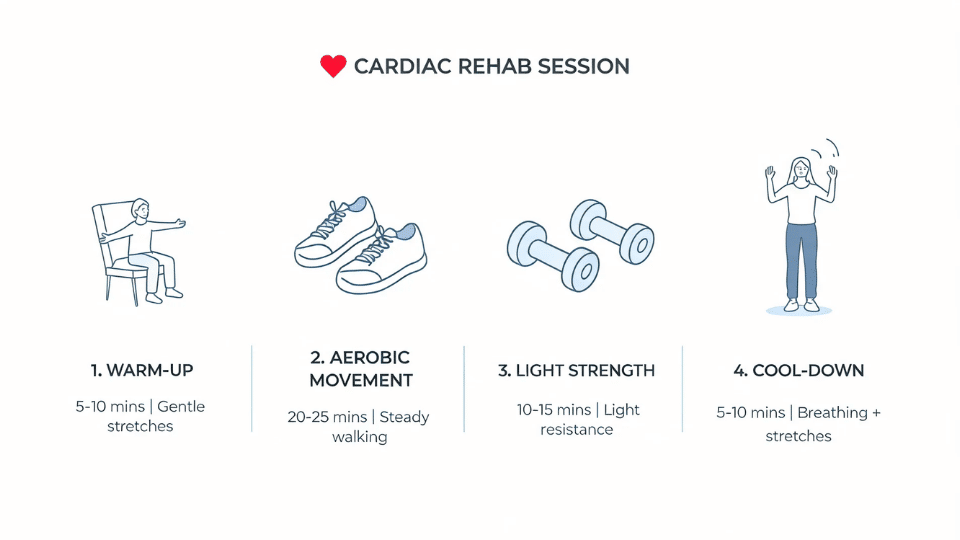
| Day | Focus | Warm-Up | Main Exercise | Cool-Down |
|---|---|---|---|---|
| Day 1 | Easy aerobic movement | Seated marching, 2–3 min | Walk on flat ground, time set by the care team | Deep breathing, 4–6 breaths seated |
| Day 2 | Lower-body strength | Deep breathing and slow seated marching | Chair squats (5–8 reps), seated leg extensions (8 each leg) | Calf raises (8–10 reps), holding chair, then seated rest |
| Day 3 | Low-impact cardio | Shoulder rolls and 2 min easy marching | Stationary bike at low resistance, or march in place | Deep breathing seated |
| Day 4 | Upper-body support | Deep breathing and gentle neck rolls | Wall push-ups (if cleared), resistance band rows (8–10 reps) | Seated rest and 4 deep breaths |
| Day 5 | Balance and full-body movement | Seated marching and ankle pumps | Walk or cycle at an easy pace for a steady, comfortable session | Calf raises (8 reps) then seated deep breathing |
The cool-down column is new here, and it matters. Every session should end with at least 3–5 minutes of reduced activity before stopping completely. An abrupt end to aerobic exercise can cause blood to pool in the lower extremities, reducing venous return to the heart. A gradual wind-down keeps circulation more stable.
This routine should feel flexible, not rigid. Repeat easier days, take additional rest days between sessions, or reduce the main exercise when energy is low. Progress comes from consistency, not intensity.
Warning Signs to Stop Immediately During Any Session
These symptoms require stopping all exercise immediately and contacting your care team or emergency services, depending on severity:
- Chest pain, pressure, tightness, or heaviness
- Dizziness, light-headedness, or feeling faint
- Unusual or sudden shortness of breath disproportionate to the effort
- Heart palpitations or an irregular heartbeat that feels different from normal
- Unusual nausea or cold sweating during exercise
- Sudden fatigue that feels significantly different from normal tiredness
- Pain or numbness radiating to the arm, jaw, neck, or back
These are not discomforts to adapt to or push through. They are the body’s signal that something needs clinical attention. Report any of these symptoms to your care team at your next appointment, even if they resolved quickly.
Common Mistakes That Slow Cardiac Rehab Progress
Recovery stalls in two directions: people either rush too hard when they feel good, or avoid all movement out of fear. Both patterns create problems.
- Doing too much too soon: Small, consistent increases are the mechanism of adaptation. A sudden jump in time, speed, or resistance is how symptoms appear in people who felt fine the day before.
- Skipping warm-ups: The first few minutes of a session are physiologically the most demanding for the heart. A seated march or deep breathing sequence before walking gives the cardiovascular system time to adjust.
- Holding your breath during strength work: Exhale during effort — specifically during the upward phase of chair squats, the push phase of wall push-ups, and the pull phase of band rows. If you cannot remember to breathe, the weight or resistance is too high.
- Comparing recovery timelines: A stent, bypass surgery, valve repair, and heart failure episode each have different physiological demands and recovery timeframes. Your plan should be calibrated to your procedure and symptoms, not to what someone else is doing.
- Quitting after one hard day: A lower-energy day calls for a shorter, easier version of the session — not cancellation. Seated marching and deep breathing on a difficult day still maintains the habit and the physiology.
- Exercising alone without a support plan: In early cardiac recovery, always make sure someone knows you are exercising and has a way to reach you. This is not overcaution — it is standard practice in supervised cardiac rehab environments for good reason. Extended rest also contributes to thoracic stiffness, which is one reason back stiffness after rest is common in people recovering from cardiac events and worth addressing early.
How Cardiac Rehab Exercises Fit Into a Broader Recovery Plan
Exercise is one component of cardiac rehabilitation, but it works best alongside the other elements of a full program.
According to NIH research and the American Heart Association’s program guidelines, formal cardiac rehabilitation also includes nutritional counseling, stress management support, education about cardiovascular risk factors, smoking cessation where applicable, and medication management.
People who complete a full cardiac rehabilitation program show reduced rates of hospital readmission and improved long-term survival outcomes.
If you have experienced unexpected weight changes since your procedure, which affects your baseline for exercise tolerance, post-surgery weight gain interacts directly with how hard any given session will feel, and is worth raising with your care team.
The foundational principles that govern exercise during limited mobility apply equally to the early weeks of cardiac recovery, in the same way they apply to anyone working around a physical restriction from exercising on crutches.
The goal of these exercises is not to get fit. It is to re-establish the body’s trust in movement, so that eventually, getting and staying fit becomes a realistic and safe next chapter.
Frequently Asked Questions About Cardiac Rehab Exercises
Can I do cardiac rehab exercises every day?
Daily movement may be possible for some people, but not every day needs to be a full session. Many recovery plans include light walking, breathing, or mobility on easier days. Strength exercises usually need rest between sessions. Follow the schedule your cardiac rehab team gives you.
What should I check before exercising?
Before starting, notice your breathing, energy level, chest comfort, dizziness, and any unusual symptoms. Make sure you are medically cleared, hydrated, and wearing supportive shoes. Keep a phone nearby if exercising at home. Do not begin if you feel chest pressure, faintness, or sudden heavy fatigue.
Is stretching safe during cardiac rehab?
Gentle stretching is often safe when done slowly and without breath-holding. Avoid deep, forceful stretches or positions that create dizziness, chest pressure, or strain around healing incisions. Stretching should feel mild and controlled. Ask your rehab team which stretches match your recovery stage.
Can I climb stairs during cardiac rehab?
Stairs may be allowed, but they can raise heart rate quickly. Start only if your care team approves. Use the railing, move slowly, and rest when needed. Avoid carrying heavy items upstairs. If you feel breathless, dizzy, or chest discomfort, stop and contact your provider.
Should I track my heart rate?
Heart rate tracking can help, but it should not replace symptom awareness. Some medications affect heart rate, so numbers may not show the full picture. Many cardiac rehab plans use effort level, breathing, and the talk test. Ask your team what heart rate range is safe for you.
Final Verdict
Cardiac rehab exercises work best when they are safe, simple, and matched to your recovery stage. The goal is not to prove toughness.
It is to rebuild steady movement through walking, seated exercises, stretching, light strength work, and breathing. Good heart recovery exercises also respect warning signs, surgery limits, and the pace your care team sets.
I would rather see someone progress slowly than push into symptoms. I hope this helps you ask better questions, choose safer movements, and feel more confident about recovery.
Share your questions or discuss your routine with your cardiac rehab team.
Sources
Tessler J, Ahmed I, Bordoni B. “Cardiac Rehabilitation.” StatPearls. Updated March 2025. https://www.ncbi.nlm.nih.gov/books/NBK537196/
Brubaker PH, Kitzman DW. “Resistance Exercise for Cardiac Rehabilitation.” PMC / NIH. 2022. https://pmc.ncbi.nlm.nih.gov/articles/PMC8930531/
Tomczak CR et al. “Benefits of Cardiac Rehabilitation: Mechanisms to Restore Function and Clinical Impact.” Circulation Research. 2025. https://www.ahajournals.org/doi/10.1161/CIRCRESAHA.125.325705
American College of Sports Medicine. ACSM’s Guidelines for Exercise Testing and Prescription. 11th Ed. ACSM, 2021.