
| Exercise Type | Strength, Speed, and Cardiovascular Endurance |
| Events | Pull-ups, 300-meter sprint, push-ups, 1.5-mile run |
| Difficulty | Intermediate to Advanced |
| Equipment | Pull-up bar, quarter-mile track |
| Best For | FBI Special Agent applicants |
| Avoid If | Active shoulder, elbow, or knee injury without medical clearance |
The FBI fitness test is one of the most consequential physical assessments in federal law enforcement, and I have seen many candidates underestimate it because the four events look manageable on paper. Pull-ups, a 300-meter sprint, push-ups, and a 1.5-mile run do not sound extreme individually.
What makes the FBI Physical Fitness Test (PFT) genuinely hard is that you complete all four in order, with no more than five minutes of rest between each event, and you need to earn at least 1 point in every single one to pass.
In this guide, I will walk you through the exact event structure, the 2025-updated scoring tables, what a genuinely competitive score looks like, how the PFT fits into the Special Agent Selection System, and the training approach I recommend to candidates who come to me with 8 to 12 weeks on the clock.
This article is for informational and educational purposes only. It does not constitute medical or legal advice. FBI hiring standards, PFT scoring tables, and eligibility requirements are subject to change. Always verify current requirements at FBIJobs.gov before applying or training for this test.
FBI Fitness Test Requirements at a Glance
The PFT is the official physical screen for FBI Special Agent applicants. The FBI updated the test format in late 2025, replacing sit-ups with pull-ups and adjusting the passing total from 12 points to 10.
That change is significant. Pull-ups are a harder movement to train from scratch than sit-ups, and the bar for a minimum passing score is now 2 to 3 clean reps for male candidates.
| Requirement | Official Detail |
|---|---|
| Test name | Physical Fitness Test (PFT) |
| Required for | FBI Special Agent applicants |
| Number of events | 4 |
| Event order | Pull-ups, 300-meter sprint, push-ups, 1.5-mile run |
| Rest between events | No more than 5 minutes |
| Passing total | 10 total points |
| Per-event minimum | At least 1 point in every event |
Failing any single event, regardless of how well you performed in the others, means you do not pass.
A candidate who runs an elite 1.5-mile time but cannot complete 2 pull-ups goes home. That is the constraint that shapes every serious training plan for this test.
FBI PFT Events in Official Order

The four events run in a fixed sequence. You cannot choose your order, and you cannot skip an event and return to it.
Understanding how each event is scored and how fatigue from earlier events affects later ones is the foundation of intelligent PFT preparation.
Event 1: Pull-Ups
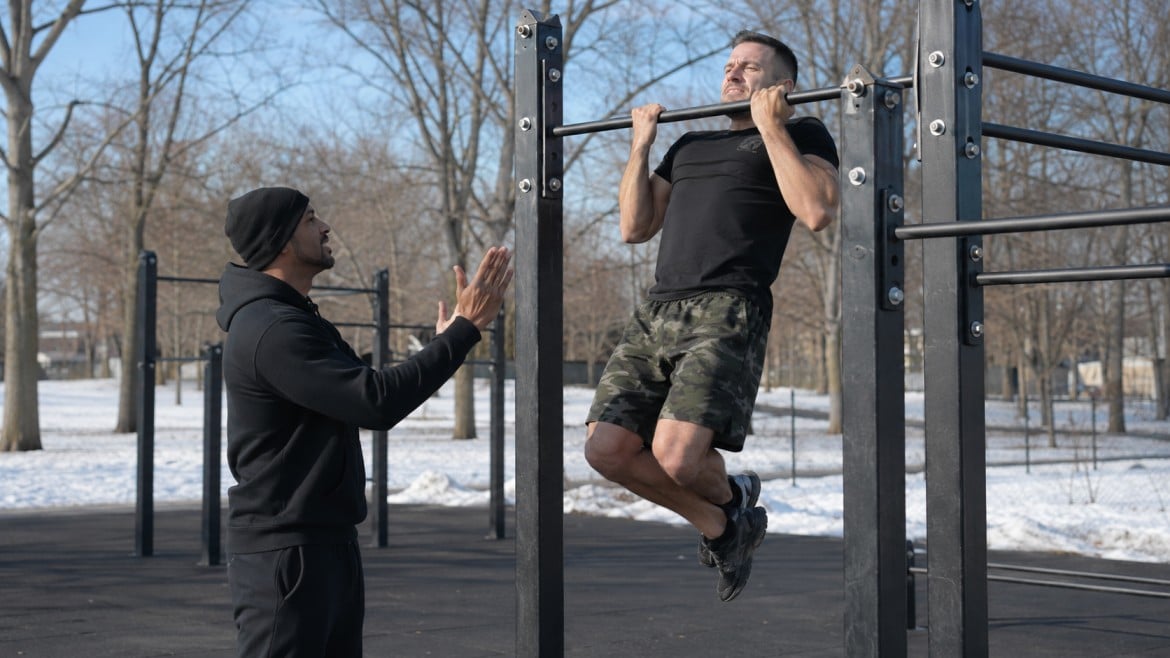
Pull-ups test upper-body pulling strength, and they come first, before any accumulated fatigue. You hang from a horizontal bar with arms fully extended. Each rep requires your chin to clear the bar, followed by a return to a full dead-hang.
Swinging, kipping, or using leg momentum disqualifies the rep. Either hand position (overhand or underhand) is allowed, and scoring is identical either way.
In my own training work with candidates preparing for law enforcement tests, pull-ups are the event people underestimate most. If you are starting from zero reps, plan for 10 to 16 weeks of consistent upper-back and grip work before you can reliably hit the 2-to-3-rep minimum.
Negative pull-ups (jumping to the top and lowering slowly over 4 to 5 seconds) and lat pulldowns are the two most reliable progressions I use with candidates who are starting from scratch.
| Score | Female Candidates | Male Candidates |
|---|---|---|
| 0 | 0 | 0 to 1 |
| 1 | 1 | 2 to 3 |
| 2 | 2 | 4 to 5 |
| 3 | 3 | 6 to 7 |
| 4 | 4 | 8 to 9 |
| 5 | 5 | 10 to 11 |
| 6 | 6 | 12 to 13 |
| 7 | 7 | 14 to 15 |
| 8 | 8 | 16 to 17 |
| 9 | 9 | 18 to 19 |
| 10 | 10 and over | 20 and over |
A competitive score on pull-ups, the kind that builds meaningful margin in your total, is 5 to 7 points: 5 reps for female candidates, 10 to 14 reps for male candidates.
Always confirm the current FBI chart before your test date, as scoring tables have been updated before and may be again.
Event 2: 300-Meter Sprint
The 300-meter sprint is run on a quarter-mile oval track. You start from a standing position and run three-quarters of one lap without changing lanes.
This event tests anaerobic power, specifically the glycolytic energy system, which is exactly the capacity that fires during explosive law enforcement scenarios.
The sprint comes second, right after your arms are fatigued from pull-ups. I program sprint-after-upper-body training blocks specifically for candidates working on the FBI PFT, because the transition is harder than most people expect.
Your legs are fresh, but your breathing is already elevated, and pacing the first 100 meters too aggressively will cost you time in the final 100.
| Score | Female Candidates | Male Candidates |
|---|---|---|
| -2 | 67.5 sec and over | 55.1 sec and over |
| 0 | 67.4 to 65.0 sec | 55.0 to 52.5 sec |
| 1 | 64.9 to 62.5 sec | 52.4 to 51.1 sec |
| 2 | 62.4 to 60.0 sec | 51.0 to 49.5 sec |
| 3 | 59.9 to 57.5 sec | 49.4 to 48.0 sec |
| 4 | 57.4 to 56.0 sec | 47.9 to 46.1 sec |
| 5 | 55.9 to 54.0 sec | 46.0 to 45.0 sec |
| 6 | 53.9 to 53.0 sec | 44.9 to 44.0 sec |
| 7 | 52.9 to 52.0 sec | 43.9 to 43.0 sec |
| 8 | 51.9 to 51.0 sec | 42.9 to 42.0 sec |
| 9 | 50.9 to 50.0 sec | 41.9 to 41.0 sec |
| 10 | 49.9 sec and below | 40.9 sec and below |
A score of -2 on this event is possible and would require you to compensate with 12 additional points across the remaining three events to still reach the passing total of 10.
That is not a realistic recovery path. Train the sprint seriously, even if running feels like your strength.
Event 3: Push-Ups
Push-ups come third, after your upper body has already performed pull-ups and your cardiovascular system is still working from the sprint. This sequencing is deliberate.
The FBI is testing whether you can produce muscular endurance under real accumulated fatigue, not in a fresh, isolated setting.
The FBI standard requires hands placed one to two hand-widths outside your chest, body in a straight line, and upper arms parallel to the floor at the bottom of each rep. That depth and hand position are stricter than most casual push-up forms.
I have seen candidates lose reps on test day because they trained to a shallower depth at home. Practice to the FBI standard, every set, every rep.
| Score | Female Candidates | Male Candidates |
|---|---|---|
| -2 | 4 and below | 19 and below |
| 0 | 5 to 13 | 20 to 29 |
| 1 | 14 to 18 | 30 to 32 |
| 2 | 19 to 21 | 33 to 39 |
| 3 | 22 to 26 | 40 to 43 |
| 4 | 27 to 29 | 44 to 49 |
| 5 | 30 to 32 | 50 to 53 |
| 6 | 33 to 35 | 54 to 56 |
| 7 | 36 to 38 | 57 to 60 |
| 8 | 39 to 41 | 61 to 64 |
| 9 | 42 to 44 | 65 to 70 |
| 10 | 45 and over | 71 and over |
For male candidates, the gap between a score of 0 (20 to 29 reps) and a score of 1 (30 to 32 reps) is meaningfully large.
Ten additional reps at FBI-standard depth, after pull-ups and a sprint, requires specific training, not just general fitness.
Build this capacity with structured upper-body toning work that targets chest and tricep endurance at a full range of motion.
Event 4: 1.5-Mile Run
The 1.5-mile run is the final event. It is run on a quarter-mile oval, which means six full laps. Walking at any point during the run results in a score of -2 for the event, making it the highest-stakes disqualifier in the test.
If you walk, your total score drops by 2, and you still need to reach 10 points overall. This event comes last because aerobic capacity under pre-existing fatigue is genuinely predictive of an agent’s physical durability.
When I program this test for clients, the 1.5-mile run is the one I treat as a pacing problem, not a speed problem. Coming out of push-ups, your arms are gone, your heart rate is elevated, and the temptation to surge on lap one is real.
The candidates I have watched fail this event almost always went out too fast in the first two laps.
| Score | Female Candidates | Male Candidates |
|---|---|---|
| -2 | 15:00 and over | 13:30 and over |
| 0 | 14:59 to 14:00 | 13:29 to 12:25 |
| 1 | 13:59 to 13:35 | 12:24 to 12:15 |
| 2 | 13:34 to 13:00 | 12:14 to 11:35 |
| 3 | 12:59 to 12:30 | 11:34 to 11:10 |
| 4 | 12:29 to 11:57 | 11:09 to 10:35 |
| 5 | 11:56 to 11:35 | 10:34 to 10:15 |
| 6 | 11:34 to 11:15 | 10:14 to 9:55 |
| 7 | 11:14 to 11:06 | 9:54 to 9:35 |
| 8 | 11:05 to 10:45 | 9:34 to 9:20 |
| 9 | 10:44 to 10:35 | 9:19 to 9:00 |
| 10 | 10:34 and below | 8:59 and below |
Confirm all scoring tables at FBIJobs.gov before your test date. The 2025 update changed the event structure; further changes are possible, and the official source is authoritative.
How the FBI PFT Is Scored

Each event generates a point score, and the four scores are added together. To pass the FBI fitness test, you need a total of at least 10 points, with a minimum of 1 point earned in each of the four events individually. High performance in one event cannot compensate for a failing score in another.
Minimum Pass vs. Competitive Score
A minimum pass of 10 points, with 1 point per event, is not a score that positions you well inside the FBI Academy.
Physical fitness ranking within the Basic Field Training Course affects both your class standing and, in some cases, your field office assignment options. FBI Academy instructors are not looking for candidates who barely scraped through.
A genuinely competitive score is around 32 or more combined points.
For male candidates, that means roughly 16 or more pull-ups (8 points), a 300-meter sprint around 42.9 seconds or faster (8 points), 61 or more push-ups (8 points), and a 1.5-mile run at 9:34 or faster (8 points).
For female candidates, 8 pull-ups, a sprint around 51.9 seconds, 39 push-ups, and a run at 11:05 are comparable targets. Training to these benchmarks, rather than the minimums, gives you a meaningful buffer on test day when nerves, weather, or fatigue inevitably reduce your peak output.
How Negative Scores Work?
A score of -2 in any event is awarded when you perform below the zero-point threshold, or when you walk during the 1.5-mile run. The practical consequence is severe.
If you receive a -2 in the sprint and 1 point each in the remaining three events, your total is 1, which is nine points short of passing.
There is no recovery from a -2 without extraordinary performance in every other event. The only reliable strategy is to train every event above the 1-point floor before your test date.
When Do You Take the FBI Fitness Test?
The FBI PFT is embedded in the Special Agent Selection System (SASS) and occurs in a structured sequence. Here is how it works in practice.
Self-Evaluation Before You Apply
Before the Meet and Greet, candidates must complete a PFT self-evaluation following official protocols. This is not a formality. It is an honest measure of where you are.
Run the full four events in order, with a maximum of five minutes of rest between each, and score yourself against the tables above. If any event scores 0 or below, you are not ready to sit the official test.
Baseline PFT and Official Attempts
After completing the Meet and Greet, candidates must take a baseline PFT within 30 days. The FBI allows one baseline attempt and two official attempts within six months of the Meet and Greet completion date.
Failing to reach 10 points or failing to earn at least 1 point in each event can result in withdrawal from SASS.
A score below 6 points on the first official attempt can trigger permanent disqualification. Six months is not a long window if you are starting from a low baseline.
How to Prepare for the FBI Fitness Test

Training for the FBI fitness test works best when you replicate the test conditions from the very first training block.
Most candidates train the four events in isolation, get reasonably good at each one separately, and then struggle badly on test day because the sequencing and accumulated fatigue are something they have never practiced.
Run the full four-event sequence in the official order at least once every 10 to 14 days throughout your prep period.
1. Pull-Up Progression (Start Here If You Have 0 to 5 Reps)
Pull-ups are the event with the longest adaptation timeline. If you can currently do 0 to 3 reps, plan a minimum of 12 weeks before your official test date.
The most effective approach I use combines three elements: negative pull-ups three times per week, lat pulldowns twice per week at moderate load, and dead hangs for grip duration.
Negative pull-ups, where you jump to the top position and lower yourself over 5 seconds, build the exact eccentric lat and bicep strength that the upward pull requires.
After 4 weeks of negatives, most candidates can complete their first full rep. By week 8, most reach 3 to 5 reps. By week 12, 6 to 10 reps is realistic if the program is followed consistently.
| Trainer Tip: When programming for clients targeting law enforcement tests, I treat pull-ups as a skill, not just a strength exercise. Form matters more than volume in the early weeks. Five clean, slow negatives per session build more applicable strength than 20 sloppy partial reps. Lock in the movement pattern first. |
2. Sprint Training (300-Meter Specific)
The 300-meter sprint is a glycolytic event, meaning it relies primarily on the fast, non-oxygen-dependent energy system. It responds to short, high-intensity interval work, not easy jogging.
Three sprint sessions per week are enough; more than that raises injury risk and compromises recovery from your upper-body work.
A reliable weekly structure is: two sessions of 3 to 5 repetitions at 150 to 200 meters with 90-second recovery, and one full test-piece 300 every 10 to 14 days to track actual time.
Approach sprint training the same way you would approach applying progressive overload principles: start with shorter, slower efforts and build both distance and intensity deliberately over weeks, not days.
3. Push-Up Volume and Form
Push-up training for the FBI PFT is not about doing maximum-rep sets until you fail. It is about building the capacity to produce 30 to 45 correct-form reps after your arms have already done pull-ups and your body has run a 300-meter sprint.
The best method is submaximal grease-the-groove work: sets of 60 to 70 percent of your current maximum, repeated 5 to 8 times throughout the day, every other day.
Over 8 weeks, this approach adds more total volume than daily failure sets and generates far less joint stress.
The compound pressing movements in functional strength training, particularly incline and standard push-up variations, translate directly to the FBI-standard depth requirement.
4. 1.5-Mile Run (Pacing Strategy)
The 1.5-mile run is the event that most fitness-oriented candidates fail to train correctly. They run long and easy most weeks, then try to run fast on test day.
The FBI PFT requires you to sustain a specific pace for six laps immediately after performing two maximal-effort upper-body events.
The training adaptation you need is not aerobic base fitness, which most applicants already have, but the ability to shift into a controlled pace while your cardiovascular system is still working from push-ups.
The most effective protocol is adding one tempo run per week at your target pace, and once every two weeks, performing a full PFT simulation where you run all four events in order and finish with your timed 1.5 miles.
Integrating post-workout yoga and stretching on your recovery days helps maintain hamstring and hip flexor mobility, which directly affects running economy over six laps.
5. Structuring Your Training Week
A practical weekly structure for an 8 to 12-week FBI PFT training block looks like this.
- Monday: pull-ups, push-up volume (submaximal sets), core.
- Tuesday: sprint intervals (3 to 4 repetitions at 200 meters).
- Wednesday: 30-minute easy run, grip and lat work.
- Thursday: push-up volume, pull-up negatives, core.
- Friday: full PFT simulation run every two weeks; sprint intervals on alternating weeks.
- Saturday: 30 to 40-minute tempo run at 1.5-mile target pace.
- Sunday: rest or active recovery, mobility work.
The three-times-per-week strength recommendation from the FBI aligns with this structure. Running frequency of 4 to 5 days per week, covering both aerobic and anaerobic work, is realistic and manageable with 48 hours between sprint sessions.
Common FBI Fitness Test Mistakes
Small training mistakes can make the FBI PFT feel much harder on test day. You can avoid many of them by training the same way you will be tested.
- Training events out of order: Practicing each event alone feels easier, but test day uses a fixed order with limited rest.
- Ignoring pull-ups until late: Pull-ups can take weeks or months to improve, especially if you start at zero reps.
- Running too hard every day: Hard daily runs can raise injury risk and make recovery harder.
- Practicing push-ups with poor form: Reps may not count if your hand position, body line, or depth misses the FBI standard.
- Aiming only for the bare minimum: Stress, poor sleep, nerves, or outdoor conditions can lower your score on test day.
The best approach is to train early, practice the full test, and build enough margin in every event.
Frequently Asked Questions
How many pull-ups do you need for the FBI fitness test?
Male candidates need a minimum of 2 to 3 pull-ups to earn 1 point, which is the minimum passing score per event. Female candidates need 1 pull-up for the same 1-point score.
To score competitively, male candidates should aim for 14 to 16 or more reps (7 to 8 points), and female candidates should aim for 7 to 8 reps. These numbers are based on the 2025-updated FBI PFT scoring tables. Always confirm the current chart at FBIJobs.gov before your test.
What is a good score on the FBI PFT?
A passing score is 10 total points with at least 1 point per event. A good score is somewhere in the 20 to 25 range. A competitive score, one that positions you well in the FBI Academy class, is 32 or higher.
The FBI Academy Basic Field Training Course treats physical fitness rankings as part of candidate evaluation, which means a minimum-pass score can affect your standing even after you are accepted. Aim higher than the floor.
How long should you train before the FBI fitness test?
Most candidates need 8 to 12 weeks if they already have a baseline of general fitness. If you are starting from a low pull-up count, 0 to 2 reps, plan for 16 weeks or more.
The self-evaluation the FBI requires before the Meet and Greet is your calibration point. Score yourself honestly against the tables, identify which events are below 2 points, and set your timeline based on the weakest event, not the average.
What happens if you fail the FBI PFT?
A score below 10 total points, or below 1 point in any single event, is a failing score. The FBI gives candidates one baseline attempt and two official attempts within six months of the Meet and Greet completion date.
A score below 6 points on the first official attempt can lead to permanent disqualification from the Special Agent Selection System.
Failing within the allowed attempts without reaching 10 points may also result in permanent SASS disqualification. Verify the current rules at FBIJobs.gov, as hiring policy details have changed before.
Can women do push-ups instead of pull-ups on the FBI PFT?
No. The FBI PFT requires pull-ups for all candidates. The scoring thresholds differ by gender, with female candidates needing 1 pull-up to score 1 point, compared to 2 to 3 reps for male candidates. There is no substitution event.
The FBI updated the test in 2025 to include pull-ups for all Special Agent applicants, replacing the previous sit-up event for the general test.
Is the FBI fitness test hard?
Yes, by design. The test is not designed to challenge trained athletes at peak performance; it is designed to screen out candidates who cannot sustain adequate physical fitness under the demands of the job.
The difficulty comes primarily from the sequencing, four events back-to-back with minimal rest, and the per-event minimum rule. A candidate can be in reasonable general shape and still fail because one event falls below the 1-point threshold. About half of first-attempt candidates do not pass.
What are five employment disqualifiers for the FBI?
Five disqualifiers for FBI Special Agent positions include non-US citizenship, a felony conviction, a domestic violence conviction, violating the FBI’s drug use policy (including recent marijuana use within specified timeframes), and defaulting on a US government-insured student loan.
The FBI also considers character, honesty, and conduct in the background investigation, which extends the disqualifier list well beyond this summary. Check FBIJobs.gov for the current complete list before beginning an application.
How long is FBI Special Agent training?
FBI Special Agent training takes place at the FBI Academy in Quantico, Virginia. The Basic Field Training Course runs approximately 18 weeks. Week 16 includes the formal New Agent Training graduation ceremony, after which newly credentialed agents report to field office assignments.
The physical fitness test is administered throughout the BFTC, not just at the start, which is why pre-Academy fitness standards matter for long-term performance.
Final Verdict
The FBI fitness test is a real screen that eliminates about half of first-attempt candidates, and the most common failure point is not lack of fitness broadly; it is lack of preparation for the specific event sequence.
The pull-up event, now central to the updated 2025 PFT format, rewards candidates who started training it early. If you can currently hit 10 or more clean pull-ups, a competitive score is realistic with 8 to 12 weeks of structured work.
If you are at 0 to 2 reps, start negative pull-up training today and give yourself 16 weeks. Everything else builds from that foundation.
When I program this test for candidates, the first instruction I give is always the same: simulate the full four-event sequence in the correct order this week and score yourself honestly. That number is your starting point, and it is the most useful information you have.
Sources
FBI Special Agent Physical Requirements, FBIJobs.gov, fbijobs.gov
Stew Smith Fitness, “2025 FBI Physical Fitness Test: New Standards and Requirements (Pull-ups Added),” October 2025, stewsmithfitness.com
National Strength and Conditioning Association, CSCS Certified Practitioner Standards for Law Enforcement Fitness, nsca.com