
| Exercise Type | Mobility & Flexibility |
| Muscles Targeted | Quadriceps, hamstrings, adductors (inner thigh), IT band / outer hip |
| Difficulty | Beginner to Intermediate |
| Equipment | None required (towel or resistance band optional) |
| Best For | Reducing thigh tightness, improving range of motion, and post-workout recovery |
| Avoid If | Acute muscle tear, undiagnosed knee or hip pain, or recent lower-body surgery without clearance |
Tight thigh muscles are one of the most common complaints I hear from people who sit for most of the day, run regularly, or have recently ramped up their leg training.
That familiar pull in the front of the thigh after a long desk day, or the stiffness in the back of the leg after deadlifts, is your quads, hamstrings, or adductors telling you they need attention.
When the right thigh stretches are matched to the right muscle and done consistently, everyday movement starts to feel noticeably easier within two to three weeks.
This guide covers how to stretch thighs across all four main areas: quads, hamstrings, inner thighs, and outer hips.
Each stretch includes step-by-step instructions, hold times, and clear guidance on when to back off. There is also a quick diagnostic section to help you identify which area is actually causing your discomfort before you start.
| Disclaimer: This article is for informational and educational purposes only. It does not constitute medical advice. Always consult a qualified healthcare provider before starting a new exercise or stretching program, especially if you are managing an existing injury or condition. |
What Thigh Stretches Actually Do For Your Body
Before getting into specific stretches, it helps to understand what the thigh muscles actually do and why they tighten up faster than most people expect.
The quads, hamstrings, and adductors are involved in nearly every lower-body movement: walking, climbing stairs, bending, squatting, running, and simply getting up from a chair.
When any of these muscles become shortened from overuse or prolonged sitting, the effects quickly ripple through the surrounding joints. Tight quads pull on the kneecap and can alter patellar tracking over time.
Tight hamstrings increase stress on the lower back. Tight adductors limit hip mobility in ways that affect balance and gait.
Thigh tightness most often comes from one or more of the following:
- Prolonged sitting with hips and knees held at 90 degrees
- Intense leg workouts, including squats, deadlifts, lunges, and cycling, without adequate recovery
- Repetitive running without complementary flexibility work. Runners working on stride mechanics alongside their stretching routine will find A and B skips useful for reinforcing hip alignment between sessions.
- Muscle imbalances where one side is overworked relative to the other
- Low baseline flexibility with no consistent mobility routine
Static stretching, defined as holding a position for 20 to 30 seconds, increases the muscle’s tolerance to a stretched length over time.
Research published in the Journal of Strength and Conditioning Research (2012) found that consistent static stretching performed three to five times per week produced measurable flexibility gains within four weeks.
It also supports blood flow through the tissue, which accelerates post-workout recovery. One stretch session produces minimal lasting change; a consistent routine does.
A good stretch should feel like mild tension, a pull you can breathe through. Sharp, stabbing, or burning sensations are signs to stop immediately. With that foundation clear, the most useful first step is identifying which part of the thigh is actually tight before reaching for any specific exercise.
Find Your Tight Spot Before You Start
The location of your discomfort is the most reliable guide to which muscle needs attention. Use this table to match your tightness to the correct area before choosing a stretch.
| Where You Feel Tight | Muscle Involved | Common Triggers |
| Front of thigh | Quadriceps | Squats, cycling, running, prolonged sitting |
| Back of thigh | Hamstrings | Running, deadlifts, heavy lifting, prolonged sitting |
| Inner thigh | Adductors | Lateral movements, squats, sports, and extended sitting |
| Outer thigh/hip | IT band / TFL / glute med | Running, cycling, unilateral training, and lateral sports |
| Upper front thigh (groin to hip) | Hip flexors | Prolonged sitting, limited daily movement |
Once you match your tight area to the right muscle, the sections ahead give you step-by-step instructions for each one. Start with the area that bothers you most and work through the others as a maintenance routine.
Front Thigh Stretches for Tight Quads
Front thigh tightness is one of the most common mobility complaints I see in people who squat, run, or cycle regularly.
The quadriceps are a group of four muscles, the rectus femoris, vastus lateralis, vastus medialis, and vastus intermedius, that all cross the knee joint, meaning tension in any one of them affects how your knee tracks and moves.
Stretching the quads also reduces anterior pull on the pelvis, which takes pressure off the lower back. Choose the variation below that matches your balance level and available space.
Once your baseline mobility improves, building quad strength through eccentric quad exercises produces better long-term results than stretching alone, since stronger muscles tend to maintain their length more consistently.
1. Standing Quad Stretch
For a detailed overview, watch the video by Baptist Health.
Stand near a wall or chair for support. Bend one knee and bring the heel toward the glutes, then gently hold the ankle. Keep both knees close together throughout.
Letting the bent knee drift outward shifts the load away from the quad and reduces the effectiveness of the stretch. Keep the hips facing forward and avoid leaning backward. Hold 20 to 30 seconds and repeat 2 to 4 times per side. Best suited for those with solid single-leg balance.
2. Side-Lying Quad Stretch
For more details, you can watch the Ask Doctor Jo video on this topic.
Lie on one side with the body in a straight line. Bend the top knee and reach back to hold the ankle. Pull the heel toward the glutes without letting the hips roll forward. Keeping a slight posterior tilt prevents the lower back from arching and keeps the stretch where it belongs: in the front of the thigh.
This removes the balance requirement entirely, making it the most reliable option for beginners or anyone managing a lower-body injury. Hold 20 to 30 seconds per side, repeating 2 to 3 times.
3. Kneeling Quad and Hip Flexor Stretch
Watch the full video from Mobility Doc for a deeper look.
Kneel on one knee with a folded towel underneath for comfort. Place the other foot flat in front. Keep the back straight and shift the hips slowly forward until a stretch develops through the front of the rear thigh.
This position simultaneously targets the rectus femoris and the hip flexors, which most standing quad stretches miss.
Hold 20 to 30 seconds per side. Skip this if kneeling causes knee discomfort; the side-lying version covers the same muscle territory just as effectively.
This kneeling split position is also the starting point for deeper strength movements, and if the ATG split squat is on your training radar, building comfort in this hip-forward position is exactly the prerequisite work it requires.
Back Thigh Stretches for Tight Hamstrings
The hamstrings are three muscles, the biceps femoris, semimembranosus, and semitendinosus, that run from the sitting bone down to just below the knee. Because they cross two joints, chronic hamstring tightness affects both hip mobility and knee movement.
Desk workers and runners are the two groups I see with the stiffest hamstrings, though for different reasons: sitting holds them in a shortened position for hours, while running repeatedly contracts them without adequate lengthening work afterward.
If you are working through an injury and need floor-based or seated movement options, the crutches workouts include seated and floor-based exercises that complement the lying and seated hamstring variations below.
1. Seated Hamstring Stretch
For a detailed overview, watch the video by Ask Doctor Jo.Sit on the floor with one leg extended and the other bent inward. Keep the back long and hinge forward from the hips. This matters more than most people realize: rounding through the spine shifts the stretch from the hamstrings to the lower back, reducing its effectiveness.
Reach toward the shin, ankle, or foot and stop wherever mild tension appears. Hold for 20 to 30 seconds, then switch sides. Repeat 2 to 3 times each. No equipment needed and produces a consistent stretch for most mobility levels.
2. Lying Hamstring Stretch With a Towel
Watch the video by Heartmybody Fitness for a more detailed overview.
Lie flat on your back and loop a towel or resistance band behind one thigh or foot. Raise the leg slowly, keeping a slight bend at the knee if needed.
Pull gently until mild tension forms along the back of the leg. Hold 20 to 30 seconds and repeat 2 to 3 times per side. This variation reduces lower back strain compared to seated forward folds, making it a good starting point for those with existing back sensitivity.
If you have a yoga strap and want to check more hamstring and hip variations using the same tool, the yoga strap stretches for beginners surround a full range of options.
3. Standing Hamstring Stretch
Watch the full video for more details from Baptist Health.
Place one heel slightly forward with the leg straight, but the knee not fully locked. Bend the standing knee slightly and hinge forward from the hips, keeping the back flat throughout.
The stretch should run along the back of the extended leg. Hold 20 to 30 seconds per side. This is the most practical option when floor access is unavailable, whether at a standing desk, during a work break, or after a run before sitting down.
Inner Thigh Stretches for Tight Adductors
The adductors are a group of five muscles along the inner thigh that pull the legs toward the midline and stabilize the pelvis during single-leg movements.
Inner thigh tightness often presents as groin stiffness, restricted hip rotation, or discomfort during wide-stance exercises like squats and lateral lunges. These three stretches target the adductors from different positions, covering different points in their range.
1. Butterfly Stretch
Watch the detailed video overview of CORE Chiropractic.
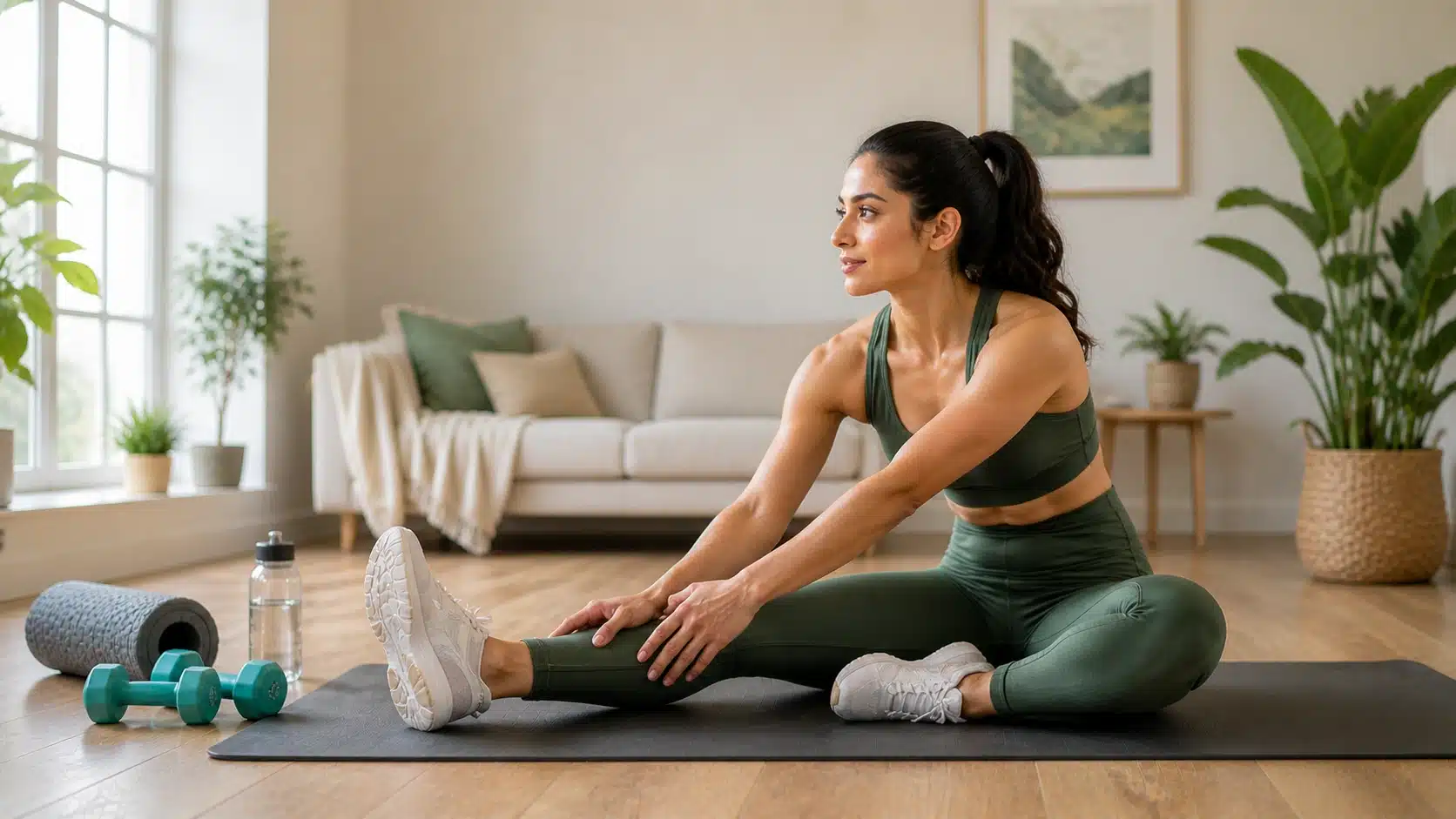
Sit on the floor and bring the soles of your feet together. Let the knees fall outward naturally. Sit tall and lean slightly forward from the hips if that feels comfortable, but avoid rounding the lower back. Do not force the knees toward the floor.
Let gravity do the work gradually over the hold. The adductors respond better to gentle, sustained pressure than to forced movement.
Hold 20 to 30 seconds and repeat 2 to 3 times. This is one of the most accessible inner thigh stretches for any fitness level, and it appears regularly in structured flexibility programs.
The hip-out position used here is a core element of the 28-day chair yoga challenge, which builds on this kind of movement week by week.
2. Side Lunge Inner Thigh Stretch
Watch the full video from Health for a deeper look.
Stand with feet set wide apart, roughly 1.5 times shoulder width. Bend one knee and shift your weight toward that side, keeping the opposite leg fully straight.
The stretch appears along the inner thigh of the straight leg. Keep the foot of the straight leg flat and make sure the bent knee does not travel past the toes.
Hold 20 to 30 seconds per side and repeat 2 to 3 times. This is the most functional adductor stretch of the three because it mirrors the lateral loading position used in sports and wide-stance strength exercises.
3. Lying Inner Thigh Stretch
For a detailed view, watch the video by K’s Perfect Fitness TV.
Lie on your back with knees bent and feet flat on the floor. Slowly let both knees fall outward, stopping before any pull feels too intense. This is a low-intensity option well-suited for beginners, older adults, or anyone managing hip sensitivity.
A small outward movement is enough to engage the inner thigh; no deep range of motion is required. Hold 20 to 30 seconds and return the knees gently to the center before repeating.
Outer Thigh Stretches for Tight Outer Hips
Outer thigh tightness tends to show up as stiffness along the side of the hip, the outer knee, or a band of tension running down the lateral leg. This is often associated with the IT band and the tensor fasciae latae (TFL).
Runners and cyclists are most commonly affected, though anyone who trains unilateral leg movements or sits with crossed legs frequently will also feel it. These three stretches target the outer thigh and hip from different positions.
1. Standing Cross-Leg Outer Thigh Stretch
Watch the video by Forward Fold With Crossed Legs.
Stand with feet together and cross one foot in front of the other. Raise the arm on the same side as the back leg, then reach it up and over toward the opposite side, allowing the upper body to lean in that direction. Keep both feet flat and the knees soft throughout.
The stretch runs along the outer thigh and lateral hip of the back leg. Hold 20 to 30 seconds per side and repeat 2 to 3 times. Use a wall for support if balance is a challenge.
2. Seated Figure Four Stretch
BYoung Physical Therapy, Watch the video for Detail overview.
Sit on the floor with both legs relaxed. Cross one ankle over the opposite knee, allowing the bent knee to fall outward. Hold the ankle with one hand and rest the other hand lightly on the bent knee for gentle control. Do not press the knee down forcefully. Sit tall and avoid rounding the lower back.
The stretch should be felt along the outer thigh and hip of the crossed leg. Hold 20 to 30 seconds per side and repeat 2 to 3 times. This variation also reaches into the deep hip external rotators, making it useful for people with piriformis-related hip discomfort.
3. Lying Outer Thigh Stretch
Have a deeper look here in the video by Jeffry Hays.
Sit on the floor with both legs extended. Bend one knee and cross that foot to the outside of the opposite thigh, placing it flat on the floor. Place one hand behind you for support and gently rotate the torso toward the bent knee. Keep the extended leg relaxed.
The stretch runs along the outer thigh of the bent leg. Hold 20 to 30 seconds per side. This is also a useful position for releasing gluteal tension that often accompanies outer thigh tightness.
A 5-Minute Daily Thigh Stretch Routine
The most common reason thigh stretching stops producing results is inconsistency. Choosing one or two stretches and forgetting them for three days, then repeating, does not allow the muscle tissue to adapt.
Here is a simple daily sequence that covers all four thigh areas in under five minutes, practical enough to do before bed or immediately after a workout.
- Side-lying quad stretch: 30 seconds each side
- Seated hamstring stretch: 30 seconds each side
- Butterfly stretch: 30 seconds
- Seated figure four: 30 seconds each side
- Kneeling quad and hip flexor stretch: 30 seconds each side (skip if kneeling is uncomfortable)
Total time is approximately 4 to 5 minutes. Perform this after any workout or as a standalone wind-down routine in the evening.
How to Stretch Thighs Without Causing More Problems
Stretching stalls progress incorrectly or creates new problems. These practical rules apply to all the thigh stretches above.
1. Warm Up Before You Start
Cold muscles are stiffer and more prone to strain. Spend 5 to 10 minutes on light movement before any dedicated stretch session. Walking at a comfortable pace, marching in place, or easy cycling all raise tissue temperature enough to make static stretching safer and more effective.
This step is most important first thing in the morning or if stretching in isolation rather than after a workout.
2. Hold Steady and Breathe Normally
Hold each stretch for 20 to 30 seconds while breathing steadily. Holding the breath increases systemic tension and works against the muscle relaxation. Avoid bouncing, which activates the stretch reflex and causes the muscle to contract rather than lengthen.
Stretch both sides equally during each session and repeat each movement 2 to 4 times when a deeper release is needed.
3. Tension Is Expected, Pain Is Not
A mild pulling sensation during a stretch is normal and expected. Sharp, stabbing, or burning sensations are not. If pain increases while holding a position, ease out slowly.
Forcing more range than the body naturally allows does not accelerate progress; it raises the risk of a muscle strain.
When to Stop and Speak With a Professional
Stop stretching and consult a doctor or physical therapist if you notice sharp or severe pain, swelling, warmth, redness, numbness, or tingling in the leg.
The same applies to thigh pain that follows a recent injury, discomfort that worsens progressively over days, or pain that affects your ability to walk normally.
| Safety Note: Thigh stretching is not appropriate immediately after an acute muscle tear. If you suspect a strain rather than general tightness, particularly if there was a sudden, sharp pain during exercise, get a clinical assessment before loading or stretching the area. |
How to Progress Your Thigh Flexibility Over Time
Improving thigh flexibility is a gradual process that requires patience and consistency. By following a structured progression, you can safely increase your range of motion while minimizing the risk of injury.
Below is a recommended pathway for progressing flexibility in the quads, hamstrings, and inner/outer thighs:
| Thigh Area | Stage 1 | Stage 2 | Stage 3 | Additional Tips |
|---|---|---|---|---|
| Quadriceps | Side-lying quad stretch | Standing quad stretch | Kneeling quad & hip flexor stretch | Pair with eccentric quad strengthening for long-term length maintenance |
| Hamstrings | Lying hamstring stretch with towel | Seated hamstring stretch | Standing hamstring stretch | Focus on hip-hinge control; helps unlock deeper movements like ATG split squats |
| Inner Thigh | Lying inner thigh stretch | Butterfly stretch | Side lunge | Gradually increase depth as hip mobility improves |
| Outer Thigh | Seated figure four | Standing cross-leg stretch | – | Start seated to minimize balance demands, progress when comfortable with range |
By progressing through these stages gradually, your muscles will adapt over time, making each stretch feel easier and safer.
Remember, flexibility gains are subtle but cumulative, consistency and mindful progression are key to long-term improvement.
Video Demonstration: Front, Back, and Inner Thigh Stretches
The video by Dr. Bri’s Vibrant Pelvic Health shows the front, back, and inner thigh stretches above with clear form cues and hold timing. Watch through once before starting to understand the correct positions before you try them.
Frequently Asked Questions
Is it normal for one thigh to be tighter than the other?
Yes, and it is more common than most people expect. Muscle asymmetries develop through everyday movement patterns: favoring one leg during stairs, sitting with more weight on one side, or training one side more in sport.
Focus additional hold time on the tighter side during each session, but do not skip the other leg. Ignoring the less-tight side eventually creates its own compensatory patterns.
Can tight thigh muscles cause knee pain?
They can. Tight quadriceps increase the compressive force on the kneecap by pulling the patellar tendon with more tension than the joint is designed to manage during regular activity. Tight hamstrings alter how force is distributed at the back of the knee during extension.
Research from the Hospital for Special Surgery consistently identifies quad and hamstring flexibility as relevant factors in managing patellofemoral pain. Regular thigh stretching helps reduce this tension and eases loading on the joint over time.
Should you stretch your thighs before or after a workout?
Light dynamic movement, such as leg swings, walking lunges, and hip circles, works better before a workout because it raises muscle temperature without reducing the force-producing capacity that static stretching can temporarily affect.
Save static thigh stretches for after a workout, when muscles are already warm and more receptive to holding longer positions.
Research published in the Scandinavian Journal of Medicine and Science in Sports (2013) found that pre-exercise static stretching can reduce strength output, though the effect is minimal for moderate-intensity training.
How often should you stretch your thighs to see results?
Three to four times a week produces measurable flexibility gains within two to three weeks for most people. Daily stretching works equally well, as long as sessions stay gentle and each hold is sustained rather than bounced.
The research on flexibility consistently shows frequency matters more than session length: three 5-minute sessions per week outperform one 15-minute session per week for sustained range-of-motion improvement.
Can I stretch tight thighs if I have a hip replacement or recent knee surgery?
Some of these stretches are used in post-surgical rehabilitation, but only under specific clearance criteria and with significant modifications. The butterfly stretch, for instance, may be contraindicated in early hip replacement recovery depending on the surgical approach.
Always obtain explicit clearance from your surgeon or physical therapist before attempting any lower-body stretching after orthopedic surgery. The crutches workouts has a safe movement options during the earlier stages of lower-body recovery.
What is the difference between thigh stretches and hip flexor stretches?
The distinction comes down to anatomy. The hip flexors, primarily the iliopsoas and rectus femoris, sit at the junction of the thigh and pelvis and are responsible for lifting the thigh toward the torso.
The kneeling quad and hip flexor stretch targets both, because the rectus femoris crosses both the hip and the knee. Pure quad stretches that bend only the knee without extending the hip, such as the side-lying version, do not meaningfully stretch the hip flexors.
If your tightness is more in the upper front thigh and groin area than the mid-thigh, the kneeling variation and the standing cross-leg outer thigh stretch will reach it better.
Final Verdict
My honest recommendation is to anchor your routine around two stretches: the side-lying quad stretch and the seated hamstring stretch.
Together, they cover the two most commonly tight areas, require no equipment, and can be done anywhere in under three minutes. Add the butterfly stretch as a third if your inner thighs or hips feel restricted.
Once those three feel manageable, usually within two to three weeks of consistent practice, layer in the kneeling quad and hip flexor stretch and the seated figure four to address depth and outer hip tightness.
The most important variable is not which thigh stretches you choose, but whether you do them consistently three to four days a week.
Start tonight with the side-lying quad stretch and the seated hamstring stretch. Hold each for 30 seconds, breathe steadily, and pay attention to how your body responds after one week.
Sources
- Behm, D.G., et al. “Acute effects of muscle stretching on physical performance, range of motion, and injury incidence in healthy active individuals.” Applied Physiology, Nutrition, and Metabolism 41(1): 1–11, 2016.
- Hartmann, H., Wirth, K., & Klusemann, M. “Analysis of the Load on the Knee Joint and Vertebral Column with Changes in Squatting Depth and Weight Load.” Sports Medicine 43(10): 993–1008, 2013.
- Hospital for Special Surgery. “Stretches and Exercises for Knee Pain.” hss.edu, December 2022.
- Simic, L., Sarabon, N., & Markovic, G. “Does pre-exercise static stretching inhibit maximal muscular performance?” Scandinavian Journal of Medicine & Science in Sports 23(2): 131–148, 2013.
- American College of Sports Medicine (ACSM). ACSM’s Guidelines for Exercise Testing and Prescription, 11th Edition. Wolters Kluwer, 2022.