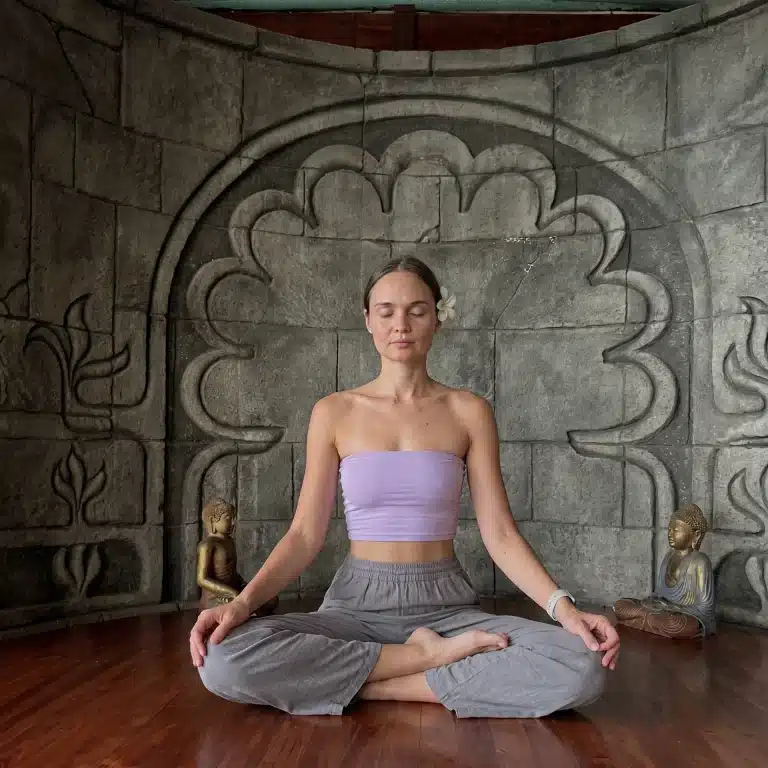
| Style | Hatha / Restorative |
| Level | Beginner to Intermediate |
| Duration | 20-45 minutes per session |
| Props Needed | Mat, folded blanket, bolster or firm pillow, optional block |
| Best Time | Morning or early evening; avoid directly before bed if using backbends |
| Avoid If | Active neck injury, severe cervical disc issues, uncontrolled high blood pressure (skip Shoulderstand and Plow) |
Have you ever felt a physical “lump” in your throat just as you were about to speak up? It is frustrating when your neck tightens and your voice feels trapped behind a wall of tension.
I know that feeling of holding back, and it usually starts in the body before the mind even catches up. Using throat chakra yoga poses offers a gentle way to release that grip through movement and breath.
By the end of this guide, you will know exactly how to open your chest, soften your jaw, and use simple sequences to find your voice again. It’s about creating space to speak your truth.
| Disclaimer: This article is for informational and educational purposes only. It does not constitute medical advice. Chakra yoga is a mind-body practice and is not a treatment for thyroid, voice disorders, anxiety, or chronic neck pain. Always consult a qualified healthcare provider before starting a new exercise or wellness program. |
What Is the Throat Chakra and Why Does Yoga Support It?
Vishuddha, the throat chakra, is the fifth energy center in the classical yogic system. Its name means “pure” in Sanskrit, and it is associated with communication, truth, listening, and creative self-expression. In the body, it corresponds to the throat region, thyroid gland, neck, jaw, shoulders, and upper chest. Its traditional color is blue, linked to clarity and calm.
When students arrive in my classes carrying throat chakra tension, I almost always see the same pattern: forward-rounded shoulders, a shortened front neck, and a jaw that never quite releases.
The body is holding back what the voice cannot yet say. Yoga addresses this physically by opening the chest, softening the neck, and using breath and sound to bring direct attention to this area.
Physically, throat chakra yoga focuses on the following:
- Gentle neck mobilization and side stretches
- Upper chest and shoulder openers
- Supported backbends that create length through the front body
- Breathwork and sound practices that engage the throat directly
That said, this is a mind-body wellness practice. Vishuddha yoga does not treat thyroid disease, voice disorders, or anxiety. If you are dealing with any of those, please work with a qualified professional alongside your yoga practice.
Throat Chakra Yoga Poses
Each pose supports the throat, neck, jaw, shoulders, or chest. Follow the order for a complete routine, or choose poses based on your comfort and experience.
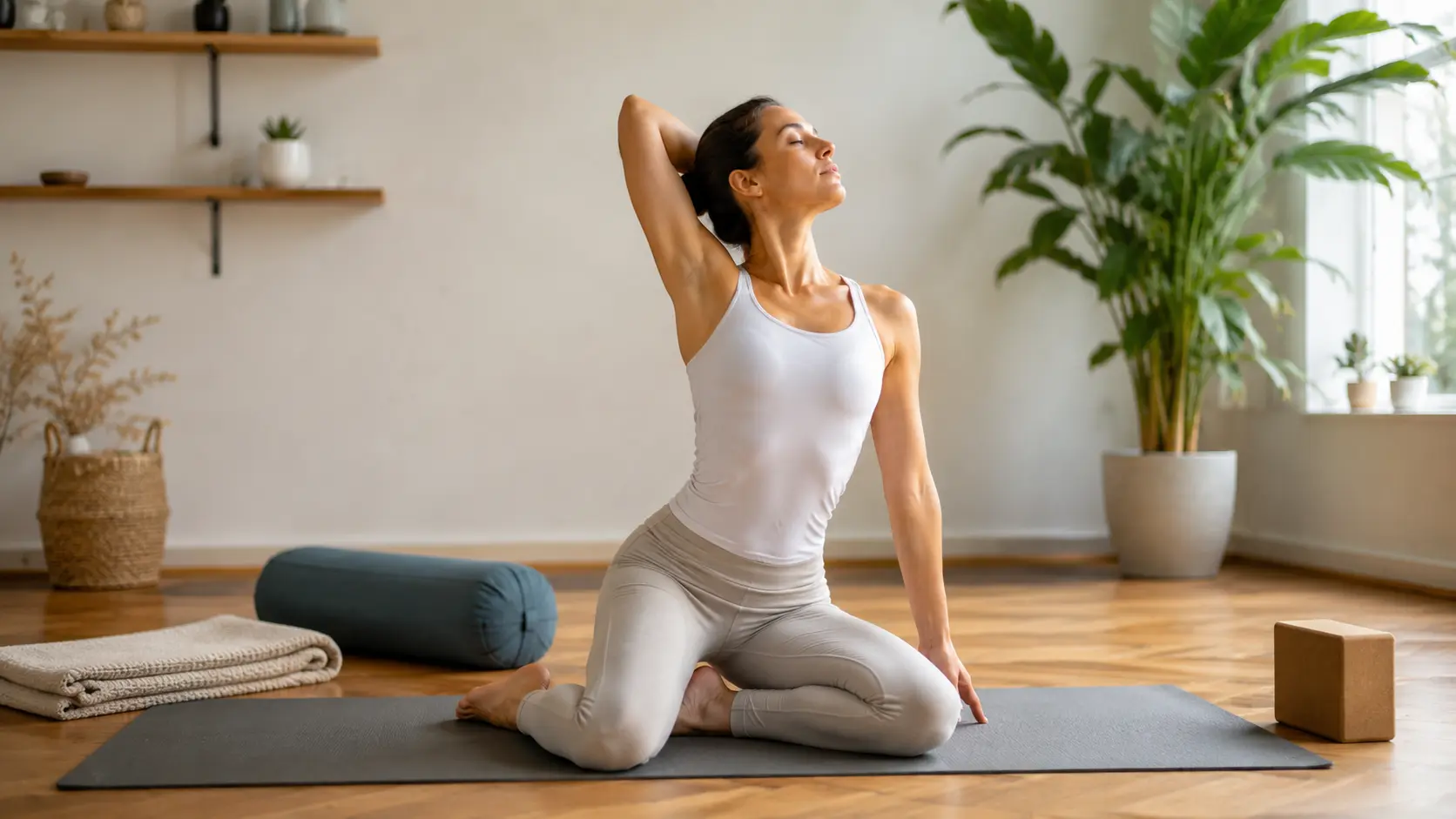
1. Seated Neck Stretch
Target area: Side neck, jaw, and shoulders
Seated Neck Stretch is a light release pose used at the start of throat chakra practice. It helps you notice neck and jaw tension before you move into larger poses.
Steps to follow:
- Sit on a cushion, folded blanket, or chair with your spine tall.
- Keep both feet grounded if you are sitting on a chair.
- Relax your shoulders away from your ears.
- Keep your chin level and your jaw soft.
- Slowly drop your right ear toward your right shoulder.
- Let your left shoulder stay heavy instead of lifting up.
- Hold the stretch for three to five slow breaths.
- Return your head to the center with control.
- Repeat the same steps on the left side.
- Do one or two rounds on each side.
Modification: If you feel tightness at the base of the skull, place a folded blanket under your sitting bones to tilt the pelvis slightly forward. This gives the neck more room to move without compression.
Precaution: Do not pull your head down with your hand. The stretch should feel mild. Stop if you feel any sharpness, tingling, or pressure behind the eye.
Instructor Tip: In my classes I cue students to imagine the left shoulder melting down toward the floor during the right-side stretch. That single image does more than any verbal instruction to keep the opposite shoulder from lifting.
2. Cat Cow Pose
Target area: Spine, upper back, neck, and breath control
Cat Cow is a warm-up pose that connects breath with spinal movement. It prepares the neck and upper back without placing pressure on the throat.
Steps to follow:
- Come onto your hands and knees on the mat.
- Place your wrists under your shoulders.
- Place your knees under your hips.
- Spread your fingers and press your palms down evenly.
- Inhale as you lift your chest forward and slightly up.
- Let your tailbone lift gently as your belly softens.
- Exhale as you round your back toward the ceiling.
- Let your head relax naturally without dropping it hard.
- Move slowly with your breath for five to eight rounds.
- Return to a neutral spine when finished.
Modification: For wrist sensitivity, come onto your fists or place a folded blanket under the heels of your hands. The movement remains the same.
Precaution: Let your neck follow the natural curve of the spine. Do not throw your head back on the inhale or jam your chin to your chest on the exhale.
3. Cobra Pose
Target area: Chest, shoulders, spine, and front body
A low Cobra is underrated in throat chakra yoga. Because the lift is modest and controlled, the throat stays long and open rather than compressed. I use the Baby Cobra guide often with newer students before progressing to Fish or Camel, because it teaches the chest-first lift without any neck strain.
Steps to follow:
- Lie on your belly with your legs extended behind you.
- Place your hands under your shoulders.
- Press the tops of your feet into the mat.
- Keep your elbows bent and close to your ribs.
- Draw your shoulders back gently.
- Inhale and lift your chest a little off the floor.
- Keep your lower ribs close to the mat.
- Keep your neck long and your gaze slightly forward.
- Hold for three slow breaths.
- Exhale and lower your chest with control.
Modification: Place a folded blanket under your forehead if your neck feels strained. Students with tight shoulders can place a block under each hand at the start.
Precaution: Do not let your lower back collapse. Keep your core gently engaged and your hips directly over your knees.
4. Bridge Pose
Target area: Chest, glutes, hamstrings, and throat area
Bridge creates a steady chest lift while the floor supports the neck. That supported quality is exactly why it belongs in throat chakra practice. Students who feel unsafe in deeper backbends almost always feel confident here, and I often pair it with heart-opening yoga poses once they are comfortable with the basic lift.
I often cue this as “a gentle conversation with the thyroid” because the position of the chin toward the chest creates mild, comfortable compression in the throat area.
Steps to follow:
- Lie on your back with your knees bent.
- Place your feet hip-width apart.
- Keep your heels close enough that your fingertips can touch them.
- Rest your arms beside your body with palms down.
- Press both feet evenly into the mat.
- Inhale and slowly lift your hips.
- Keep your knees facing forward, not falling outward.
- Lift your chest gently toward your chin.
- Hold for three to five breaths.
- Exhale and lower your spine down slowly.
Modification: If your lower back tightens, widen your feet to hip-width. Alternatively, keep the chest very low (literally two to three inches off the mat) and focus purely on the chest opening.
Precaution: Keep the jaw loose. If your gaze drifts upward and your neck shortens, bring your eyes forward again.
5. Fish Pose
Target area: Front neck, upper chest, upper back, and breast space
Fish is one of the stronger throat chakra poses because it opens the front of the neck and chest. It works best when the body has enough support.
Steps to follow:
- Lie on your back with your legs relaxed.
- Place your forearms beside your body.
- Press your elbows and forearms into the floor.
- Lift your chest gently upward.
- Draw your shoulder blades slightly together.
- Keep most of your weight in your arms and elbows.
- Let the top of your head move lightly toward the mat only if your neck feels safe.
- Keep the throat open but not strained.
- Hold for two to four breaths.
- Press into your forearms and lower down slowly.
Modification: Place a block under your sacrum (the flat triangular bone at the base of your spine) for a supported, passive version. This is especially useful for longer holds of one to three minutes.
Precaution: Do not turn your head in this pose. Keep your gaze at the ceiling throughout.
6. Camel Pose
Target area: Chest, front shoulders, hip flexors, and throat area
The camel gives a deeper front body stretch, so it should come after easier poses. It can feel strong around the chest and throat, so control matters.
Steps to follow:
- Kneel on the mat with your knees hip-width apart.
- Keep your thighs upright and your hips stacked over your knees.
- Place your hands on your lower back.
- Point your fingers downward.
- Press your hips slightly forward without squeezing your lower back.
- Lift your chest first before leaning back.
- Keep your jaw soft and your throat open.
- Let your head move back only a little if your neck feels steady.
- Stay for two to three breaths.
- Come out slowly by leading with your chest.
Modification: Place a folded blanket or bolster under your upper back so your head does not need to reach the floor. This supported version is excellent for longer holds and removes strain from the neck entirely.
Precaution: Never bear full weight on the crown of the head. If you feel any sharpness or pressure in the neck, reduce the lift or use a bolster immediately.
| Instructor Tip: I tell students to imagine their sternum lifting toward the ceiling like someone is pulling a string attached to the center of their chest. The head follows last, not first. That sequence prevents the neck from doing work the chest should be doing. |
7. Downward Dog
Target area: Spine, shoulders, hamstrings, and back of the neck
Downward Dog works well as a reset pose after backbends. It lets the head relax and helps the spine lengthen.
Steps to follow:
- Start on your hands and knees.
- Place your hands shoulder-width apart.
- Spread your fingers and press into the mat.
- Tuck your toes under.
- Lift your hips up and back.
- Bend your knees if your hamstrings feel tight.
- Lengthen your spine instead of forcing your heels down.
- Let your head hang naturally between your arms.
- Breathe slowly for three to five breaths.
- Lower your knees back to the mat when ready.
Modification (beginner): Keep your hands on your lower back throughout and do not reach for your heels. The chest lift alone is sufficient for a full throat chakra benefit. Tuck your toes under to raise the height of your heels if needed.
Advanced variation: Once the chest-first lift feels natural over several sessions, you can reach one hand at a time toward the heel while maintaining the lift. Do not sacrifice the chest opening to reach the heel.
Precaution: Come out by leading with your chest, not by pushing up from the lower back. Rest in Child’s Pose for several breaths after Camel.
Target area: Shoulders, upper back, core control, and throat area
Shoulderstand is a traditional throat chakra pose, but it is not required. It places more pressure near the neck, so it belongs only in advanced practice.
Steps to follow:
- Place folded blankets under your shoulders, not under your head.
- Lie on your back with your head resting on the mat.
- Keep your neck long and still.
- Bend your knees toward your chest.
- Slowly lift your hips off the floor.
- Support your back with both hands.
- Lift your legs upward only if you feel stable.
- Keep your elbows close enough to support your back.
- Hold only while your breath stays smooth.
- Come down slowly with control.
Modification: Keep a generous bend in your knees throughout. Students with wrist sensitivity can use fists or come onto their forearms for Dolphin Pose as an alternative.
Precaution: Press through your hands and lengthen your spine rather than forcing your heels toward the floor. The heels are the last thing to address, not the first.
9. Plow Pose
Target area: Upper back, spine, shoulders, and throat area
Plow is another advanced pose connected with the throat area. It should come only after a strong setup, warm muscles, and steady breathing.
Steps to follow:
- Start from Shoulderstand only if your setup feels safe.
- Keep your neck still and your gaze upward.
- Support your back with your hands.
- Slowly lower your legs behind your head.
- Bend your knees if your back or hamstrings feel tight.
- Let your toes reach toward the floor only if comfortable.
- Keep your breath smooth and easy.
- Stay for a short time only.
- Bring your hands back to your back for support.
- Roll down slowly, one part of the spine at a time.
Modification: If the full tongue extension feels too much in a group setting, keep the mouth wide open and the exhale audible without extending the tongue. The throat release is the goal.
Advanced variation: Hold the pose with tongue extended and eyes wide (gazing toward the brow center) for the full duration of the exhale. This is the traditional Simhasana and intensifies the release through the face and jaw.
Precaution: The sound should come from the back of the throat with a relaxed exhale, not from a strained forced breath. If your throat feels raw after, you are pushing too hard.
Beginner-Friendly Throat Chakra Yoga Sequence

If you are new to throat chakra yoga poses, use this sequence to build familiarity before adding Camel, Shoulderstand, or Plow. If you are also exploring other energy centers, a broader chakra yoga practice can help you understand how Vishuddha connects to the rest of the system. Move through it slowly and keep your breath steady throughout. The goal is ease, not intensity.
| Pose | Duration | Key Cue |
| Seated Neck Stretch | 3-5 breaths each side | Let the opposite shoulder melt down |
| Cat-Cow Pose | 5-8 rounds | Neck follows spine, not the other way |
| Puppy Pose | 5-8 breaths | Hips stay above knees throughout |
| Cobra Pose (low) | 3 breaths, 2 rounds | Lift only as far as comfortable |
| Supported Bridge Pose | 5 breaths or 1-3 min with block | Do not turn your head |
| Supported Fish Pose | 2-4 breaths or 1-2 min with bolster | Chest leads, head follows last |
| Lion’s Breath | 3-5 rounds seated | Let the sound be audible, not forced |
| Supported Savasana | 5-10 minutes | Bolster under knees, eye pillow optional |
Each pose in this sequence prepares the next. The neck stretches and Cat-Cow warm the upper body; Puppy and Cobra begin to open the chest; Bridge and Fish deepen that opening with floor support; Lion’s Breath gives the throat a direct release; and Savasana lets everything settle. Do not rush the transitions.
Breathwork and Sound Practices for Vishuddha

Breathwork and sound practices can support throat chakra yoga by bringing attention to your breath, voice, and throat area. They are simple, gentle, and helpful before or after yoga poses.
1. Ujjayi Breath
Ujjayi breath creates a soft, ocean-like sound in the throat as you breathe slowly through the nose. It helps you notice the connection between breath, voice, and inner calm.
For throat chakra practice, keep the sound gentle instead of forced. This breath can help you feel steady, present, and more aware of the throat area during yoga.
2. Humming Breath
Humming breath uses gentle vibration to bring awareness to the throat, face, and chest. You breathe in normally, then hum softly as you exhale.
The sound should feel smooth and relaxed, not loud or strained. This practice may help settle the mind before yoga or create a calm ending after your poses. Keep your jaw loose and your shoulders relaxed.
3. Mantra Chanting
Mantra chanting is often used in throat chakra practice because sound is closely linked with expression. The traditional seed sound for Vishuddha is “Ham.” You can chant it slowly while sitting comfortably and breathing with ease.
The goal is not to sing perfectly, but to feel the vibration and focus. Chanting may support clarity, confidence, and honest self-expression.
Throat Chakra Affirmations to Use During Practice
Affirmations are not magic phrases. They work in throat chakra yoga because they give the mind something honest and specific to focus on while the body is in a pose. Repeat them silently during holds, or speak them aloud after Lion’s Breath or humming practice when the throat is already open.
- I speak my truth with honesty and ease.
- My voice is clear. My words have value.
- I listen as openly as I speak.
- I express myself fully and without fear.
- My throat is open. My breath is steady.
These work best when they feel true rather than aspirational. If “I speak my truth easily” feels like a lie right now, try “I am learning to speak my truth.” That small adjustment keeps the practice honest, which is exactly what Vishuddha is asking for.
How to Build a Consistent Throat Chakra Yoga Practice
The students I see make the most progress with throat chakra yoga are not the ones who do a two-hour session once a month. They are the ones who do ten to fifteen minutes three or four times a week. Consistency matters more than duration here, because the patterns that tighten the neck and jaw build up daily and need to be addressed daily.
A practical starting structure that works well for most people:
- Morning (10 min): Seated neck stretch, Cat-Cow, Puppy Pose, three rounds of humming breath
- Evening (20 min): Full beginner sequence above, ending with five minutes of Savasana
- Before a difficult conversation: Seated neck stretch, two rounds of Lion’s Breath, three rounds of Ujjayi
Give this structure four to six weeks before evaluating whether it is working. Physical tension in the neck and jaw that took years to accumulate will not dissolve in a week. What most people notice first is not that the tension is gone but that they become aware of it sooner, which is the first step toward releasing it.
Common Mistakes to Avoid
These mistakes can make the practice feel tense instead of useful. Check them before you build a longer routine.
| Mistake | Why it matters | What to do instead |
|---|---|---|
| Starting with advanced poses | Shoulderstand and Plow place more pressure near the neck | Begin with neck stretch, Cat Cow, Low Cobra, Supported Bridge, or Supported Fish |
| Forcing the head back | It can strain the neck and make the throat feel pinched | Lift through the chest first, then move the head only as far as feels safe |
| Skipping support in Fish or Bridge | The neck and back may work harder than needed | Use a bolster, folded blanket, block, or firm pillow |
| Clenching the jaw | A tight mouth can keep the throat area tense | Keep your teeth slightly apart and let your tongue rest |
| Practicing through warning signs | Pain, dizziness, blocked breath, or head pressure can signal strain | Stop, rest, and choose a safer pose |
A safer practice feels steady, clear, and easy to leave at any time. Keep the poses simple until your breath and neck both feel ready.
Frequently Asked Questions
Can this help with public speaking?
Yes, a short routine may help you feel calmer before speaking. Use gentle neck stretches, Cat Cow, Supported Fish, and humming. Skip intense backbends right before a talk because they may leave you tired, shaky, or less steady.
Can I do the routine from a chair?
Yes. Sit tall with both feet on the floor. Practice neck stretches, slow breathing, jaw release, and seated Cat Cow. Skip floor poses and use the seated version as a simple midday reset at work or home.
What should I feel during practice?
You may feel mild stretching, easier breathing, warmth in the upper chest, or better jaw awareness. You should not feel sharp pain, numbness, head pressure, dizziness, or blocked breathing. Stop right away if those signs appear.
Do I need Sanskrit pose names?
No. English pose names are enough for home practice. Sanskrit can help in class settings, but a safe setup matters more. Learn the position, breath, and limits before worrying about traditional names or spelling at first.
Can I practice before singing?
Yes, but keep it light. Choose neck stretches, Supported Fish, humming, and jaw release. Avoid strong sound work or tiring backbends right before singing because your voice should feel fresh, steady, and easy that day.
Conclusion
Finding your voice starts with a relaxed body and a steady breath. Moving through these throat chakra yoga poses helps you trade that familiar neck tightness for a sense of openness and ease.
I have covered how gentle stretches, chest openers like Bridge, and simple sounds can settle your nerves before you need to speak up. This practice works because it focuses on the physical roots of communication, giving you a grounded way to express your truth.
Whether you have ten minutes or just two, these movements help you show up more clearly.
Try the short humming practice today and notice how it changes your energy. Feel free to share which pose helped you feel the most open.