| Topic | Planet Fitness Red Light Therapy (Total Body Enhancement) |
| Machine | Beauty Angel vibration + red light booth |
| Session Length | 12 minutes |
| Membership Required | PF Black Card (access varies by location) |
| Best For | Post-workout recovery, skin support, and relaxation add-on |
| Avoid If | Pregnancy, photosensitive medications, epilepsy, active eye conditions. Consult a provider first. |
When I first started recommending recovery tools to clients, most of them walked past the red light booth at Planet Fitness without a second thought. Once I explained what it actually does and how to use it properly, it became a consistent part of several post-workout routines.
Planet Fitness red light therapy, marketed as the Total Body Enhancement machine, is not complicated, but it works better when you understand what it is, what it realistically delivers, and how to set it up on your first visit.
This guide covers the science behind the machine, a step-by-step walkthrough for using it correctly, what results to expect at different timeframes, and who should hold off until they have checked with a provider. By the end, you will have a clear picture of whether this tool belongs in your gym routine.
What is Planet Fitness Red Light Therapy?
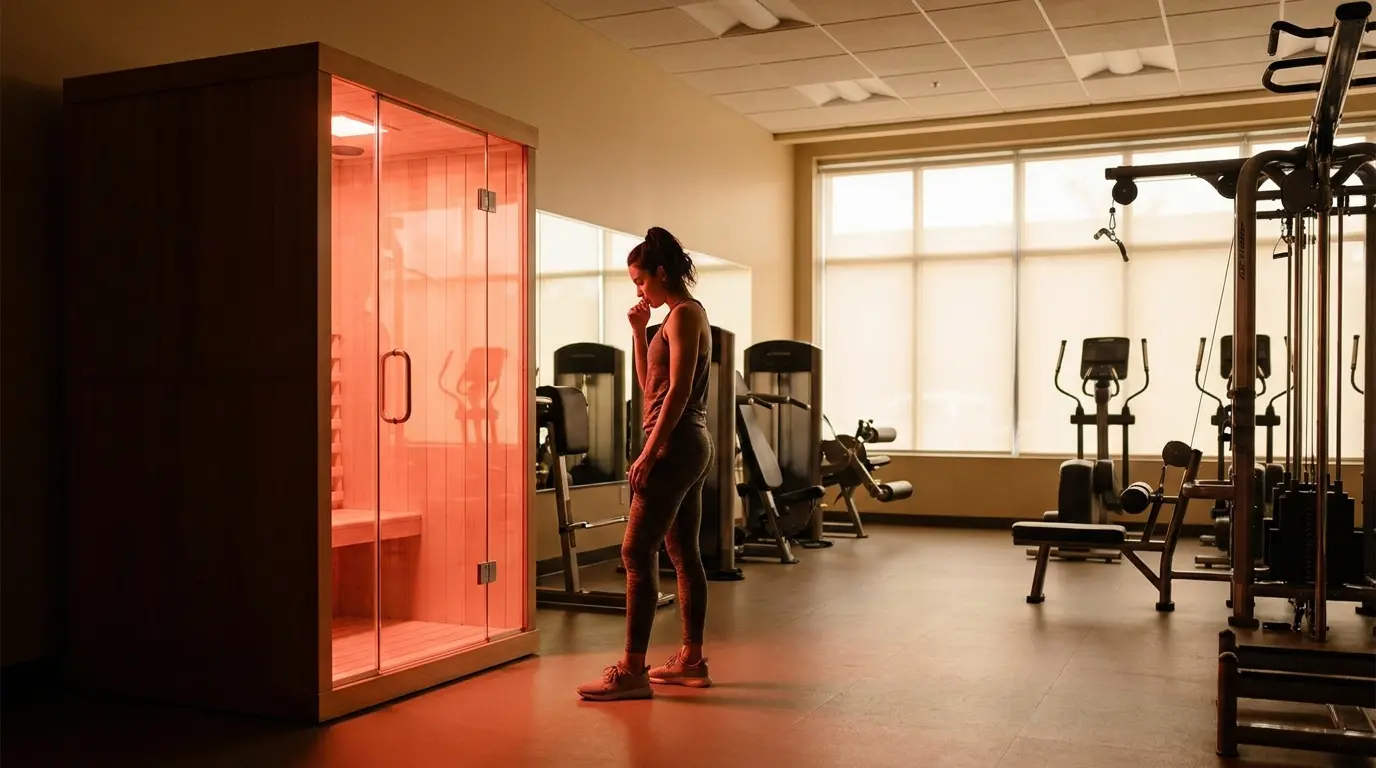
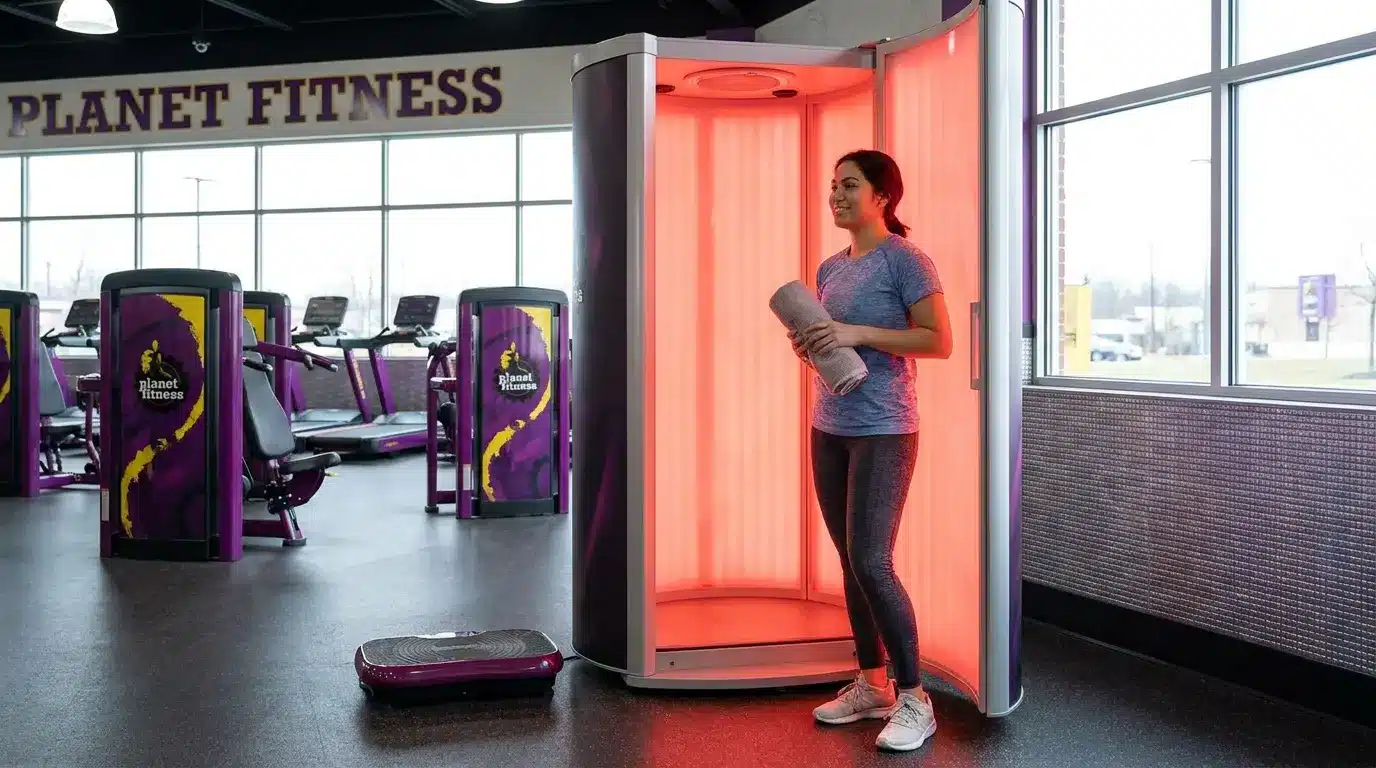
Planet Fitness red light therapy refers to the Total Body Enhancement booth, a stand-up enclosure available at Black Card-eligible locations.
The machine combines red light panels with an optional vibration platform under your feet.
The model used in most locations is the Beauty Angel series, which emits light in the red wavelength range (roughly 633 nm for surface skin support) along with some near-infrared output depending on the specific unit.
The key distinction from a tanning bed is that red light therapy does not use ultraviolet (UV) light and is not designed to darken the skin. UV radiation penetrates the skin and triggers melanin production.
Red and near-infrared light work differently: they penetrate the outer skin layers and interact with mitochondria in cells, supporting cellular energy production (ATP) without the UV skin damage risk.
A 2019 review published in Seminars in Cutaneous Medicine and Surgery confirmed that low-level red light in this wavelength range can support collagen synthesis and reduce inflammation markers in skin tissue.
The vibration plate built into the floor is a separate feature. Whole-body vibration platforms work by rapidly contracting and relaxing muscle fibers, typically at frequencies between 30 and 50 Hz, which can support circulation and reduce post-exercise muscle soreness independent of the red light.
Both features run simultaneously during the 12-minute session, which is why members often feel looser after using it even if they are unsure which element is responsible.
How to Use Red Light Therapy at Planet Fitness
Knowing how to use red light therapy at Planet Fitness correctly makes the difference between a calming 12 minutes and a rushed, confusing experience.
The machine has a control panel, vibration settings, fan controls, and occasionally audio options.
All of these need to be configured before the light cycle starts. Here is the full step-by-step sequence I walk first-time users through.
Step 1: Check Your Black Card Access and Sign In
Total Body Enhancement is a Black Card perk. Confirm your membership tier at the front desk or on the Planet Fitness app before planning your first session.
At most locations, staff activate the machine from a kiosk or front desk terminal and assign you a private room.
Ask staff to walk you through the process on your first visit, because the controls vary slightly between older and newer Beauty Angel models, and a one-minute explanation from staff saves several minutes of guessing inside the booth.
Step 2: Prepare Before the Timer Starts
Once a staff member activates the machine, you may have only 60 to 90 seconds before the session begins.
Lock the private room immediately, set down your phone and belongings, and remove your shoes.
Footwear is not allowed on the vibration plate. Do not rush through undressing once the session has started, since every second of the 12-minute window counts toward your exposure time.
Step 3: Choose Your Clothing Level
Red light does not penetrate thick fabric effectively. For most members, wearing workout shorts and a fitted top gives the best combination of coverage and skin access.
The booth is private, so you can dress down to your comfort level, but thicker layers like hoodies, compression tights, or multiple fabrics will reduce how much light reaches your skin.
I tell clients to dress the way they would for a warm yoga class: light, fitted, and comfortable. Clean, dry skin is preferable to skin with heavy lotion or oil, which can leave residue on the machine panels.
Step 4: Set Up Eye Protection
The red light panels are bright. While they do not emit UV radiation, staring directly at the lamps for 12 minutes can cause eye fatigue and mild discomfort, especially for people with light-sensitive eyes.
If your location provides goggles, use them. If not, standard sunglasses work well, or simply keep your eyes closed.
The closed-eyes option is the simplest approach, and many members find it makes the session feel more like a short rest.
Step 5: Set the Vibration Level First
The vibration plate control is usually a foot icon on the panel. Start at the lowest setting (level 1 or 2) on your first visit.
Higher frequencies, typically levels 4 and above, can feel unexpectedly strong on an unfamiliar platform, particularly if you have not used whole-body vibration before.
Bend your knees slightly rather than locking them out, and use any side straps the machine provides to maintain balance.
The goal is a mild oscillation that stimulates circulation, not a setting so strong that you are gripping the handles to stay upright.
Step 6: Adjust Fan and Audio Settings
Most Beauty Angel models have a fan to prevent the enclosed space from feeling warm. Turn this on during setup, not mid-session.
If your machine has an audio guide or music option, set your preferred level before the light cycle begins so you can settle into a standing rest position without fumbling with the panel.
Once everything is configured, stand facing the center of the booth with a relaxed posture and let the session run.
Step 7: Cool Down and Clean the Machine
Toward the end of the 12 minutes, the vibration plate will typically reduce intensity before stopping.
Once the session ends, step down carefully, as your legs may feel slightly different after vibration, similar to the brief steadiness adjustment after using a vibrating foam roller.
Dress, then use the provided spray and paper towels to wipe the interior panels and the vibration platform before leaving.
Cleaning the machine after each use is standard gym etiquette and required at most Planet Fitness locations.
| Trainer Tip: On your first three visits, treat the session as a calibration period. Note how the vibration level feels, whether the brightness is comfortable, and whether you feel any muscle response or calm afterward. Make one adjustment per visit (vibration level, clothing, or eye protection) until you find the setup that feels best for your body. |
What Does Planet Fitness Red Light Therapy Do? The Science Behind It
The mechanisms behind red light therapy are better established than most gym-floor conversations suggest. Understanding them helps set accurate expectations and explains why the results feel subtle rather than dramatic.
Cellular Energy Production (Mitochondrial Stimulation)
Red and near-infrared light in the 600 to 900 nm range is absorbed by cytochrome c oxidase, an enzyme in the mitochondria that plays a central role in ATP (cellular energy) production.
When this enzyme absorbs photons from red light, it temporarily increases the rate of ATP synthesis, giving cells more energy to carry out repair and maintenance functions.
A 2017 review in the Journal of Photochemistry and Photobiology B found that this photobiomodulation effect was consistent across multiple tissue types, including skin fibroblasts and muscle cells, at light intensities comparable to those in commercially available therapy devices.
Collagen Synthesis and Skin Support
Fibroblasts, the skin cells responsible for producing collagen and elastin, respond to red light exposure by increasing collagen production.
This is the mechanism behind most skin-related benefits reported in clinical red light therapy research: smoother texture, reduced fine lines, and more even tone with sustained use.
The effect builds over weeks of consistent sessions, not after one or two visits.
For the Planet Fitness booth specifically, full-body exposure means skin across your arms, legs, and torso receives light simultaneously, which is broader coverage than most home devices offer.
Inflammation and Recovery Support
Red light therapy has measurable anti-inflammatory effects at the cellular level.
A 2016 study in the American Journal of Physical Medicine & Rehabilitation found that photobiomodulation reduced levels of pro-inflammatory cytokines (IL-6 and TNF-alpha) in muscle tissue following exercise-induced damage.
For gym members, this translates to a potential reduction in delayed onset muscle soreness (DOMS) and faster perceived recovery between sessions. It is a rational reason to use the booth after leg day or a hard cardio session.
What the Vibration Platform Adds
Whole-body vibration at 30 to 50 Hz produces rapid involuntary muscle contractions throughout the lower body and core.
Research from the European Journal of Applied Physiology has shown that brief WBV sessions can increase lower-limb blood flow and reduce muscle stiffness post-exercise.
The relaxed, loosened feeling many members notice after the booth is partly attributable to this vibration effect, independently of the red light.
It is worth knowing this distinction because if you ever use the booth with the vibration off, the experience will feel noticeably different.
What Results Can You Realistically Expect From Planet Fitness Red Light Therapy?
Results from consistent use fall into a predictable pattern across three time windows. I would not track this by hoping for visible changes in the mirror after one session. The timeline for red light therapy works more like a stretching habit than an acute intervention.
After the First Session
The most common first-session experience is warmth from the enclosure, mild muscle looseness from the vibration, and a general sense of calm, similar to how your body feels after light sauna use.
Some people report feeling more awake; others feel more relaxed. Neither response indicates whether the therapy is working at a cellular level.
Treat the first visit as a comfort and settings test: assess whether the vibration level is appropriate, whether your eye protection is adequate, and whether the 12-minute duration feels sustainable to repeat several times per week.
After 2 to 4 Weeks of Regular Use
At this stage, small patterns become easier to notice.
Members who use the booth consistently after training sessions often report that their legs feel less heavy after workouts, that soreness resolves faster between sessions, and that the post-workout calm from the booth helps them mentally close out their training day.
Some people notice that their skin feels slightly softer or smoother, particularly on areas with more direct light exposure like forearms and shins.
These changes are subtle and not universal, as individual skin type, hydration, sleep quality, and training volume all affect how the body responds.
After 8 Weeks or More
Eight weeks of 2 to 3 weekly sessions give you enough data to make an honest judgment. Compare your soreness patterns, perceived recovery speed, and skin texture to your pre-habit baseline.
Research on photobiomodulation for skin improvement typically shows measurable collagen density changes at 8 to 12 weeks with consistent exposure (Wunsch & Matuschka, Photomedicine and Laser Surgery, 2014).
If you are feeling meaningfully better after workouts and the booth fits easily into your routine, it has earned its place. If the difference feels negligible after two months of consistent use, it is reasonable to deprioritize it.
| Note: Factors that affect individual results include sleep quality, hydration, training intensity, skin type, and whether you are using the booth pre- or post-workout. None of these variables disqualify you from trying it. They simply explain why two people with the same membership can have meaningfully different experiences. |
Benefits of Planet Fitness Red Light Therapy
The practical benefits of the Total Body Enhancement booth sit within a realistic range. I would not frame any of these as guaranteed outcomes, since individual responses vary too much for that.
Even so, the following benefits have both user-reported support and mechanistic plausibility based on current research.
Post-Workout Recovery Support
Using the booth after training, particularly after lower-body sessions, long cardio blocks, or high-volume resistance work, gives your body a dedicated 12-minute window to begin shifting from effort to repair.
The combination of reduced inflammatory signaling from red light and increased circulation from the vibration plate makes this one of the more rational recovery applications at any gym.
It does not replace sleep, protein intake, or rest days, but it can complement all three.
Skin Texture Improvement Over Time
With consistent sessions over 6 to 12 weeks, many members notice changes in skin smoothness, particularly on areas that receive direct, unobstructed light exposure.
This is one of the better-documented applications of red light therapy in clinical settings and is the primary use case for medical-grade devices.
The Planet Fitness booth provides broad coverage, though the specific wavelength output and intensity of the Beauty Angel models are lower than clinical devices used in dermatology.
Relaxation and Mood After Training
The quiet, enclosed, low-stimulus environment of the booth, combined with the vibration and warmth, consistently produces a calming effect for members who use it after training.
For people who find it difficult to mentally transition out of a workout headspace, the 12-minute booth session can serve as an intentional cooldown ritual, which has its own value independent of any physiological effect.
A Low-Effort Add-On That Fits Any Routine
One underrated benefit is the low barrier to entry. The booth requires no additional equipment, no setup beyond what is described above, and only 12 minutes.
For members who already pay for Black Card access, it is a zero-marginal-cost addition to any training session.
Even if the direct effects on your body are modest, a low-effort habit that consistently moves you in a positive direction is worth keeping.
How Often Should You Use Planet Fitness Red Light Therapy?
Frequency is one of the most-searched questions on this topic, and the answer depends on what you are trying to get from the sessions.
Based on both the research on photobiomodulation and the practical patterns I see in gym members who stick with the habit, here is a useful framework.
For general recovery support, 2 to 3 sessions per week are the most sustainable starting point. This frequency allows adequate light exposure over time without overuse and fits naturally into a gym schedule of 3 to 4 training days per week.
Simply use the booth after most training sessions. Daily use is not harmful for most healthy adults, but it is also not demonstrably more effective than 3 sessions per week for the outcomes most members are pursuing.
For skin-specific goals, consistent 3-per-week use over a minimum of 8 weeks is the protocol most consistent with clinical red light therapy research. Sporadic use, such as one or two sessions per month, is unlikely to produce measurable skin changes. The collagen synthesis response to photobiomodulation is cumulative, not acute.
If you experience headaches, eye strain, or dizziness during sessions, reduce frequency and vibration level before stopping entirely. These symptoms usually indicate that the vibration setting is too high or that the session environment needs adjustment, not that red light therapy itself is the cause.
Planet Fitness Red Light Therapy vs Other Recovery Tools at the Gym
The Total Body Enhancement booth is one of several recovery tools available at Planet Fitness Black Card locations.
Understanding where it sits relative to the alternatives helps you choose the right tool for different situations rather than using the booth by default for everything.
| Recovery Tool | Primary Mechanism | Best Application | Time Required |
|---|---|---|---|
| Total Body Enhancement (Red Light) | Cellular photobiomodulation + vibration plate | Post-workout calm, skin support over weeks | 12 minutes |
| HydroMassage | Water-pressure massage through a membrane | Immediate muscle tension relief, faster soreness response | 10 to 20 minutes |
| Massage Chair | Mechanical pressure on specific muscle groups | Targeted upper back and neck tension | 5 to 15 minutes |
| Stretching / Foam Rolling | Mechanical tissue release, neurological relaxation | Mobility maintenance, acute soreness management | 5 to 20 minutes |
The most important distinction is that HydroMassage tends to produce more immediate, localized relief of soreness than the red light booth, while the booth’s recovery and skin benefits accumulate over time.
For acute post-leg-day soreness, HydroMassage is often the better immediate choice.
For a consistent habit that supports recovery and skin health over months, the Total Body Enhancement booth fits that role well. Many members use both in rotation depending on their training day.
Who Should Use It and Who Should Check with a Provider First
The booth is well-suited for Black Card members who want a low-effort post-workout recovery habit, members with realistic expectations about gradual results, and people who enjoy recovery tools like HydroMassage or massage chairs and want a complementary add-on.
It is also a reasonable option for members curious about red light therapy who want to try it before investing in a home device.
You should consult a provider before using it if you are pregnant, take photosensitizing medications (certain antibiotics, retinoids, and antifungals can increase skin sensitivity to light), have a seizure disorder or light-triggered photosensitivity, or have active eye conditions.
Anyone with balance impairment or a recent lower-limb injury should approach the vibration plate setting with caution. Start at level 1 and hold the side rails until you have assessed your stability on the platform.
Common Mistakes First-Time Users Make
These are the errors I see most often when members try the booth without any preparation. Most of them are easy to avoid once you know what to look for.
| Mistake | Why It Happens | The Fix |
|---|---|---|
| Starting vibration at a high level | Assuming higher = more effective | Begin at level 1 or 2 and increase only when comfortable |
| Wearing thick or layered clothing | Uncertainty about what to wear inside the booth | Wear light, fitted workout clothing for direct skin exposure |
| Staring at the light panels | Curiosity about the light source | Use goggles, sunglasses, or keep eyes closed throughout |
| Judging results after one or two sessions | Expecting an acute effect similar to massage | Track across 4 to 8 weeks of consistent 2 to 3 sessions per week |
| Applying heavy lotion before the session | Normal post-shower skincare routine | Apply skincare after the session, not before |
| Skipping the machine wipe-down | Uncertainty about whether it is required | Always spray and wipe panels and the platform before leaving |
Getting these details right on the first visit removes the friction that causes most people to try the booth once and abandon it. The setup is simple once you have done it correctly two or three times.
Is Planet Fitness Red Light Therapy Safe?
For most healthy adults, Planet Fitness red light therapy is considered low risk when used as directed.
Red and near-infrared light in the wavelength range used by commercial booths does not carry the skin cancer risk associated with UV radiation, and there is no evidence that standard session durations cause tissue damage in healthy individuals.
The main safety considerations are practical. The brightness of the panels can cause temporary eye discomfort if you stare at them directly; the vibration plate can feel unexpectedly strong at higher settings; and the enclosed booth may feel warm or claustrophobic for some users.
None of these are medical risks for healthy adults. They are comfort factors that are fully controllable through the session settings.
The one area where extra caution is warranted is photosensitive medications.
Several commonly prescribed drugs, including certain tetracycline antibiotics, fluoroquinolones, and topical retinoids, increase the skin’s sensitivity to light exposure.
If you take any medication with a photosensitivity warning, confirm with your prescribing provider whether red light wavelengths in the visible-to-near-infrared range are a concern before using the booth regularly.
Frequently Asked Questions About Planet Fitness Red Light Therapy
These are the questions I hear most often from members who are new to the Total Body Enhancement booth or considering it for the first time.
How Long Is Each Planet Fitness Red Light Therapy Session?
Standard sessions on the Total Body Enhancement machine run 12 minutes. This duration is fixed by the machine and cannot be extended during a single visit. Most protocols for photobiomodulation research use similar session lengths, so the 12-minute format aligns with evidence-based guidelines. Most locations allow one session per visit, and Black Card members can use it as frequently as their membership allows without additional fees.
Does Planet Fitness Red Light Therapy Use Infrared Light?
Most Beauty Angel models used in Planet Fitness locations emit light primarily in the visible red range (around 633 nm) with some near-infrared output. Whether your specific club’s machine includes near-infrared depends on the model installed. If the specific wavelength matters for your goals, particularly for deeper tissue penetration associated with near-infrared, ask staff to check the machine specifications or look for a posted information card on the booth itself. Do not assume near-infrared is present without confirmation.
How to Use Red Light Therapy at Planet Fitness for the First Time?
Check in at the front desk with your Black Card to activate the machine. Once in the private room, remove your shoes and set down your belongings before the session timer starts. Wear light, fitted clothing, apply eye protection, set the vibration plate to level 1, turn on the fan, and stand in a relaxed, slightly bent-knee position on the platform. Let the 12-minute session run, wipe down the booth when finished, and drink water afterward. Visit two or three times before adjusting vibration levels or changing your clothing setup.
What Should I Wear in the Planet Fitness Red Light Therapy Booth?
Wear what you would to a warm yoga class: light workout shorts and a fitted top allow the best light-to-skin contact without overexposure or discomfort. Remove shoes and socks. Avoid heavy lotions or oils directly before the session, as they can interfere with light absorption and leave residue on the panels. Beyond that, dress to your comfort level. The booth is private, the session is short, and there is no dress code beyond shoes off and a machine wipe-down after use.
Summing Up
Planet Fitness red light therapy earns its place in a gym routine for members who use it consistently and keep their expectations honest.
In my experience working with clients who have incorporated the Total Body Enhancement booth, the recovery benefits are real but incremental, closer to how consistent foam rolling feels over weeks than to a single ice bath.
The skin improvements take the longest to notice and are most visible in areas that receive consistent, unobstructed exposure over 8 or more weeks.
If you are already a Black Card member, the booth costs you nothing extra and takes 12 minutes.
Walk in, set the vibration to level 1, wear eye protection, and give it 3 or 4 sessions before deciding whether it belongs in your routine.
Starting after leg day is a good entry point because that is where the vibration and anti-inflammatory combination tends to make the most noticeable difference.
Sources
- Hamblin, M.R. (2016). Photobiomodulation for the management of alopecia. Journal of Investigative Dermatology Symposium Proceedings.
- Avci, P. et al. (2013). Low-level laser (light) therapy (LLLT) in skin. Seminars in Cutaneous Medicine and Surgery, 32(1), 41–52.
- Wunsch, A. & Matuschka, K. (2014). A controlled trial to determine the efficacy of red and near-infrared light treatment in patient satisfaction, reduction of fine lines, wrinkles, skin roughness, and intradermal collagen density increase. Photomedicine and Laser Surgery, 32(2), 93–100.
- Ferraresi, C. et al. (2016). Photobiomodulation in human muscle tissue. American Journal of Physical Medicine & Rehabilitation, 95(10), e57–e70.
- Cochrane, D.J. (2011). Vibration exercise: the potential benefits. International Journal of Sports Medicine, 32(2), 75–99.