
| Exercise Type | Strength and injury prevention |
| Muscles Targeted | Hamstrings, glutes, lower back |
| Difficulty | Beginner to Advanced (variations for every level) |
| Equipment | Bodyweight, resistance bands, dumbbells, sliders, or a machine |
| Best For | Building hamstring control, reducing strain risk, and improving hip hinge |
| Avoid If | Active hamstring strain, recent lower-body surgery, uncontrolled sharp pain during lowering |
Strong hamstrings are not built by rushing reps or chasing heavy weights too soon. Eccentric hamstring exercises train the muscle to stay strong while it lengthens, which is the same kind of control needed during running, lifting, jumping, and sudden stops.
If hamstrings feel weak, tight, or prone to straining, slow-lowering drills can pinpoint where control is lacking. I like these moves because they make every rep honest; you cannot fake balance, tempo, or form.
Ahead, the focus stays on practical exercises, clear steps, form cues, beginner options, and ways to progress without overloading the legs. A few small changes in speed and setup can make hamstring training feel completely different.
| Disclaimer: This article is for informational and educational purposes only. It does not constitute medical advice. If your grief is accompanied by thoughts of self-harm, please reach out to a licensed mental health professional or call the 988 Suicide and Crisis Lifeline before beginning any new wellness practice. |
What Makes an Exercise “Eccentric”?
An exercise becomes eccentric when the working muscle stays active while it lengthens under tension. This is the lowering or resisting phase of a movement, not the lifting phase. In a squat, the eccentric phase happens as the body descends. In a biceps curl, it happens as the weight slowly returns to the starting position.
The same principle applies to hamstring training, where the muscle controls the leg as it moves into a longer position. The main focus is slow control, steady tension, and clean form.
Research published in the British Journal of Sports Medicine found that eccentric hamstring training significantly reduces hamstring strain rates in athletes, particularly during high-speed running and deceleration tasks.
This type of work builds both strength and movement awareness, preparing the muscle to handle force more reliably.
If the body drops, swings, or loses position during a rep, the movement is not sufficiently controlled. Make the exercise easier, slow the tempo, and keep tension where it belongs.
Why Eccentric Hamstring Training Matters
Eccentric hamstring training matters because it builds strength where the muscle often loses control — during lengthening, slowing down, landing, sprinting, and hip-hinge movements under load. When I program this for clients returning from hamstring strains, eccentric work is always the first priority before any heavy loading begins.
- Builds strength and control in a stretched position: The hamstrings learn to handle tension while lengthening, which improves control where the muscle often feels weak or unstable.
- Supports running, landing, and slowing down: During running, jumping, and stopping, the hamstrings help control the leg and reduce unstable or rushed movement patterns.
- Helps lower injury risk: Better eccentric strength helps the hamstrings manage sudden force during sprinting, sports, and quick directional changes. The same eccentric loading principle is used on the front of the leg during ACL and quad rehabilitation.
- Improves hip hinge form: Exercises like Romanian deadlifts teach the hips to move back while the spine stays steady and the hamstrings remain active throughout the range.
- Balances lower-body strength: Most training programs emphasize quads over hamstrings. Eccentric hamstring work directly addresses that imbalance.
- Fits different fitness levels: These exercises can be adjusted through range, speed, support, or load, making them accessible for beginners and effective for advanced trainees.
| Trainer Tip: The value is not in forcing the hardest variation. A slow, controlled half-range rep delivers more training benefit than a full rep done with shaking, collapsing, or pain. Control is the actual work; depth is a reward for earning it. |
Start with slow, clean reps and progress only when control stays steady throughout the full lowering phase.
The Best Eccentric Hamstring Exercises
Use these exercises as a practical menu for building hamstring control. Start with the option that matches your level, then progress only when your form stays steady.
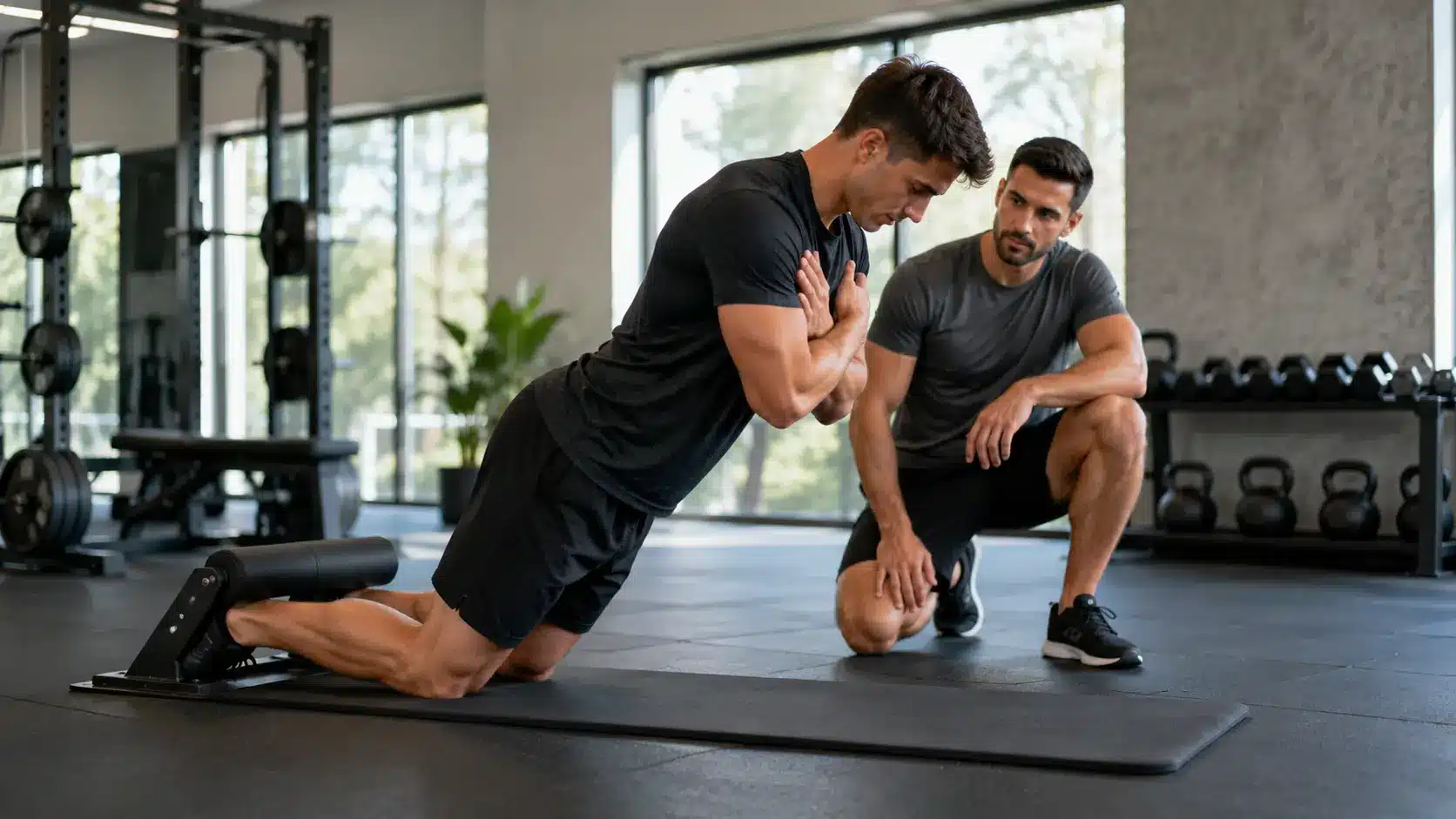
1. Nordic Hamstring Curl
Nordic hamstring curls are among the strongest bodyweight exercises for training the hamstrings through a slow lengthening phase. The movement looks simple, but it demands serious control from the back of the thighs.
By lowering forward from the knees, the hamstrings resist your body weight and learn to manage force during sprinting, running, landing, and sudden stops without relying on speed or momentum.
Steps to do it properly:
- Begin kneeling on a soft mat, with ankles anchored firmly under a stable object.
- Keep shoulders, hips, and knees aligned so your body forms one straight line.
- Brace your core gently, keeping ribs down and lower back relaxed throughout.
- Slowly lower your body forward, letting the hamstrings control the full descent.
- Keep your hips open, avoiding any bend or collapse through the waist.
- Catch yourself with your hands once your hamstrings can no longer control lowering.
- Push lightly through your hands and return to the starting kneeling position.
- Repeat for 2 to 3 sets of 3 to 6 slow reps.
Modification: Use a resistance band around your chest or hips for support. Lower only halfway first, then increase depth once control feels steady and pain-free.
2. Assisted Nordic Hamstring Curl
Supported Nordic curls give the same basic training effect as the full version, but with less strain and more room to learn. This makes them a smart starting point when regular Nordic curls feel too hard or shaky.
Using the hands, a band, or a shorter range helps the hamstrings control the descent without letting the body drop quickly toward the floor.
Steps to do it properly:
- Kneel on a soft mat, keeping your ankles secured under a stable anchor.
- Keep your hips extended, chest lifted, and core lightly braced before lowering.
- Place your hands slightly forward, ready to support your body when needed.
- Lower your body forward slowly, keeping the movement smooth and controlled throughout.
- Use your hands lightly once the hamstrings can no longer control the descent.
- Avoid pushing too hard with your arms, so the hamstrings still work.
- Return to the start by pressing gently through your hands and legs together.
- Repeat for 2 to 3 sets of 4 to 6 controlled reps.
Modification: Start with a very small range of lowering and use your hands early for support. Add more range only when the descent stays slow and controlled.
3. Romanian Deadlift
Loaded Romanian deadlifts train the hamstrings, glutes, and posterior chain through a controlled hip hinge.
The main goal is to lower the weight slowly while keeping the spine neutral and the hips moving back behind the body. This exercise builds hamstring strength in the stretched position, directly useful for lifting, running, and any daily movement that requires reliable hip control.
The same hip-hinge pattern is the foundation of functional strength training across most lower-body programs.
Steps to do it properly:
- Stand tall with feet hip-width apart, holding the weight in front of your thighs.
- Keep your knees softly bent, with your spine long and chest facing forward.
- Push your hips back slowly, letting the weight travel close to your legs.
- Lower for 3 to 5 seconds until your hamstrings feel gently stretched.
- Keep your shoulders pulled back, avoiding any rounding through the upper back.
- Stop the movement before your back rounds or your hips tuck underneath.
- Drive your hips forward and squeeze your glutes to return to standing.
- Repeat for 3 sets of 6 to 10 steady, controlled reps.
Modification: Practice the hip hinge without weight first, using a wall behind your hips as feedback. Add light dumbbells only when your back stays neutral throughout the full range.
4. Single-Leg Romanian Deadlift
Balanced single-leg Romanian deadlifts train one hamstring at a time while challenging balance, hip position, and foot control. This exercise is useful when one side feels weaker or less stable than the other.
The slow lowering phase teaches the standing leg to manage tension while the torso and back leg move together in a controlled, steady pattern.
Steps to do it properly:
- Stand tall on one leg, keeping a soft bend in your standing knee.
- Hold a light dumbbell or place your hands on your hips for control.
- Hinge forward slowly by sending your hips straight back behind your body.
- Let the opposite leg move backward as your torso lowers toward the floor.
- Keep both hips square, avoiding rotation as your body moves through space.
- Lower only until your hamstring stretches and your balance stays controlled.
- Drive through the standing foot and return to the upright starting position.
- Repeat for 2 to 3 sets of 6 to 8 reps per side.
Modification: Hold a wall, chair, or rack with one hand for balance. Use bodyweight first, then add light weight after both hips stay square.
5. Slider Hamstring Curl
Sliding hamstring curls are a strong home-friendly choice because they need only sliders, towels, or paper plates. The exercise trains the hamstrings as the heels move away from the body and the legs extend.
Keeping the hips lifted makes the movement harder, so the hamstrings must control both knee extension and pelvic position without letting the body sag.
Steps to do it properly:
- Lie on your back with your knees bent and your heels on sliders.
- Keep your arms relaxed beside you, with palms pressing lightly into the floor.
- Lift your hips into a bridge, keeping ribs down and glutes active.
- Pull your heels toward your glutes until your knees bend comfortably underneath.
- Slowly slide your legs away, taking 3 to 5 seconds to extend.
- Keep your hips lifted, avoiding any drop through the pelvis or lower back.
- Lower your hips only after completing the full controlled outward slide.
- Repeat for 2 to 3 sets of 6 to 10 controlled reps.
Modification: Start with eccentric-only reps by pulling heels in with hips down, then lifting hips and slowly sliding legs out with control and steady breathing.
6. Stability Ball Hamstring Curl
Unstable ball curls train the hamstrings, glutes, and core together because the body must control the moving surface. The ball adds a balance challenge, so rushing the rep usually causes wobbling or hip drop.
By rolling the ball away slowly, the hamstrings remain active during the lengthening phase, while the core helps keep the pelvis stable.
Steps to do it properly:
- Lie on your back with both heels resting on a stable exercise ball.
- Place your arms on the floor, using them lightly for balance and support.
- Lift your hips into a bridge, keeping your body straight and steady.
- Bend your knees and roll the ball toward your glutes with control.
- Slowly roll the ball away until your legs reach a controlled extended position.
- Keep your hips lifted, avoiding sagging through your lower back or pelvis.
- Move slowly through each rep, keeping the ball from wobbling side to side.
- Repeat for 2 to 3 sets of 8 to 12 smooth reps.
Modification: Use a smaller range of motion and keep your hips slightly lower at first. Increase the bridge height once the ball stays steady and controlled.
7. Eccentric Machine Hamstring Curl
Machine-based hamstring curls are useful when you want direct hamstring work without worrying about balance or body position. The machine supports the torso, so attention can stay on the slow lowering phase.
By curling the weight up and lowering it under control, the hamstrings learn to resist force throughout a clear, steady range of motion.
Steps to do it properly:
- Set up on the seated or lying hamstring curl machine with proper alignment.
- Adjust the pad so it rests comfortably just above the back of the ankles.
- Grip the handles lightly and keep your hips steady against the machine pad.
- Curl the weight toward your body without swinging, jerking, or lifting your hips.
- Lower the weight slowly for 3 to 5 seconds with full control.
- Avoid letting the weight stack drop, bounce, or pull your legs quickly.
- Keep your breathing steady and maintain tension until each rep is complete.
- Repeat for 3 sets of 8 to 12 controlled, pain-free reps.
Modification: Curl the weight with both legs and lower with one leg only if control stays smooth. Otherwise, reduce weight and use both legs.
8. Band Eccentric Hamstring Curl
Banded hamstring curls are joint-friendly, easy to adjust for different strength levels, and accessible at home. They work well as a starting point before machine work, or as a lighter accessory volume at the end of a session.
The key focus is not the curl itself but the slow return to the start position, where the hamstring resists the band and controls the leg as it straightens.
Selecting the right rep ranges for strength versus endurance goals will determine whether to keep these in the 10-15 range or drop to 6-8 with a heavier band.
Steps to do it properly:
- Anchor a resistance band low behind you using a secure, stable point.
- Loop the band around one ankle, making sure it sits comfortably and safely.
- Lie face down or stand while holding a sturdy surface for balance.
- Bend your knee and curl your heel toward your glutes with control.
- Pause briefly at the top, keeping your hips still and core steady.
- Slowly straighten your leg back, resisting the band during the return phase.
- Keep the movement smooth, without snapping the leg back into the starting position.
- Repeat for 2 to 3 sets of 10 to 15 reps per leg.
Modification: Use a lighter band or move closer to the anchor point. Keep the return phase slow, even if the range needs to stay short.
9. Glute-Ham Raise
Glute-ham raises train the hamstrings, glutes, and lower back as one connected posterior chain. This makes them more demanding than isolated curl variations and more specific to athletic movement patterns.
The exercise is performed on a glute-ham developer, where the feet stay anchored and the body lowers forward.
The hamstrings must control both knee and hip positions, creating strong tension through the entire back body. Stronger glutes from exercises like these also directly support hip stability, the same quality developed through glute med training for hip balance.
Steps to do it properly:
- Set up on a glute-ham developer, securing your feet firmly under pads.
- Position your knees on the pad, keeping your torso tall and aligned.
- Brace your core lightly and squeeze your glutes before starting the movement.
- Lower your body forward slowly, letting the hamstrings resist the motion.
- Keep your spine neutral and avoid collapsing through your chest or hips.
- Stop lowering before the control breaks, or your body will drop too quickly forward.
- Pull yourself back up using your hamstrings and glutes with controlled effort.
- Repeat for 2 to 3 sets of 4 to 8 strong reps.
Modification: Use your hands to assist at the bottom or shorten the lowering range. Build control gradually before trying full reps without support.
10. Razor Curl
Razor curls are a tough bodyweight hamstring exercise that mixes knee bending with a fixed hip position. They create strong tension in the hamstrings, so they suit people who already have good control during easier movements.
The slight hip bend changes the feel of the exercise, making the lowering phase deep, focused, and challenging.
Steps to do it properly:
- Kneel on a soft mat with your ankles anchored under a stable setup.
- Keep your hips slightly bent rather than locking your body completely straight.
- Brace your core and keep your torso controlled before starting the descent.
- Lower your body forward slowly, maintaining the same hip angle throughout movement.
- Resist the forward drop by keeping strong tension through both hamstrings.
- Use your hands or a band once control becomes difficult near the bottom.
- Return carefully to the start without rushing or losing your body position.
- Repeat for 2 sets of 3 to 6 slow, controlled reps.
Modification: Use a resistance band or keep the range very small at first. Focus on maintaining the hip angle rather than lowering too deeply too soon.
11. Eccentric Good Morning
Controlled good mornings train the hamstrings and glutes through a hip-hinge pattern while asking the spine to stay steady. This move is best for people who already understand how to hinge without rounding the back.
The slow lowering phase increases hamstring tension, but the weight should stay light enough to keep posture clean throughout every rep.
Steps to do it properly:
- Stand with feet hip-width apart, keeping your weight balanced through both feet.
- Place a light barbell across the upper back, or keep hands behind the head.
- Keep your knees slightly bent, core braced, and spine long before hinging.
- Push your hips back slowly as your torso lowers toward the floor.
- Lower only until your hamstrings stretch and your back position stays strong.
- Keep your neck neutral, avoiding looking too far upward or downward.
- Drive hips forward to stand tall, keeping the movement smooth and controlled.
- Repeat for 2 to 3 sets of 6 to 10 steady reps.
Modification: Start with bodyweight good mornings or a light dowel across your back. Add weight only when the hinge pattern feels smooth and stable.
Choose one or two movements first, keep the lowering phase slow, and let control guide the next step. Stronger hamstrings come from patient practice over time.
Weekly Eccentric Hamstring Routine
Use this weekly plan to train hamstrings without overloading them. Keep the lowering phase slow, rest well, and stop if any sharp pain appears.
| Day | Focus | Exercises | Sets and Reps | Notes |
|---|---|---|---|---|
| Monday | Strength and control | Romanian Deadlift, Slider Hamstring Curl | 3 sets of 8 reps, 2 sets of 8 reps | Lower each rep for 3 to 5 seconds, keeping the movement smooth. |
| Tuesday | Recovery | Light walking, gentle mobility | 15 to 25 minutes | Keep it easy. Avoid deep stretching if the hamstrings feel very sore. |
| Wednesday | Single-leg stability | Single-Leg Romanian Deadlift, Band Eccentric Hamstring Curl | 2 sets of 6 reps per side, 2 sets of 12 reps per leg | Use support for balance and focus on clean hip control. |
| Thursday | Rest | No direct hamstring training | Full rest or easy movement | Let the hamstrings recover before the next strength session. |
| Friday | Eccentric control | Assisted Nordic Hamstring Curl, Stability Ball Hamstring Curl | 2 sets of 4 to 6 reps, 2 sets of 8 to 10 reps | Use a short range if control breaks during the lowering phase. |
| Saturday | Light movement | Easy cycling, walking, or mobility | 20 to 30 minutes | Keep effort low and avoid sprinting or heavy leg work. |
| Sunday | Full rest | Recovery day | No planned training | Check soreness, tightness, and control before starting the next week. |
This routine provides enough practice without causing daily hamstring strain. Progress by adding control first, then range, reps, or load when recovery feels normal.
Who Should Avoid Eccentric Hamstring Exercises?

Eccentric hamstring exercises are helpful, but they can be too intense for some people. If pain, poor control, or recent injury is present, start with caution.
- People with recent hamstring injury signs: Avoid these exercises if there is a fresh strain, tear, bruising, swelling, or sharp hamstring pain.
- Anyone recovering from surgery or major injury– lower-body surgery, serious muscle injury, or ongoing rehab should be cleared by a healthcare professional first.
- People with severe lower back pain: Romanian deadlifts, good mornings, and hinge-based moves may worsen symptoms if the back cannot stay stable.
- Anyone who cannot control the lowering phase: If the body drops quickly, shakes heavily, or loses form, easier variations are needed first.
- People with balance or mobility limits: Single-leg exercises and advanced movements may increase fall risk without support or supervision.
- Beginners returning after a long break: Advanced options like Nordic curls, razor curls, and glute-ham raises may be too demanding at first.
Most people do not need to avoid them forever. Assisted versions, shorter ranges, and lighter resistance can make training safer.
Common Mistakes Beginners Make and How to Fix Them
Even simple hamstring exercises can go wrong when control is rushed. These beginner mistakes show what to watch for before form, recovery, or progress suffers.
| Common Mistake | Why It Happens | How to Fix It |
|---|---|---|
| Lowering too fast or chasing full range | The exercise is too hard, or the focus shifts toward depth rather than control. | Lower for 3 to 5 seconds and stay in a range you can control. |
| Starting with advanced moves or heavy weights | Nordic curls, razor curls, and heavy hinges can quickly overload beginners. | Start with band curls, sliders, assisted variations, or light Romanian deadlifts. |
| Skipping warm-up and recovery | Cold muscles feel stiff, and hamstrings need time after eccentric loading. | Warm up for 5 to 10 minutes and leave 48 hours before hard hamstring work. |
| Losing spine or hip position | The core, glutes, or hamstrings are not controlling the movement well. | Brace lightly, keep the spine neutral, and stop the set when form breaks. |
| Training through pain | Pain is ignored or mistaken for normal exercise effort. | Stop immediately and switch to a pain-free option or seek professional advice. |
| Adding volume too quickly | Too many sets, reps, or harder variations cause excessive soreness. | Increase only one thing at a time: reps, range, load, or difficulty. |
Fixing these mistakes early makes eccentric hamstring work safer and more useful. Once control improves, harder exercises and better results become much easier.
Tips for Eccentric Hamstring Training
Eccentric hamstring exercises deliver the best results when training stays consistent and intentional. These tips focus on improving exercise quality, tracking progress, and getting more value from each session.
- Train while fresh and focused: Place eccentric hamstring exercises early in your workout when energy, concentration, and movement quality are at their highest.
- Monitor technique regularly: Use a mirror or record a few reps to spot hip shifts, balance issues, posture changes, or other movement compensations.
- Track tempo and progress: Count the lowering phase consistently and keep a training log to monitor improvements in control, strength, and exercise difficulty.
- Improve lower-body stability: Maintain even foot pressure during standing exercises and strengthen the glutes to support better hip mechanics.
- Address side-to-side differences: If one leg feels weaker or less controlled, focus on improving symmetry before progressing to harder variations.
- Plan recovery around training demands: Schedule intense hamstring sessions away from races, games, or sprint workouts, and stay hydrated to support performance.
- Keep training varied, and finish with light movement: rotate exercise variations every few weeks, and use easy walking or cycling after workouts to reduce stiffness.
Consistent attention to technique, recovery, and progression often produces better long-term results than constantly increasing exercise difficulty or training volume.
Frequently Asked Questions
Can eccentric hamstring exercises improve flexibility?
Yes, eccentric hamstring training may improve active flexibility because the muscle learns to control tension in a longer position. This differs from passive stretching because the hamstring stays engaged throughout the range. Progress should stay gradual to avoid excessive soreness or strain, particularly in the first two to three weeks.
Why do hamstrings cramp during eccentric exercises?
Cramping typically happens when the hamstrings fatigue, lose control, or are being asked to work harder than they are ready for. Reduce the range of motion, lower the rep count, and rest longer between sets. Warm-up quality and hydration both affect cramping frequency, particularly during the first few sessions.
Should eccentric hamstring exercises feel harder than regular curls?
Yes. Eccentric movements often feel harder because the muscle controls the lengthening phase rather than simply shortening. This creates more mechanical tension and requires more neuromuscular focus. The exercise should feel challenging throughout the lowering phase but not sharp, sudden, or painful at any point.
Can older adults do eccentric hamstring training?
Older adults can perform eccentric hamstring exercises safely if movement control, balance, and joint comfort are adequate. Seated machine curls and band-based options are generally safer starting points than Nordic curls or glute-ham raises. Anyone with a history of injury, pain, or limited mobility should seek medical guidance before beginning.
What should be done if soreness lasts more than three days?
Soreness lasting more than three days is a sign to reduce training volume, range of motion, or intensity in the next session. Use light movement rather than a hard workout. Persistent pain, bruising, or unexpected weakness in the affected leg should be evaluated by a healthcare provider.
How often should eccentric hamstring exercises be done each week?
Two to three sessions per week with 48 hours between each is generally enough to build strength without accumulating excessive fatigue. Beginners often do well starting with two sessions, while more trained individuals can handle three. Quality and recovery matter more than session frequency at this type of training intensity.
Final Thoughts
Strong hamstrings are built through steady control, not rushed reps. I would start with simple movements, keep the lowering phase slow, and let form decide when to progress. You learned what eccentric training means, why it matters, which exercises to use, how to adjust them, and what mistakes to avoid.
You also saw how a weekly routine can make the work easier to follow without overloading the legs. Eccentric hamstring exercises help you build strength where the muscle often needs it most, during lengthening and slowing down.
That can support running, lifting, landing, and daily movement. Try one tip this week, then share your experience in the comments or read a related training blog.