| Medical Clearance Required: Always consult your doctor or physical therapist before beginning any exercise program during injury recovery. If you are experiencing sharp Achilles pain, sudden weakness, significant swelling, or any difficulty walking normally, stop and seek professional assessment before attempting these exercises. |
| Exercise Type | Strength / Rehabilitation |
| Muscles Targeted | Gastrocnemius, soleus, Achilles tendon |
| Difficulty | Beginner to Intermediate |
| Equipment | Step or flat floor; optional dumbbell or weighted backpack |
| Best For | Achilles tendinopathy, calf weakness, lower-leg injury recovery |
| Avoid If | Suspected Achilles rupture, recent tendon surgery (without clearance), severe swelling or bruising |
When I first started working with clients dealing with Achilles tendinopathy, the recurring frustration was this: they would rest, feel better, return to activity, and flare up again within days.
The missing piece was almost always controlled tendon loading. Eccentric calf exercises are the most-researched intervention for rebuilding load tolerance, and when performed correctly, they can help the Achilles tendon become genuinely resilient rather than just pain-free for a few weeks.
This guide covers what eccentric calf exercises actually do to the tendon, the nine movements I use with clients from early recovery through return to sport, the Alfredson heel drop protocol and how to track your response to it, and the mistakes I see people make that quietly stall their progress.
If you are dealing with stiffness after your first few steps in the morning or pain that builds during a run, this is where the rehabilitation needs to start.
What Are Eccentric Calf Exercises?
Eccentric calf exercises focus on the lowering phase of a calf raise. Instead of pushing up as the main effort, you slowly control the heel as it drops toward or below the ground.
This controlled lowering loads the calf muscles while they lengthen, creating tension through the Achilles tendon. Over time, that tension can help the tendon adapt and become more tolerant of load.
A straight-knee version mainly targets the gastrocnemius, the larger calf muscle behind the knee. A bent-knee version shifts more work to the soleus, the deeper calf muscle.
Since both connect into the Achilles tendon, training both positions gives better support. Research on eccentric loading for Achilles tendinopathy has grown since Alfredson’s 1998 heel drop study.
A 2023 systematic review and meta-analysis published in BMC Sports Science, Medicine and Rehabilitation found that eccentric exercise produced greater improvements in pain and function for midportion Achilles tendinopathy compared to other exercise modalities.
That is not a small distinction at DR 14 in the competitive rehabilitation space: the tendon responds specifically to this type of load in a way that passive rest simply cannot replicate.
How Eccentric Loading Actually Helps the Achilles Tendon

The Achilles tendon is made primarily of collagen fibers arranged in a parallel structure that allows it to store and release energy during walking, running, and jumping. When tendinopathy develops, that collagen organization becomes disrupted, tendon cells become reactive, and the tissue loses some of its capacity to handle load without pain.
Eccentric loading addresses this directly. The same principle that makes eccentric quad exercises effective for patellar tendon rehabilitation applies here: the slow lowering phase creates tensile force through the tendon at a controlled speed and magnitude, which stimulates tenocytes, the cells responsible for collagen production, to lay down new collagen and remodel the existing disorganized tissue.
Over a 12-week rehabilitation period, this repeated, graded stimulus can improve both the structural quality of the tendon and its capacity to handle the forces of daily and athletic activity without flaring up.
The keyword is graded. Too much load too fast overwhelms the tendon. Too little provides no stimulus for adaptation. The exercises below are ordered from easiest to most demanding for that reason. Start where you can complete the movement with control and acceptable discomfort, and progress only when that threshold has been reliably met.
| Trainer Tip: In my experience, the clients who recover fastest are not the ones who push hardest. They are the ones who track their pain response consistently. Rate your Achilles discomfort on a 0-10 scale before exercise, during the last set, and the morning after. If your morning-after score is higher than it was before you started, reduce the load before the next session. |
Benefits of Eccentric Calf Exercises for Achilles Tendon Health
The benefits of eccentric calf exercises come from the same mechanism: controlled tendon loading during the lengthening phase of movement. Each benefit below connects directly to that physiological process rather than being a generic claim about “strengthening.”
- Improves tendon load tolerance. The Achilles must absorb forces of seven to twelve times bodyweight during running. Eccentric loading progressively raises the threshold at which the tendon triggers a pain response, allowing it to handle more activity before symptoms develop.
- Strengthens the gastrocnemius and soleus. Stronger calf muscles absorb more force before transferring the load to the tendon. This is why addressing both the straight-knee and bent-knee positions matters: one targets each muscle independently.
- Supports tendon collagen remodeling. Repeated mechanical loading over a 12-week protocol encourages the tenocytes to produce organized collagen, which helps restore the tendon’s structural integrity over time.
- Reduces pain and stiffness over time. Multiple clinical trials have documented pain reduction with the Alfredson protocol, typically beginning around weeks 3 to 6 as the tendon adapts to the loading stimulus.
- Enhances ankle stability and neuromuscular control. Single-leg variations challenge proprioception and balance, which tends to deteriorate during lower-leg injuries and must be retrained before returning to sport.
- Assists recovery from overuse injuries. Eccentric work reintroduces load in a structured, graduated way that does not demand the explosive concentric output of running or jumping, making it ideal for mid-rehabilitation use.
- Builds long-term resilience in the calf-Achilles complex. When maintained beyond the initial pain-free period, these exercises reduce the likelihood of future flare-ups by building a reserve of tendon capacity above the threshold that daily activity demands.
The benefits above build on each other. Stronger calf muscles reduce tendon strain. Better collagen organization improves load tolerance. Improved load tolerance widens the gap between what the tendon can handle and what daily life actually asks of it. That gap is what genuine recovery feels like.
Top Eccentric Calf Exercises for Achilles Tendon Strength
These nine movements progress from the lowest-demand double-leg floor option to weighted and decline variations. The right starting point depends on your current symptoms, not your fitness level.
If the first exercise causes more than mild, manageable discomfort during the lowering phase, it is too advanced. Step back rather than push through.
1. Double-Leg Eccentric Calf Lower
This is where most rehabilitation programs should begin. Because both legs share the load, the demand on the affected Achilles is significantly lower than in any single-leg variation.
The focus here is on learning the movement pattern and establishing baseline calf control before progressing.
How to do it:
- Stand upright with feet hip-width apart on a step or flat floor.
- Rise onto both toes as high as comfortable, pausing briefly at the top.
- Slowly lower both heels together over 4 seconds, keeping the movement smooth and controlled.
- Avoid bouncing at the bottom. Return to the start and repeat.
Sets and reps: 10 to 15 reps for 2 to 3 sets. Slow lowering is the priority, not range of depth.
Make it easier: Perform on flat ground rather than a step. Use a chair or wall for balance support if needed.
2. Floor-Based Eccentric Heel Lower
This variation is specifically recommended for insertional Achilles tendinopathy, where pain sits at the attachment point near the heel bone rather than in the mid-tendon.
The flat surface eliminates the heel drop below the step level, which reduces compressive load on the insertion. When I program this for clients with insertional symptoms, I keep them here for the first four to six weeks rather than moving to step-based work prematurely.
How to do it:
- Stand with both feet flat on the floor.
- Rise onto your toes using both legs together.
- Shift your weight slightly toward the affected side.
- Slowly lower the heel back to floor level over 3 to 4 seconds, keeping the movement smooth and pain-free throughout.
- Repeat while maintaining good posture and balance.
Sets and reps: 10 to 15 reps for 2 to 3 sets. Do not rush the lowering phase.
Make it easier: Hold a countertop for support. Reduce the load by distributing weight more evenly between both legs.
3. Seated Eccentric Calf Raise
With the knee bent throughout this movement, the gastrocnemius is largely taken out of the equation, and the soleus becomes the primary working muscle.
The soleus has a higher proportion of slow-twitch fibers than the gastrocnemius, making it the key muscle for endurance activities like prolonged walking and standing. This seated position is also useful on high-symptom days when standing exercises feel too aggravating.
How to do it:
- Sit on a bench with feet flat on the floor.
- Place a weight or resistance across your knees (a light dumbbell works well).
- Lift both heels as high as comfortable, then shift more load onto the affected side.
- Slowly lower the heel back to the floor over 3 to 4 seconds.
- Repeat while keeping the movement controlled.
Sets and reps: 10 to 15 reps for 2 to 3 sets.
Make it easier: Start without added weight. Use only bodyweight until the movement pattern feels reliable.
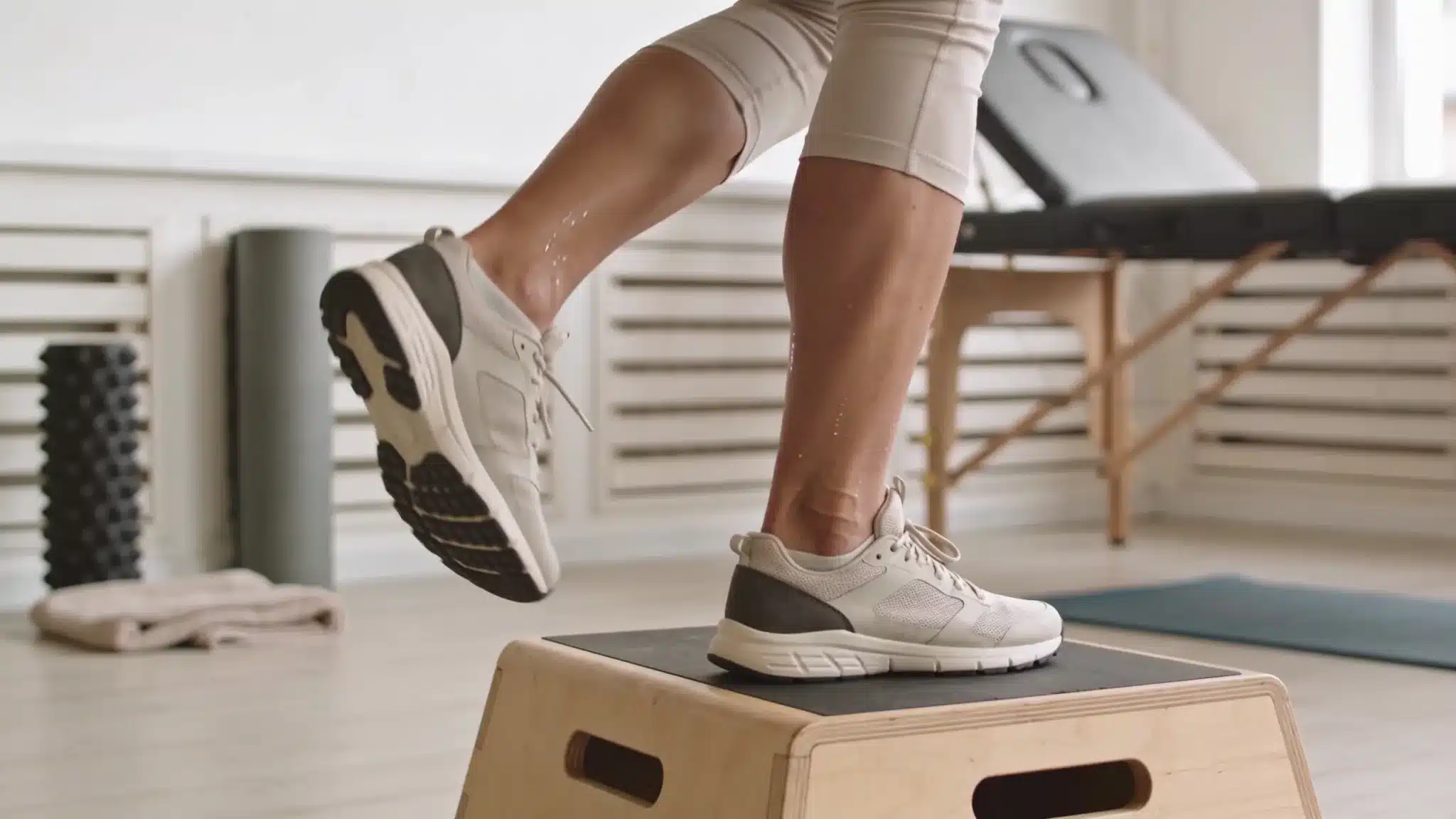
4. Straight-Knee Eccentric Heel Drop
This is the foundational movement of the Alfredson protocol and the most researched single exercise for midportion Achilles tendinopathy.
The straight knee keeps the gastrocnemius under full tension throughout the lowering phase, which creates the specific load this muscle needs to develop the strength that supports the Achilles during running and stair climbing.
How to do it:
- Stand on a step with your heels hanging slightly off the edge.
- Rise onto your toes using both feet.
- Shift your weight onto the affected leg while keeping the knee straight.
- Slowly lower the heel below step level over 4 seconds.
- Use the other foot to return to the top position and repeat.
Sets and reps: 8 to 12 reps for 2 to 3 sets. Lower the heel for a full 3 to 5 seconds each repetition.
Make it easier: Perform on flat ground rather than a step. Use both legs during the lowering phase if single-leg control is not yet reliable.
5. Bent-Knee Eccentric Heel Drop
The bent-knee version is the second movement in the Alfredson protocol. By keeping the knee flexed throughout, the gastrocnemius is shortened, and the soleus becomes the primary load carrier.
Because the soleus supports the ankle during most of the stance phase of walking and running, strengthening it here has direct carryover to the activities most likely to aggravate Achilles symptoms.
How to do it:
- Stand on a step with both feet near the edge.
- Bend the working knee slightly and maintain that bend throughout the entire exercise.
- Rise onto your toes using both feet for support.
- Shift your weight onto the affected leg carefully.
- Slowly lower the heel below the step over 4 seconds, keeping the knee bent.
- Return to the top using both feet and repeat.
Sets and reps: 8 to 12 reps for 2 to 3 sets.
Make it easier: Hold onto a railing for balance. Reduce the lowering depth or move to flat ground if step-based work causes a sharp response.
6. Single-Leg Eccentric Calf Raise
Once double-leg exercises feel comfortable and morning-after stiffness is not increasing between sessions, single-leg loading provides a meaningfully higher training stimulus.
The full bodyweight on one leg roughly doubles the tendon load compared to the split-weight double-leg version. This variation also begins to develop the ankle stability and proprioception that will be essential before returning to running or jumping activities.
How to do it:
- Stand on one foot near the edge of a step.
- Use both feet if needed to rise onto the toes.
- Lift the non-working foot off the step carefully.
- Slowly lower the working heel below step level over 4 to 5 seconds.
- Keep the ankle aligned and avoid letting it roll inward or outward.
- Return to the top and repeat under full control.
Sets and reps: 8 to 10 reps for 2 to 3 sets. Lower for at least 3 to 5 seconds per rep.
Make it easier: Use fingertip support on a wall. Begin with a smaller lowering range before moving to a full heel drop.
7. Eccentric Step-Down Calf Lower
This movement adds a coordination challenge to the standard heel drop by requiring the working leg to control the body through a downward stepping motion.
It is more functional than the straight heel drop because it replicates the mechanics of stair descent and the deceleration demands of changing direction. When I program this for clients preparing to return to sport, it is often the bridge movement between isolated calf work and full activity.
How to do it:
- Stand on a low step with one foot planted.
- Shift your bodyweight onto the working leg carefully.
- Allow the opposite heel to move slowly toward the floor, controlling the descent with the planted calf and ankle.
- Lower slowly while maintaining ankle and knee alignment throughout.
- Pause briefly before returning to the start position.
- Repeat without rushing the movement.
Sets and reps: 8 to 12 reps for 2 to 3 sets at a slow, steady tempo.
Make it easier: Use a lower step. Hold a railing and perform a smaller range of motion if needed.
8. Weighted Eccentric Heel Drop
Adding external resistance continues to raise the tendon loading stimulus once bodyweight single-leg work feels consistently manageable.
The Alfredson protocol recommends progressing to a weighted backpack once bodyweight reps can be completed without increased next-morning symptoms. Even with added weight, the lowering phase and movement quality must take priority over how much load is used.
How to do it:
- Wear a lightweight backpack or hold a dumbbell safely at your side.
- Stand on a step with your heels near the edge.
- Rise onto your toes using both feet.
- Shift weight onto the working leg carefully.
- Lower the heel slowly below step level over 4 to 5 seconds.
- Return to the top and repeat smoothly.
Sets and reps: 8 to 12 reps for 2 to 3 sets. Increase weight only when current resistance feels fully controlled.
Make it easier: Return to bodyweight if added resistance increases symptoms in the 24 hours after a session.
9. Decline Surface Eccentric Calf Raise
The decline board changes the ankle angle at the start of the lowering phase, placing the calf and Achilles under load through a greater range of dorsiflexion. This creates a higher mechanical demand than standard step-based heel drops and is most appropriate during later rehabilitation stages, typically after 8 to 10 weeks of consistent work on the earlier variations. This is an exercise to earn, not to start with.
How to do it:
- Stand on a decline board with feet shoulder-width apart.
- Rise onto your toes using both feet.
- Transfer weight onto the affected leg gradually.
- Slowly lower the heel while maintaining ankle alignment throughout the full range.
- Keep the movement controlled from top to bottom.
- Return to the start and repeat carefully.
Sets and reps: 8 to 10 reps for 2 to 3 sets, lowering for 4 to 5 seconds.
Make it easier: Start on a very slight decline. Return to standard heel drops if this variation increases symptoms.
The Alfredson Heel Drop Protocol for Achilles Tendon Rehabilitation
The Alfredson protocol is the most widely studied structured program for midportion Achilles tendinopathy. It is built specifically around the two eccentric heel drop variations above, straight-knee for the gastrocnemius and bent-knee for the soleus, performed twice daily for 12 weeks.
The original research by Dr. Håkan Alfredson, published in The American Journal of Sports Medicine in 1998, found that 77% of patients with chronic midportion Achilles tendinopathy were able to return to their previous sport after completing the protocol.
| Component | Detail |
|---|---|
| Exercise type | Eccentric heel drops (straight-knee and bent-knee) |
| Reps and sets | 3 sets of 15 reps per variation |
| Frequency | Twice daily |
| Duration | 12 weeks |
| Progression | Add external weight only when bodyweight feels fully manageable |
| Best suited for | Midportion Achilles tendinopathy |
The protocol requires commitment to twice-daily sessions, which is more volume than most rehabilitation programs. The logic is that the tendon needs a consistent loading stimulus to trigger remodeling, and once-daily work may not be sufficient early in the process. If twice daily is not possible initially, once daily is a reasonable starting point, with the expectation that results may take longer to appear.
Straight-Knee vs. Bent-Knee: Why Both Matter
| Variation | Primary Muscle | Functional Role |
|---|---|---|
| Straight-knee heel drop | Gastrocnemius | Running, jumping, and stair climbing |
| Bent-knee heel drop | Soleus | Walking, prolonged standing, and lower-leg endurance |
Both muscles feed directly into the Achilles tendon. Strengthening only the gastrocnemius leaves the soleus as the weak link, and vice versa. In my own training and in the clients I’ve programmed for, skipping the bent-knee version is one of the most common reasons people plateau during Achilles rehab at weeks 4 to 6.
What to Expect During the 12 Weeks
Weeks 1 to 2: The exercises will likely feel challenging, and the calf may be noticeably sore, particularly after the first few sessions. This is expected as the muscles and tendons adjust to the new loading demand. Mild calf soreness is acceptable; sharp or worsening Achilles pain is not.
Weeks 3 to 6: Control improves, and most people begin to notice better tolerance during daily activities like walking and stair use. Morning stiffness often starts to reduce during this period, though it may not disappear entirely.
Weeks 7 to 10: Bodyweight reps begin to feel more manageable. This is the appropriate window to consider adding light resistance if symptoms have been stable. Avoid jumping ahead to heavy loading even if the tendon feels significantly better.
Weeks 11 to 12: The focus shifts to building confident, smooth movement and preparing for the gradual return to more demanding activities. Walking, stairs, and light jogging should feel notably more comfortable than at the start of the program.
How to Track Pain Response During the Protocol
Using a simple pain scale during and after each session removes the guesswork from progression decisions. These are the thresholds I use with clients.
- During exercise: Discomfort should feel mild to moderate, 3 to 5 out of 10. Sharp, sudden pain above a 5 is a signal to stop the session.
- Immediately after: Symptoms should settle within 20 to 30 minutes. If they are building rather than reducing, the session was too intense.
- The next morning: Stiffness should not be meaningfully worse than it was before the previous session.
- Weekly trend: Over 4-week blocks, either pain should be reducing, function should be improving, or both. Flat or worsening response over 4 weeks warrants a clinical reassessment.
- If symptoms increase: Reduce reps, range of motion, speed, or added weight before reducing frequency. The stimulus still matters; the magnitude needs to decrease.
| Caution: The Alfredson protocol is designed for midportion Achilles tendinopathy, where pain sits 2 to 6 cm above the heel bone. If your pain is located right at the heel attachment, deep heel drops can increase compressive load on the tendon insertion and may aggravate symptoms. Use the floor-based eccentric heel lower instead, and get clinical guidance before progressing to step-based work. |
Progression Criteria: When to Advance to the Next Exercise
One of the most common mistakes I see in Achilles rehabilitation is advancing too quickly based on how the tendon feels during the session rather than how it responds over 24 to 48 hours.
Tendons have a delayed response to loading. You can feel fine during a workout and wake up significantly stiffer the next morning. The criteria below are based on 24-hour response, not in-session comfort.
Move to the next variation only when all three conditions are met consistently across three or more consecutive sessions:
- Pain during the lowering phase stays at or below 4 out of 10.
- Morning-after stiffness is not increasing from session to session.
- You can complete the full prescribed reps and sets with controlled speed on every repetition.
If you meet the criteria on one session but not the next, reset the clock. Three consistent sessions, not one good session, is the progression threshold. This patience is what separates clients who reach full rehabilitation from those who cycle repeatedly through flare-up and rest.
Supporting Strategies to Maximize Results

Eccentric calf exercises do the heavy lifting in Achilles tendon rehabilitation, but the habits around them determine how smoothly the tendon adapts. These strategies are not optional extras; they directly affect how much load the Achilles carries between sessions.
Stretching: Use dynamic ankle circles and light calf mobilization before exercise to warm up the tissue. Static calf stretches should be saved for after training. Deep static stretching before an already-irritated tendon can increase its sensitivity in the short term.
Foam rolling: Rolling the calf muscles slowly helps reduce tissue tightness and improve comfort. Avoid pressing directly onto a painful section of the Achilles tendon itself, as the tendon does not respond well to compression when it is reactive.
Footwear: Wear supportive shoes throughout the rehabilitation period, not just during exercise. A temporary heel lift inside the shoe can reduce Achilles strain during walking by slightly reducing the range of ankle dorsiflexion the tendon must absorb. This is a short-term management tool, not a long-term fix.
Load management outside exercise: Hill walking, stair frequency, standing time, and running volume all load the Achilles between sessions. These need to be managed alongside your rehabilitation exercises, not treated as separate. A session that goes well can still result in a flare-up if you walk five kilometers on the same day.
Nutrition: Protein intake supports tissue repair throughout rehabilitation. Emerging research also suggests that collagen supplementation combined with vitamin C, taken 30 to 60 minutes before loading exercise, may enhance tendon collagen synthesis. This is a supplement to the program, not a replacement for it.
| Note: Supporting strategies work best when paired with consistent eccentric loading. Footwear, foam rolling, and nutrition can reduce the tendon’s baseline irritability, but they do not provide the mechanical stimulus the tendon needs to remodel. The exercises are non-negotiable; everything else supports them. |
Who Should and Should Not Try Eccentric Calf Exercises
These exercises are well-suited for a specific rehabilitation population. They are not appropriate for every Achilles or lower-leg problem. The table below covers the clearest cases in each direction.
| Who Should Try | Who Should Not Try |
|---|---|
| People with midportion Achilles tendinopathy and mild to moderate stiffness after rest. | Anyone with a suspected Achilles rupture, a snapping sensation during activity, or sudden severe pain. |
| Runners or active adults with recurring Achilles tightness that builds during or after activity. | People with major swelling, bruising, or difficulty walking with a normal gait pattern. |
| Athletes returning to training after being cleared for rehabilitation exercises by a clinician. | Anyone with sharp pain during each repetition that does not stay within a manageable range. |
| People with calf weakness that becomes noticeable during walking, climbing stairs, running, or jumping. | Those recovering from recent Achilles surgery without explicit clearance from their surgeon or physiotherapist. |
| Individuals following a structured tendon-strengthening or rehabilitation plan with clinical oversight. | People with open wounds, active infection, severe inflammation, or significant balance impairment. |
When symptoms are severe or the injury mechanism is unclear, a clinical assessment before starting these exercises is the right first step. Conditions like a high ankle sprain require a different rehabilitation approach entirely before any calf loading is appropriate.
Eccentric calf exercises are a powerful rehabilitation tool, but they work within a defined set of conditions. Outside those conditions, they need to be modified or replaced.
Common Mistakes That Slow Achilles Recovery
These are the errors I see most consistently in the clinic and in training programs. They are rarely dramatic mistakes. Most are small habits that add up to stalled progress.
- Training on a Cold Tendon: Starting eccentric heel drops without warming up can increase stiffness. Do 3 to 5 minutes of gentle walking or ankle circles first.
- Changing Footwear Often: Switching between flat shoes, cushioned trainers, and worn-out footwear changes Achilles load. Keep footwear consistent during rehab.
- Skipping Recovery Days: Tendons adapt during rest, not during exercise. Daily intense calf work can cause symptoms to build over time.
- Ignoring Daily Load: Walking, stairs, and long standing also stress the Achilles. Factor them into your total rehab load, especially early on.
- Letting the Ankle Roll: Pronation or supination during lowering shifts stress unevenly. Keep your heel, ankle, and second toe aligned.
- Stopping Too Early: Pain often improves before the tendon is fully rebuilt. Complete the full 12-week program to reduce re-injury risk.
The Role of Hip and Glute Strength in Achilles Recovery
This is a section that most Achilles rehabilitation guides omit entirely, and it is worth addressing directly. Weak glutes and hip abductors change the mechanics of how force travels through the lower limb during every walking and running stride.
When the hip fails to stabilize the pelvis effectively, the knee often drops inward, the foot pronates, and more of the ground reaction force is absorbed by the calf and Achilles rather than distributed across the entire kinetic chain.
In clinical practice, addressing hip strength alongside eccentric calf work consistently produces better outcomes than calf work alone for athletes returning to running. This does not require complex programming.
Adding three sets of clamshells, glute med exercises, or hip abduction work two to three times per week during the Achilles rehabilitation period is often enough to meaningfully reduce the stress the tendon is absorbing during daily movement.
If you have access to a physiotherapist or strength and conditioning specialist, ask for a hip strength screen alongside your Achilles assessment. The two are not as separate as most rehabilitation plans treat them.
| Trainer Tip: When I program eccentric calf exercises for clients, I pair them with 2 to 3 sets of single-leg glute bridges on the same day. The bridge does not load the Achilles directly, but it starts addressing the hip stability deficits that often contributed to the tendinopathy in the first place. |
Frequently Asked Questions
How long do eccentric calf exercises take to work for Achilles tendinopathy?
Most people begin to notice meaningful improvement in daily pain and stiffness between weeks 3 and 6 of a consistent twice-daily program. Full tendon adaptation and reliable return to sport-level activity typically requires the complete 12-week Alfredson protocol. Improvements in pain during daily walking often come faster than improvements in tolerance for running-level loads, which can take up to 16 to 20 weeks in more chronic cases.
Should I do eccentric calf exercises if my Achilles is still painful?
Mild to moderate pain during eccentric heel drops, up to about 4 or 5 out of 10, is acceptable and expected during tendinopathy rehabilitation. The key question is what happens to that pain over the 24 hours after the session. If symptoms settle back to their baseline level by the next morning, the load was appropriate. If morning stiffness is noticeably worse, reduce the load before the next session. Sharp pain above a 5 during the exercise itself, or rapidly worsening symptoms across multiple sessions, are signals to seek clinical input.
Can I run while doing the Alfredson protocol?
In most cases, yes, with modifications. The original Alfredson research allowed patients to continue their sporting activities during the 12-week protocol, provided they could manage the overall tendon load. Running volume, hills, and speed work should typically be reduced while symptoms are active. A structured run-walk program that gradually reintroduces running load alongside the heel drop protocol is often more effective than complete running cessation, which tends to lead to sudden increases in tendon load when athletes return. If you are non-weight-bearing due to injury severity, a crutches workout program can help maintain fitness while the Achilles is protected.
Are eccentric calf exercises effective for insertional Achilles tendinopathy?
Standard step-based eccentric heel drops that take the heel below the level of the step can increase compressive load on the Achilles tendon insertion, which often aggravates insertional tendinopathy rather than helping it. For insertional symptoms, the floor-based eccentric heel lower is a safer starting point. Some evidence supports isometric calf holds, where the heel is held in a raised position for 30 to 45 seconds, as a lower-irritation alternative for insertional cases. Clinical guidance is particularly important for insertional tendinopathy because the management differs meaningfully from midportion presentations.
How many sets and reps of eccentric heel drops should I do each day?
The Alfredson protocol specifies 3 sets of 15 repetitions for both the straight-knee and bent-knee variations, performed twice daily. That is 6 total sets per session, 12 per day. For people beginning rehabilitation or dealing with higher baseline symptoms, starting at 2 sets of 8 to 10 reps once daily and building gradually over the first two to three weeks is a reasonable approach. The program only produces its full benefit when adherence is consistent over the full 12 weeks.
Why does my calf feel sore but my Achilles feels better after eccentric exercises?
Calf muscle soreness after eccentric heel drops is a normal and expected response, particularly in the first two to three weeks of a new program. Eccentric contractions create more microtrauma in the muscle fiber than concentric work, which is part of what drives the strength adaptation. Whether soreness signals muscle growth depends largely on where it is felt: as long as the soreness is in the belly of the calf muscle rather than at or around the Achilles tendon itself, and it settles within 48 hours, this is a sign the program is working as intended. If you are noticing less tendon sensitivity alongside the calf soreness, that pattern typically indicates positive tendon adaptation.
Does eccentric training for the Achilles help peroneal tendon pain?
Eccentric calf exercises target the Achilles tendon and the gastrocnemius-soleus complex primarily, so they do not directly rehabilitate the peroneal tendons, which run along the outer ankle. However, if calf weakness is contributing to poor ankle mechanics that are loading the peroneals unevenly, improving calf strength through eccentric training may reduce secondary peroneal stress. For direct peroneal tendon rehabilitation, specific eversion strengthening and proprioception work are more appropriate primary interventions.
Final Verdict: Are Eccentric Calf Exercises Worth the Commitment?
The evidence for eccentric calf exercises in Achilles tendinopathy rehabilitation is stronger than for almost any other conservative intervention available. The Alfredson protocol has decades of clinical research behind it, and the physiological rationale for why controlled eccentric loading drives tendon adaptation is well-established. That said, these exercises only work if you follow the 12-week program consistently, use the correct variation for your presentation (floor-based for insertional, step-based for midportion), and respect the 24-hour pain response rule rather than pushing through sharp or worsening symptoms. Start with the double-leg calf lower if you are in early rehabilitation, or move to the straight-knee and bent-knee heel drops once you can tolerate single-leg loading without a next-morning flare-up. The single most important thing you can do today is track your morning-after stiffness before your first session so you have a real baseline to compare your progress against.
Sources
Alfredson H, Pietilä T, Jonsson P, Lorentzon R. “Heavy-load eccentric calf muscle training for the treatment of chronic Achilles tendinosis.” The American Journal of Sports Medicine. 1998. https://pubmed.ncbi.nlm.nih.gov/9617396/
Prudêncio DA, Maffulli N, et al. “Eccentric exercise is more effective than other exercises in the treatment of mid-portion Achilles tendinopathy: systematic review and meta-analysis.” BMC Sports Science, Medicine and Rehabilitation. 2023. https://www.ncbi.nlm.nih.gov/pmc/articles/PMC9878810/
Malliaras P. “Physiotherapy management of Achilles tendinopathy.” Journal of Physiotherapy. 2022. https://pmc.ncbi.nlm.nih.gov/articles/PMC1724744/
Pringels L, et al. “Loading Speed and Intensity in Eccentric Calf Training Impact Acute Changes in Achilles Tendon Thickness and Stiffness.” Medicine and Science in Sports and Exercise. 2025.