
| Exercise Type | Strength, Mobility, Core Conditioning |
| Muscles Targeted | Rectus abdominis, transverse abdominis, gluteus maximus, hamstrings, quadriceps, deltoids, pectorals, gastrocnemius |
| Difficulty | Beginner |
| Equipment | Bodyweight only, wall, optional mat |
| Best For | Core strength, posture correction, low-impact home training |
| Avoid If | Acute back injury, recent surgery, active pregnancy without medical clearance |
Wall Pilates for beginners is one of the most underrated entry points into strength training I’ve seen in eight years of working with clients who want to build core control without jumping straight into gym equipment.
The wall does something no mat can replicate: it gives you instant biofeedback on where your spine, hips, and shoulders actually are, not where you think they are.
That feedback is exactly what beginners need.
When I program wall-based Pilates for new clients, I consistently see faster progress in spinal alignment and deep core activation compared to mat-only protocols during the first four weeks.
The wall removes the guesswork from body position and lets the muscles do their job.
In this guide, you will find what wall Pilates actually targets at a muscular level, 10 beginner exercises with precise cues, a 15-minute starter workout, a full 28-day challenge plan, and the progression criteria that tell you when to make moves harder, not just “when it feels easy.”
Disclaimer: This article is for informational and educational purposes only. It does not constitute medical advice. Always consult a qualified healthcare provider before starting a new exercise program, particularly if you are managing a health condition, recovering from injury, or pregnant.
What Is Wall Pilates and How Does It Work?
Wall Pilates is a form of Pilates training that uses a fixed wall surface to add stability, proprioceptive feedback, and controlled resistance to traditional Pilates movements.
Unlike mat Pilates, where beginners often struggle to locate their neutral spine or maintain hip alignment, the wall provides a physical reference point that keeps the body honest during each rep.
The mechanics work in two directions. In some exercises, wall roll-downs, wall angels, and wall planks, the wall steadies the body so you can learn a movement pattern without fighting for balance.
In others, wall glute bridges, wall leg presses, pressing your feet into the wall creates additional resistance for the glutes and hamstrings, making these moves more demanding than their floor equivalents, despite no extra equipment.
This adjustability is what makes wall Pilates genuinely useful for beginners. Moving closer to the wall reduces difficulty; stepping further back increases it. Changing the height at which your feet press against the wall shifts which muscles are loaded most.
I’ve used this same lever, distance, and foot height to progress clients from near-zero baseline to handling challenging full-body routines across a four-week block.
Wall Pilates vs Regular Pilates: What Beginners Should Know
| Feature | Regular Pilates | Wall Pilates |
|---|---|---|
| Support | Uses body awareness to hold form. | Uses the wall to guide position. |
| Best for | People with more control and experience. | Beginners who need extra support. |
| Common issue | Beginners may strain the lower back or use the wrong muscles. | The wall helps reduce poor form and compensation. |
| Muscle focus | Core work can be harder to feel at first. | Core and stabilizer muscles are easier to target. |
| Beginner benefit | Builds control over time. | Helps you learn proper alignment sooner. |
Once your body learns the correct movement patterns through wall-supported work, transitioning to mat Pilates becomes significantly easier.
If you are weighing up which format fits your goals, the differences between Pilates and yoga are also worth understanding before committing to a program. Think of wall Pilates as building the software before running the program.
Who Should Try Wall Pilates?
Wall Pilates works well for a broad range of people, but it is especially well matched to specific situations I see regularly in practice:
- Beginners with no strength training background who want to start with controlled, low-injury-risk movement, if you are completely new to exercise, reviewing the exercise principles every beginner should know before starting will make the cues in this guide considerably easier to apply
- People returning to exercise after a sedentary period, illness, or mild lower back issues
- Anyone who wants a home-based routine with zero equipment cost
- Individuals seeking low-impact training that spares the knees, hips, and ankles
- Those with poor posture from desk work who need scapular and thoracic spine retraining
Wall Pilates is not appropriate as a standalone program for people managing acute disc herniation, recovering from joint replacement surgery, or experiencing active sciatic nerve pain without clearance from a physical therapist.
If you are pregnant, consult your obstetrician before starting, as some positions may need modification after the first trimester.
The Muscles Wall Pilates Actually Works
One thing I notice when reviewing beginner wall Pilates programs online is that the muscular targets are described vaguely, “core,” “glutes,” “back.” That is not enough information to train intelligently. Here is what you are actually loading:
- Transverse abdominis: The deep core stabilizer that wraps around the spine like a corset. Wall dead bugs and wall planks are the primary transverse abdominis drivers in this program.
- Gluteus maximus and medius: The primary movers in wall bridges and wall squat holds. The medius is also challenged in single-leg variations.
- Hamstrings (biceps femoris, semitendinosus, semimembranosus): Loaded isometrically in wall bridges when feet are placed higher on the wall, increasing the hip extension demand.
- Quadriceps: Primary mover in wall squat holds. The lower the squat, the more the vastus medialis (inner quad) is recruited.
- Gastrocnemius and soleus: Targeted directly in wall calf raises and secondarily in wall sit with heel lifts.
- Pectorals and anterior deltoids: Primary movers in wall push-ups, with load adjusted by body angle relative to the wall.
- Lower trapezius and serratus anterior: The often-neglected scapular stabilizers are challenged significantly in wall angles when done correctly.
| Exercise | Primary Muscles | Secondary Muscles |
| Wall Glute Bridge | Gluteus maximus, hamstrings | Transverse abdominis, lumbar erectors |
| Wall Squat Hold | Quadriceps, gluteus maximus | Core stabilizers, gastrocnemius |
| Wall Plank | Transverse abdominis, rectus abdominis | Serratus anterior, anterior deltoid |
| Wall Dead Bug | Transverse abdominis | Lumbar multifidus, hip flexors |
| Wall Angels | Lower trapezius, serratus anterior | Rhomboids, posterior deltoid |
| Wall Push-Up | Pectoralis major, anterior deltoid | Triceps, core stabilizers |
Understanding which muscles each move targets lets you balance your weekly training, and helps you understand why a given exercise feels harder on one side than the other, which is often a useful signal about muscle imbalances worth addressing.
What You Need Before Starting
The setup requirements for wall Pilates are minimal, which is part of its appeal for home training.
Space: You need a clear wall with at least six feet of floor space in front of it, enough to lie down lengthwise with your legs extended. Move furniture away from the work area. Slippery hardwood floors are worth addressing with a yoga mat or grip socks before you start.
Equipment: No equipment is required for any of the exercises in this program. Optional additions that become worth considering after two to three weeks, once form is established:
- A yoga or Pilates mat reduces floor pressure on the spine during bridge and dead bug work
- Grip socks prevent foot slipping during wall bridges and squat holds
- Light ankle weights (0.5kg to 1kg), useful for wall leg circles once hip stability improves
- A resistance band can be added around the thighs during bridges to increase gluteus medius activation
|
Safety Note: Start every session without weights or bands, regardless of your fitness background. Wall Pilates uses unfamiliar ranges of motion and positioning. Adding load before your body has learned the movement patterns is the most common cause of lower back strain in this type of training. If you experience sharp pain in the lumbar spine during any exercise, stop immediately and consult a healthcare provider before continuing. |
10 Beginner Wall Pilates Exercises With Precise Cues
These exercises form the foundation of the 28-day wall Pilates challenge outlined further below. Learn each one before you start the challenge. The cues below go beyond the basic steps; they tell you what to feel, not just what to do.
1. Wall Roll Down
Best for: Spinal segmentation, hamstring length, thoracic mobility
Wall roll-downs teach you to move your spine one vertebra at a time, a skill that transfers to nearly every other Pilates movement. Most beginners have collapsed through the thoracic spine and stiff lumbar vertebrae, so the roll-down quickly reveals where your spinal mobility is restricted.
How to do it:
- Stand with your back lightly touching the wall, feet hip-width apart, about two inches from the baseboard.
- Keep your knees soft, a 5 to 10 degree bend, not fully locked.
- Inhale to lengthen. On the exhale, tuck your chin toward your sternum and let the weight of your head begin pulling you forward.
- Roll down through the cervical spine, then upper thoracic, mid-thoracic, and finally the lumbar vertebrae. Do not rush this; each section should be separate from the one above it.
- Stop when you feel a stretch in the hamstrings or lower back. Your hands may reach the floor or stop at shin height; both are fine.
- On the next exhale, press the tailbone slightly forward and roll back up from the lumbar spine first, then thoracic, then cervical. Your head is always the last thing to come up.
Reps and sets: 5 to 8 slow reps. This functions as both a warm-up and a practice movement.
| Trainer Tip: If you feel your lower back “dump” forward or your pelvis tips excessively, place a folded towel between your lower back and the wall before starting. This cues your lumbar spine to stay long as you roll. |
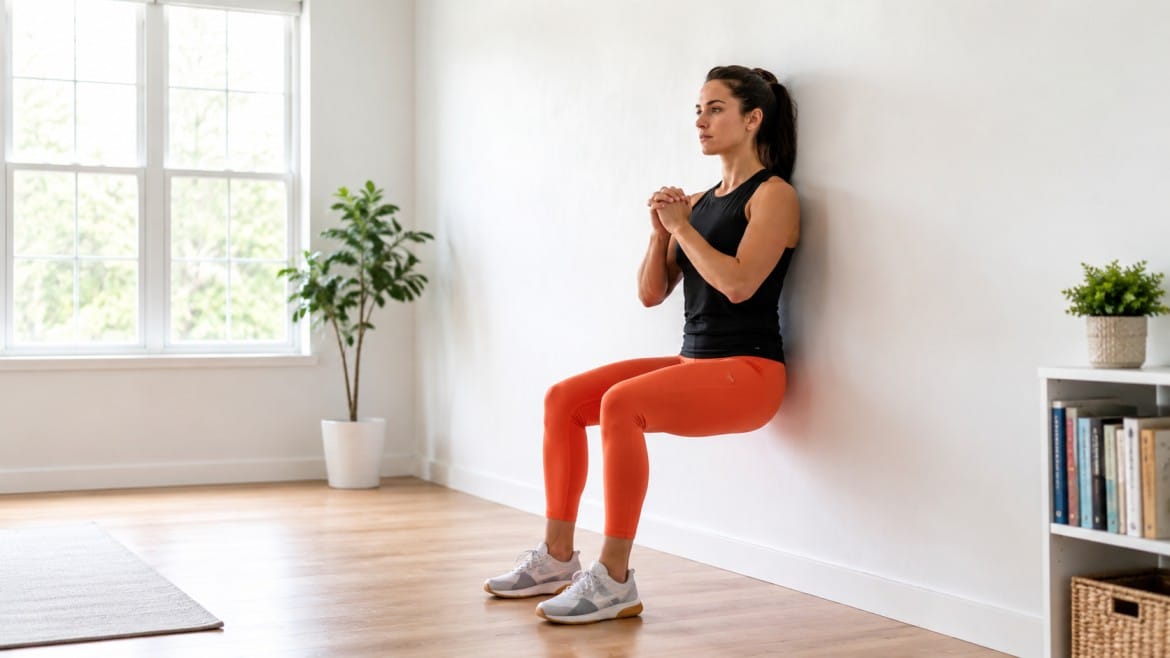
2. Wall Squat Hold
Best for: Quadriceps, gluteus maximus, core isometric endurance
The wall squat hold is an isometric quadriceps exercise that also demands substantial core stability to keep the spine from sliding or arching against the wall. In my experience with beginners, 10 seconds of a properly held wall squat produces more quadriceps activation than 15 rushed bodyweight squats.
How to do it:
- Stand with your back flat against the wall, feet hip-width apart, and step forward about 18 inches from the baseboard.
- Slide your back down the wall until your thighs are between 45 degrees and parallel to the floor. Start at 45 degrees for the first two weeks.
- Your knees should be directly above your ankles, not over your toes. If your knees are moving forward, your feet need to step out further.
- Press your lower back firmly into the wall. You should feel contact from the tailbone to the mid-back.
- Breathe steadily throughout the hold. Exhale on exertion, inhale as you reset.
- Slide back up slowly. Never drop from the hold; the eccentric return is where additional muscle work happens.
Reps and sets: Hold for 10 to 30 seconds. Rest 30 seconds. Repeat 2 to 3 times.
Beginner’s tip: Stay at a shallower angle until 20-second holds feel manageable with good form. Knees caving inward is the signal to reduce depth, not push through.
3. Wall Glute Bridge
Best for: Gluteus maximus, hamstrings, transverse abdominis
Wall glute bridges differ from floor bridges in an important way: placing your feet on the wall shifts the loading toward the hamstring-to-glute connection rather than primarily through the quads.
When I program this for clients with weak posterior chains, placing feet higher on the wall, at a roughly 70-degree angle, increases hamstring recruitment noticeably.
How to do it:
- Lie on your back with your tailbone approximately 12 to 18 inches from the base of the wall.
- Bend your knees and place both feet flat on the wall at a height where your knees form approximately a 90-degree angle.
- Arms rest alongside your body, palms pressing lightly into the floor for stability.
- Inhale. On the exhale, press your feet firmly into the wall and drive your hips upward by squeezing the glutes, not by pushing through the lower back.
- At the top, your body should form a straight line from knees to shoulders. Your ribs stay down, do not let the ribcage flare upward.
- Hold the top position for two seconds, then lower with control over a 3-second count.
Reps and sets: 8 to 12 reps. 1 to 2 sets. Rest 45 seconds between sets.
Beginner’s tip: If you feel this primarily in your lower back rather than your glutes, lower your hips halfway only and focus on the squeeze before progressing to full range.
4. Wall Leg Circles
Best for: Hip joint control, hip flexor mobility, lower core stability
Leg circles challenge the hip joint to move through rotation while the pelvis stays completely still, a combination that most beginners find surprisingly difficult.
The stabilizing leg on the wall is doing active work throughout, which is often overlooked. I cue clients to treat the wall contact leg as “actively pressing,” not just resting.
How to do it:
- Lie on your back with one foot pressed flat against the wall, knee at roughly 90 degrees.
- Extend the other leg upward toward the ceiling, foot flexed.
- Place both hands on your hip bones; you will use them to detect unwanted movement.
- With your core lightly engaged, make small clockwise circles with the extended leg. Keep the circles small enough that your hands feel no hip movement.
- After 8 to 10 circles, reverse direction for another 8 to 10.
- Switch legs and repeat.
Reps and sets: 8 to 10 circles each direction, each leg. 1 set per side.
Beginner’s tip: If your hip rocks or your lower back lifts off the floor, reduce the circle diameter by half. A 6-inch circle done cleanly is far more valuable than an 18-inch circle with compensation.
5. Wall Push-Up
Best for: Pectoralis major, anterior deltoid, triceps, core anti-rotation
Wall push-ups are a precision exercise, not a “beginner’s easy substitute.” Standing closer to the wall uses roughly 10 to 15 percent of your bodyweight as resistance.
Stepping back until your body is at a 45-degree angle shifts that to approximately 40 percent.
The load is fully scalable, which makes this exercise useful across a much wider range of fitness levels than most people assume.
How to do it:
- Stand facing the wall and place your hands at chest height, shoulder-width apart. Fingers spread, middle fingers pointing straight up.
- Step your feet back until you feel your core engage to keep your hips from dropping. Start close enough that this engagement is light.
- Your body should form a straight line from heels to the crown of your head, no hip sag, no raised backside.
- Inhale as you bend the elbows and bring your chest toward the wall, keeping elbows at a 45-degree angle from your torso (not flaring out to 90 degrees).
- Exhale and press back to the start. Do not lock the elbows at the top.
Reps and sets: 8 to 12 reps. 1 to 3 sets. Rest 45 seconds.
Beginner’s tip: Step closer to the wall to make it easier. When you can do 12 reps cleanly with a controlled 3-second lower phase, step back two inches and repeat the progression.
6. Wall Plank
Best for: Transverse abdominis, serratus anterior, scapular stability
The wall plank is the correct entry point before a floor plank for beginners. When a floor plank fails, it usually fails at the lower back, which then builds compensation patterns.
The wall plank lets the transverse abdominis do its job at a manageable load level before you add bodyweight gravity against it.
How to do it:
- Place both hands on the wall at shoulder height, shoulder-width apart.
- Step your feet back until your body is in a straight line and you can feel light core engagement needed to maintain it.
- Push slightly into the wall with your hands; do not just lean. This activates the serratus anterior, which keeps the shoulder blades from winging.
- Keep your head neutral, ears over your shoulders. Do not let the head drop forward or back.
- Breathe steadily. Hold without holding your breath.
- Step forward to release. Do not collapse; lower yourself intentionally.
Reps and sets: Hold for 15 to 30 seconds. Rest 30 seconds. Repeat 2 times.
Beginner’s tip: If the lower back sags or aches during the hold, your feet are too far back. Step them closer until you find the position where the core works, but the back feels neutral.
7. Wall Dead Bug
Best for: Transverse abdominis, lumbar multifidus, anti-extension core control
The wall dead bug is the best deep core exercise I know for beginners because the wall gives a clear, honest check on whether the spine is moving.
If your lower back lifts off the floor as your arm is overhead, and you can feel it, that is the movement too large. Reduce the range. In a floor dead bug without wall foot contact, beginners lose this feedback instantly.
How to do it:
- Lie on your back with both feet pressed flat into the wall, knees at 90 degrees.
- Keep your lower back pressed firmly into the floor; you should be able to slide a hand under your lumbar curve, but not a fist.
- Reach both arms straight toward the ceiling.
- On an exhale, slowly lower one arm overhead toward the floor. Keep the lower back pinned. Stop before the back lifts.
- Inhale, return the arm to vertical. Repeat on the other side.
Reps and sets: 8 to 10 reps each arm. 1 to 2 sets.
Beginner’s tip: Press the non-moving foot harder into the wall when the arm moves. This countertension helps hold the pelvis steady.
8. Wall Calf Raise
Best for: Gastrocnemius, soleus, ankle stability, single-leg balance
Calf strength is frequently undertrained in beginner programs and is directly linked to ankle stability, Achilles tendon health, and shock absorption during walking.
The wall here functions only as a light balance reference, fingertip contact, not a leaning post.
How to do it:
- Stand facing the wall with fingertips resting lightly on the surface at hip height.
- Feet hip-width apart, weight evenly distributed through the balls of both feet.
- On the exhale, slowly rise onto your toes over a 2-second count. Aim for maximum height.
- Pause for one second at the top. Feel the gastrocnemius contract fully.
- Lower your heels slowly over a 3-second count. Do not let the heels drop; that eccentric control builds more strength than the lift itself.
Reps and sets: 10 to 15 reps. 1 to 2 sets.
Beginner’s tip: The eccentric (lowering) phase is where most of the strengthening happens. Do not bounce at the bottom. Pause briefly with heels just above floor level before the next rep.
9. Wall Sit With Heel Lifts
Best for: Quadriceps endurance, gastrocnemius, hip stabilizers
Adding heel lifts to a wall sit targets the calf and simultaneously challenges hip stability as the weight shifts forward.
When I program this for clients, I cue them to maintain even pressure across both feet during the lift; most people shift weight to one side without realizing it.
How to do it:
- Set up in your wall squat position at a comfortable depth, around 45 degrees to start.
- Core engaged, back pressed flat against the wall.
- With the upper body completely still, slowly lift both heels off the floor.
- Pause one second at the top, feeling the calves work while the quadriceps hold the squat.
- Lower the heels with control. Do not drop them.
- Repeat without coming out of the squat between reps.
Reps and sets: 8 to 12 heel lifts. 1 to 2 sets.
Beginner’s tip: If both heels simultaneously feel too unstable, start by alternating one heel at a time. Once balance is steady, move to bilateral lifts.
10. Wall Angels
Best for: Lower trapezius, serratus anterior, thoracic extension, posture correction
Wall angels are the most diagnostic exercise in this entire program. They reveal immediately whether you have the thoracic mobility and scapular control needed for good posture.
In my experience, roughly 80 percent of beginners cannot keep their lower back, upper back, and head touching the wall simultaneously while sliding their arms upward. That limitation is exactly what this exercise is addressing.
How to do it:
- Stand with your back against the wall, feet about 4 to 6 inches from the baseboard.
- Press the back of your head, upper back, and sacrum into the wall. Some people will feel a gap in the lower back, which is normal initially.
- Bend your elbows to 90 degrees at shoulder height, like goalposts. Try to keep the backs of your hands and forearms touching the wall.
- On the exhale, slowly slide your arms upward along the wall, maintaining as many contact points as possible.
- Stop at the point where you must either lose wall contact or arch the lower back. That is your current limit; work from there.
- Inhale and slide arms back down with control.
Reps and sets: 6 to 10 slow reps. 1 to 2 sets.
Beginner’s tip: If the arms cannot stay in contact with the wall past shoulder height, that is diagnostic information, not failure. Work within the available range, and it will improve within two to three weeks of consistent practice.
15-Minute Beginner Wall Pilates Workout
This workout is structured with the same progression logic I use when programming for new clients: mobilize first, load the large muscles next, challenge stability last, then decompress on the way out.
Do not rush the warm-up; the roll-downs specifically prepare the spine for every loaded movement that follows.
Warm-Up: 3 Minutes
- Shoulder rolls: 30 seconds, large and slow
- Wall roll-downs: 5 reps with a 6-second down, 6-second up tempo
- Cat-cow on mat: 6 reps, linking movement to breath
- Gentle marching in place: 60 seconds, lift knees to hip height
Main Workout: 10 Minutes
Move through each exercise with control. If you need more than 30 seconds of rest between sets during the first week, take it; the goal is sustained good form, not minimizing rest time.
| Exercise | Reps or Time | Sets | Rest |
|---|---|---|---|
| Wall Squat Hold | 20 seconds | 2 | 30 sec |
| Wall Glute Bridge | 10 reps | 2 | 30 sec |
| Wall Push-Up | 10 reps | 2 | 30 sec |
| Wall Leg Circles | 8 each way, each leg | 1 | 20 sec |
| Wall Plank | 20 seconds | 2 | 30 sec |
| Wall Dead Bug | 8 reps each arm | 1 | 20 sec |
If any exercise breaks down in form before the rep count is complete, stop the set early. Two clean reps are more useful than 10 compensated ones.
Cool-Down: 2 Minutes
Finish with slow, passive stretching to decompress the muscles loaded during the workout.
- Wall hamstring stretch: Lie near the wall, extend one leg up against it, hold 30 seconds on each side
- Chest stretch: Stand side-on to the wall, extend one arm out flat against it, gently rotate your body away, hold 20 seconds on each side
- Child’s pose: 30 seconds, focusing on breathing into the lower back
- Slow diaphragmatic breathing: 4 breaths in through the nose, 6 out through the mouth
How to Progress the Exercises
One of the most common mistakes beginners make is adding difficulty before the current level is mastered.
Here is the specific criteria I use with clients before advancing each exercise, not “when it feels easy,” but when these specific markers are met:
Progression Criteria by Exercise
- Wall Squat Hold: Progress to 45-degree depth when you can hold 30 seconds at a 45-degree angle for 3 consecutive sets without lower back fatigue. Progress to near-parallel when 30 seconds at 45 degrees is easy for 3 sets.
- Wall Glute Bridge: Progress to placing feet higher on the wall (increasing hamstring demand) when 12 reps at the current foot height are fully controlled with a 3-second lowering phase. Progress to the single-leg variation when both legs feel equally strong.
- Wall Push-Up: Progress by stepping back one shoe-length when 12 reps with a slow (3-second) lowering phase feel manageable for 2 consecutive sessions.
- Wall Plank: Progress to a floor plank when you can hold 45 seconds against the wall with no hip sag and no breath-holding for 2 consecutive sessions.
- Wall Angels: Progress is measured by increased wall contact, when your arms can slide from 90 degrees to overhead while maintaining head, upper back, and lower back contact simultaneously.
Equipment Progressions (Weeks 3 to 4)
Once the above criteria are consistently met, you can add the following without changing the exercises themselves:
- Light ankle weights (0.5kg) during wall leg circles to increase hip flexor demand
- Resistance band around the thighs during wall glute bridges to recruit the gluteus medius. If you want to extend this into a broader core resistance routine, weighted core exercises pair well with wall Pilates once the foundation is solid
- Longer hold times (up to 60 seconds) on wall squat holds and wall planks
- Slower rep tempos, 4 seconds down, 2 seconds up, on bridges and push-ups
What Is the 28-Day Wall Pilates Challenge?

The 28-day wall Pilates challenge is a structured 4-week plan designed to build strength, posture control, and a consistent training habit using only wall-based Pilates exercises.
If you have already completed a structured home program before, such as the 28-day chair yoga challenge, the format here will feel familiar, though the muscular demands shift substantially toward the posterior chain and core stabilizers.
The design follows a progressive overload model: Week 1 builds movement competency, Week 2 adds volume, Week 3 extends hold times and improves endurance, and Week 4 combines everything into full-body sessions at longer durations.
The key feature of a well-designed 28-day challenge, and what separates it from simply doing the exercises randomly, is the planned alternation between high-effort sessions and recovery sessions.
Muscle adaptation happens during rest, not during training. That is why the rest and stretch days in this plan are not optional filler days. They are part of the program.
28-Day Wall Pilates Challenge Plan
This 28-day wall pilates challenge gives you a simple 4-week plan to build strength, control, and a steady routine. Start slow, focus on form, and take rest days seriously.
Week 1: Movement Competency
Goal: Learn the form of each exercise, establish breathing patterns, and identify any mobility restrictions
| Day | Focus | Workout Length |
|---|---|---|
| 1 | Warm-up, wall roll-down, wall squat | 10 min |
| 2 | Core basics: wall dead bug, wall plank | 10 min |
| 3 | Posterior chain: wall bridge, wall leg circles | 12 min |
| 4 | Rest or gentle stretch only | 5 to 10 min |
| 5 | Upper body: wall push-ups, wall angels | 10 min |
| 6 | Full-body beginner flow (all 10 exercises, 1 set each) | 12 min |
| 7 | Stretch and breathing, no loaded exercises | 8 min |
Week 1 is not the week to push hard. The goal is to collect information about your body, which exercises feel awkward, which muscles fatigue quickly, and which side is weaker. That information shapes how Week 2 is approached.
Week 2: Volume Build
Goal: Add a second set to key exercises, extend hold times by 5 to 10 seconds
| Day | Focus | Workout Length |
|---|---|---|
| 8 | Lower body: squats and glute bridges (2 sets each) | 15 min |
| 9 | Core and balance: dead bug, leg circles, plank | 15 min |
| 10 | Upper body and posture: push-ups, angels, calf raises | 12 min |
| 11 | Rest or light mobility work | 8 min |
| 12 | Full-body routine (2 sets key exercises) | 15 min |
| 13 | Lower body emphasis: squats, bridges, calf raises, heel lifts | 15 min |
| 14 | Active recovery: roll-downs, hamstring stretches, child’s pose | 10 min |
By the end of Week 2, most beginners report that the basic exercises feel noticeably more controlled. The “thinking” required to maintain form decreases, which is exactly the adaptation we are looking for.
Week 3: Endurance and Control
Goal: Extend hold times to near-maximum, slow rep tempos, begin testing single-leg progressions
| Day | Focus | Workout Length |
|---|---|---|
| 15 | Core endurance: dead bug, extended plank holds | 18 min |
| 16 | Posterior chain: bridges with a 3-second hold at the top, leg circles | 18 min |
| 17 | Upper body: slower push-ups, longer angel holds | 15 min |
| 18 | Rest or gentle stretching | 10 min |
| 19 | Full-body strength (2 to 3 sets, slower tempo throughout) | 18 min |
| 20 | Posture and upper back: angels, roll-downs, push-ups | 15 min |
| 21 | Easy recovery flow, passive stretches only | 10 min |
Week 3 is where people often plateau briefly before breaking through. If an exercise feels harder than it did in Week 2, that is usually a sign you are doing it more correctly, not that you have lost fitness.
Week 4: Full Integration
Goal: Combine all exercises into full-body sessions, apply progressions where earned
| Day | Focus | Workout Length |
|---|---|---|
| 22 | Full-body wall Pilates (all exercises, 2 sets each) | 20 min |
| 23 | Lower body strength with heel lift progressions | 20 min |
| 24 | Core and posture emphasis | 18 min |
| 25 | Rest or mobility work | 10 min |
| 26 | Arms, glutes, and deep core | 20 min |
| 27 | Full-body challenge flow, apply all earned progressions | 20 min |
| 28 | Final workout and full cool-down stretch sequence | 20 min |
After completing Day 28, you have three viable next steps: repeat the 28-day wall Pilates challenge with the progressions applied throughout (essentially a second cycle at greater difficulty).
Transition to mat Pilates using the body awareness built here, or continue wall Pilates and add light resistance bands or ankle weights as described in the progression section.
How Often Should You Do Wall Pilates?
For beginners following this plan, 3 to 4 active workout days per week is the target. The remaining days should alternate between light stretching, mobility work, and full rest.
This frequency gives muscles adequate time to adapt between sessions; the adaptation window for untrained muscle tissue is approximately 48 to 72 hours per muscle group.
A sustainable beginner schedule across a standard week:
- 3 days: Full wall Pilates sessions (e.g., Monday, Wednesday, Friday)
- 2 days: Light stretching or a short 8-minute mobility routine
- 2 days: Full rest, no deliberate exercise
If you are following the 28-day challenge, the schedule is built into the plan, including all rest and stretch days as written. Skipping them to “do more” is one of the most common beginner mistakes, and one of the most common reasons beginners plateau or quit by Week 3.
Common Mistakes Beginners Make
Wall Pilates is beginner-friendly, but these small form mistakes can make exercises feel harder than they should:
- Holding Your Breath: Inhale before the move, exhale during the effort, and keep your ribs soft.
- Arching the Lower Back: Keep your ribs and hips steady so your lower back does not overwork.
- Rushing Through Reps: Move slowly because Pilates works best when each rep is controlled.
- Choosing Exercises That Are Too Hard: Do simple moves well before trying harder ones with poor form.
- Skipping Warm-Ups: Start with a few minutes of gentle movement to prepare your muscles and joints.
Start with shoulder rolls, gentle marching, wall roll downs, or cat-cow. Keep it light and slow before moving into harder exercises.
Frequently Asked Questions
Does Wall Pilates Really Work for Beginners?
Yes. Wall Pilates is a good starting point because the wall gives support and helps you feel proper form. You can build core strength, balance, and control with simple moves, especially when you practice three to four times a week.
Can Wall Pilates Help With Weight Loss?
Wall Pilates can support weight loss, but it works best with daily movement and healthy eating. It builds strength, improves body control, and may help you stay active. It usually does not burn many calories on its own.
How Long Does It Take to See Results From Wall Pilates?
Many beginners feel better control and less body stiffness within one to two weeks. Strength changes may show after three to five weeks. Posture and balance often improve more slowly with steady practice over six to eight weeks.
How Often Should Beginners Do Wall Pilates?
Beginners usually do well with three to four sessions each week. This gives your body enough practice without too much strain. Rest days matter because your muscles need time to recover, grow stronger, and move with better control.
Can You Do Wall Pilates With Lower Back Pain?
It depends on your pain. Gentle moves may help some people build support around the spine. Stop if pain feels sharp, spreads, or gets worse. For ongoing back pain, ask a physiotherapist before starting a new routine.
What Is the Difference Between Wall Pilates and Reformer Pilates?
Reformer Pilates uses a machine with springs and a moving platform. Wall Pilates uses your body weight and a wall for support. Reformer classes offer more resistance options, while wall Pilates is easier to do at home.
Can Wall Pilates Improve Posture?
Yes. Wall Pilates can help you notice how your shoulders, spine, and hips line up. Moves like wall angels, wall roll-downs, and wall planks build control in key support muscles. Regular practice may improve posture over time.
Final Verdict
In my experience programming for beginners across multiple training contexts, wall Pilates stands out because it solves the problem that makes most beginner programs fail: people do not know where their body is during exercises, so they compensate instead of adapting.
The wall fixes that. When I program the wall dead bug or wall bridge for a new client alongside the same exercise without the wall reference, activation in the target muscles is noticeably stronger with the wall feedback in place from session one.
If you are starting from zero or returning after a long break, the 15-minute workout in this guide is your starting point, specifically the wall glute bridge and wall plank, which give the clearest and fastest feedback on whether your core and posterior chain are actually working.
Do those two exercises cleanly for a week, and you will have the foundation to run the full 28-day challenge from a position of genuine control.
Sources
Lim, E.C.W., et al. “Effects of Pilates-based exercises on pain and disability in individuals with persistent nonspecific low back pain.” Journal of Orthopedic and Sports Physical Therapy, 2011. jospt.org
Akuthota, V., et al. “Core strengthening.” Archives of Physical Medicine and Rehabilitation, 2004. NIH PubMed Central
American College of Sports Medicine. “ACSM’s Guidelines for Exercise Testing and Prescription,” 11th Edition. acsm.org