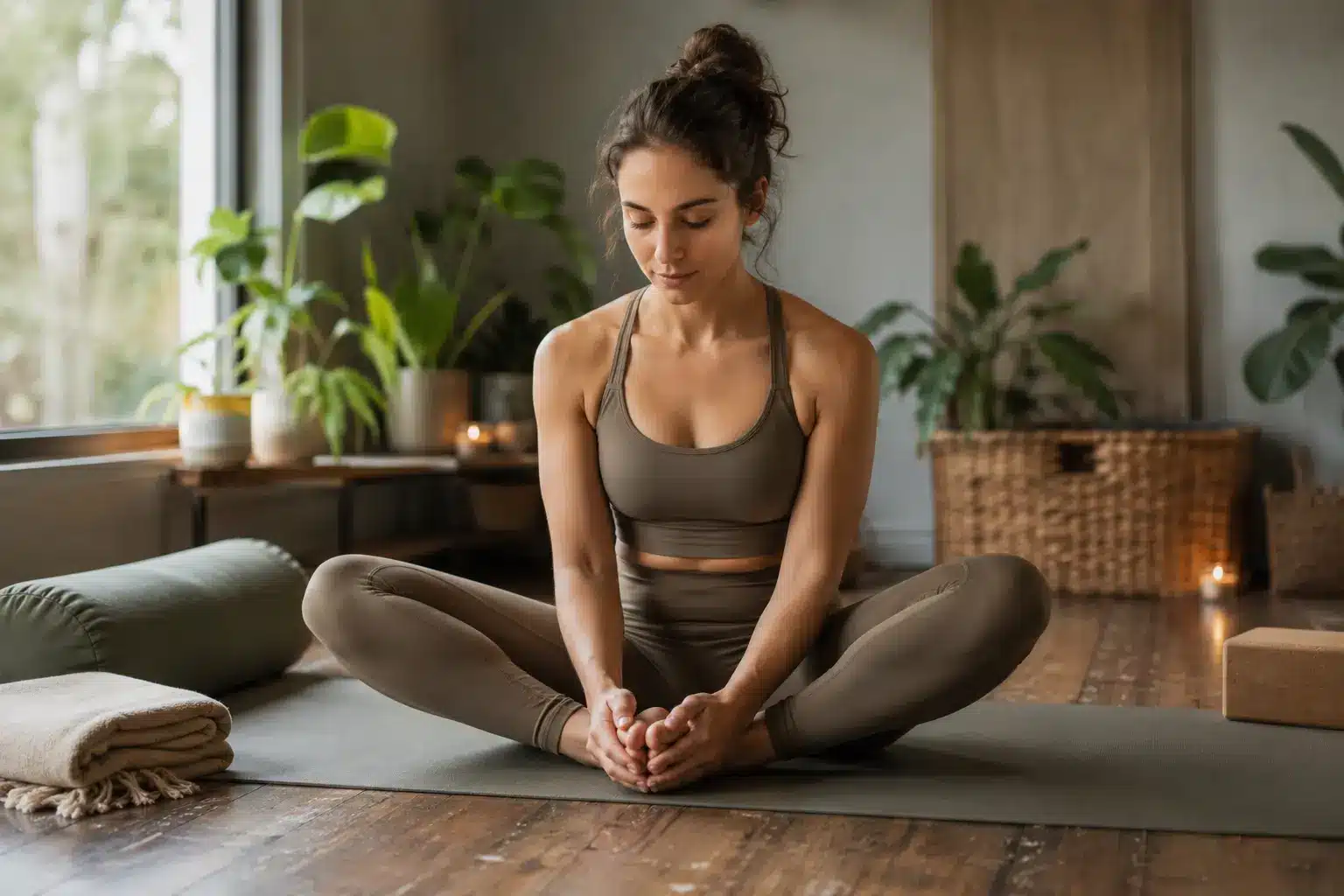
Does it feel like your lower back and hips are locked in a literal vice every time your period arrives? Curling up with a heating pad is a natural instinct, but staying completely still often makes that deep pelvic stiffness feel even worse.
I know the frustration of being too drained for a full workout while remaining too uncomfortable to find any real rest. These gentle stretches for cramps are designed to release tension and soften the pain without demanding much energy.
You will find how simple movements, similar to mobility yoga , can calm your nervous system and help you feel like yourself again. By the end, you’ll have a practical toolkit of poses to navigate your cycle with ease.
The Essential Pre-Stretch Checklist for a Safer Practice
Period cramps happen because the uterus contracts to shed its lining, and those contractions can radiate into the lower back, hips, and legs while leaving you feeling drained.
The right stretches for cramps can ease that tension by encouraging blood flow and calming the muscles around the uterus. But movement only helps when your body is ready for it.
If your pain feels sharp, severe, or different from your usual cramps, rest is the better choice today.
Otherwise, run through this quick check before you begin:
- Can you breathe normally without bracing against the pain?
- Can you shift positions without a sharp or stabbing sensation?
- Do you feel steady, not lightheaded or dizzy?
- Does the discomfort feel similar to your usual period cramps?
If you answered yes to all four, gentle movement is likely safe for you.
Stretches for cramps are not supposed to hurt to work. Relief comes from softening and releasing, not from pushing deeper into a pose. Suppose anything increases your pain, back off. Gentleness is the whole point.
Safety Note: These stretches are appropriate for mild to moderate period pain that feels similar to your usual cramps. If your pain is sharp, stabbing, or significantly worse than usual, rest is the better choice today. Always check with your doctor if cramping patterns change or worsen over several cycles.
Follow These Stretches for Cramps
This 10 to 15 minute routine can be done in order or by choosing poses that suit your cramps. Move slowly, breathe deeply, use support, and stop if pain increases.
1. Adapted Child’s Pose
Adapted Child’s Pose is a gentle resting stretch that can help when period cramps spread into your lower back, hips, or pelvis. It is a good option when your body wants comfort and light movement, but not anything too active.
How to do it:
- Kneel on your mat with your knees slightly wider than your hips.
- Keep enough space between your knees so your belly feels comfortable.
- Slowly fold your upper body forward between your thighs.
- Rest your forehead on the mat, a pillow, or a folded towel.
- Stretch your arms forward or relax them at your sides.
- Stay in the pose and take slow, steady breaths.
How long to hold: Stay for 5 to 10 slow breaths. Repeat 1 to 3 times if the pose feels soothing.
Make it easier: Place a pillow under your chest, forehead, or hips for extra support. If you feel pressure in your belly, widen your knees more or come out of the pose.
2. Cat-Cow Stretch
Cat-Cow Stretch is a slow, flowing movement that can help when cramps make your lower back feel tight or stiff. It also moves the belly area gently without putting direct pressure on it.
How to do it:
- Start on your hands and knees.
- Keep your wrists under your shoulders and knees under your hips.
- Inhale as you let your belly drop slightly toward the mat.
- Lift your chest and tailbone gently.
- Exhale as you round your back upward.
- Tuck your chin toward your chest and curl your tailbone under.
- Keep moving between both positions with slow breaths.
How long to hold: Repeat for 5 to 20 rounds at a slow, steady pace.
Make it easier: Place a folded blanket under your knees. If your wrists hurt, come down onto your forearms or try the same movement while seated in a chair.
3. Reclining Twist
Reclining Twist is a gentle stretch that can help when cramps spread into your lower back, belly, or hips. It keeps your body supported while providing a soft release to the back and waist.
How to do it:
- Lie flat on your back with your legs extended.
- Bend one knee slowly toward your chest.
- Guide that knee across your body to the opposite side.
- Let the knee rest on the mat, a pillow, or a folded blanket.
- Keep both shoulders relaxed and close to the floor.
- Stretch your arms out to the sides if that feels comfortable.
- Stay in the twist and breathe slowly.
- Bring the knee back to center, then repeat on the other side.
How long to hold: Hold for 5 to 8 slow breaths on each side. Repeat 1 to 2 times per side.
Make it easier: Place a pillow under your bent knee. Keep the twist small if your belly, hips, or lower back feel sensitive.
4. Cobra Pose
Cobra Pose is a gentle backbend that can help when cramps make you curl forward. It opens the front of the body and may ease mild back stiffness.
How to do it:
- Lie face down on your mat.
- Keep your legs relaxed and hip-width apart.
- Place your elbows under your shoulders to start in Sphinx Pose.
- Press your forearms gently into the mat.
- Lift your chest slowly without forcing the movement.
- Keep your belly and hips soft against the floor.
- If Sphinx feels comfortable, straighten your arms slightly into a low Cobra.
- Stop before you feel strain or pressure in your lower back.
How long to hold: Hold for 3 to 5 slow breaths. Repeat 1 to 2 times.
Make it easier: Stay in Sphinx Pose instead of Cobra. Place a folded towel under your chest, or skip this pose if lying on your belly feels uncomfortable.
5. Forward Fold
Forward Fold is a calming stretch that can help when period cramps move into your lower back, thighs, neck, or shoulders. It works best when you keep it soft, not deep.
How to do it:
- Stand with your feet hip-width apart, or sit with your legs extended.
- Bend your knees slightly to reduce strain.
- Fold forward slowly from your hips.
- Let your upper body hang heavy.
- Relax your head, neck, and shoulders.
- Rest your hands on the floor, blocks, a chair, thighs, or shins.
- Breathe slowly and let your body soften into the stretch.
- Avoid pulling yourself deeper or forcing your legs straight.
How long to hold: Hold for 5 to 8 slow breaths. Repeat 1 to 2 times.
Make it easier: Bend your knees more. If standing feels uncomfortable, sit down and place pillows over your legs so your upper body has support.
6. Pigeon Pose
Pigeon Pose can help when cramps feel like they settle into your hips, pelvis, or lower back. During your period, a figure-four stretch is often the gentler place to start.
How to do it:
- Lie on your back with your knees bent.
- Keep both feet flat on the mat.
- Cross one ankle over the opposite thigh, just above the knee.
- Let the crossed knee fall open gently.
- Stay here if the stretch already feels strong enough.
- For a deeper stretch, hold behind your bottom thigh.
- Slowly draw both legs toward your chest.
- Stop before you feel sharp pulling, pinching, or knee discomfort.
- Release gently, then repeat on the other side.
How long to hold: Hold for 5 to 8 slow breaths on each side. Repeat 1 to 2 times per side.
Make it easier: Keep your bottom foot on the floor. Place a pillow under your head, and skip full Pigeon Pose if your hips or knees feel tight.
7. Corpse Pose
Corpse Pose is a resting pose that helps your body settle after stretching. It can be especially helpful when cramps are accompanied by tiredness, tension, or stress.
How to do it:
- Lie flat on your back.
- Let your arms rest slightly away from your body.
- Turn your palms upward.
- Let your feet fall open naturally.
- Place a pillow or folded blanket under your knees if your lower back feels tight.
- Close your eyes if that feels comfortable.
- Breathe slowly and let your belly rise and fall.
- Bring your focus back to your breath whenever your mind wanders.
How long to stay: Stay for 2 to 5 minutes. You can stay longer if your body feels comfortable.
Make it easier: Lie on your side if your back feels sore. Use a blanket for warmth, or place a pillow under your knees for extra support.
Instructor Tip: If your belly feels any pressure, widen your knees further or slide a folded blanket between your hips and heels for lift. The belly should hang freely, not compress.
10-Minute Stretch Routine for Period Cramps
A short routine can be enough when cramps make your body feel tight, heavy, or sore. You do not need to push through every pose. Start with the ones that feel safe, and skip anything that adds pressure or pain.
| Time | Stretch | What to Do |
|---|---|---|
| Minute 1 | Belly breathing | Lie down or sit. Place one hand on your belly and breathe slowly. |
| Minutes 2 to 3 | Cat-cow stretch | Move between rounding and arching your back for 5 to 10 slow rounds. |
| Minutes 4 to 5 | Adapted child’s pose | Fold forward with knees wide. Rest your forehead on a mat or pillow. |
| Minutes 6 to 7 | Reclining twist | Lie on your back and guide one bent knee across your body. Repeat both sides. |
| Minute 8 | Figure-four stretch | Cross one ankle over the opposite thigh. Hold gently on each side. |
| Minutes 9 to 10 | Corpse pose | Lie still with support under your knees. Breathe slowly and let your body rest. |
Stretches to help period cramps work best when you treat them as a flexible tool rather than a fixed prescription. Your symptoms shift from day to day, and so can your approach.
Stop if any stretch makes the pain sharper. Keep the routine soft and slow.
Breathing Techniques to Pair With Period Cramp Stretches

Breathing can make each stretch feel softer and easier to hold. When cramps make your belly, hips, or back tense, slow breathing gives your body a clear signal to loosen up.
Use these simple breathing methods while holding each pose. You do not need to force deep breaths. Just keep the pace slow and steady.
Belly Breathing
Belly breathing works well with resting poses like child’s pose, reclining twist, and corpse pose. It helps you stop bracing against the cramps and settle into the stretch.
Here’s how to do it:
- Inhale through your nose.
- Let your belly soften as you breathe in.
- Keep your shoulders relaxed.
- Exhale slowly through your nose or mouth.
- Repeat for 5 to 10 breaths in each stretch.
If your belly feels tight, do not push it outward. Let the breath stay small and easy.
Longer Exhales
Longer exhales can help when cramps make your body feel tense or restless. The longer breath out tells your body to slow down.
Here’s how to do it:
- Inhale for 4 counts.
- Exhale for 6 counts.
- Keep your jaw, shoulders, and belly soft.
- Repeat for 5 to 10 rounds.
Use this during poses that feel safe and supported. If counting makes you feel stressed, let it go and breathe naturally
What to Do If Stretching Does Not Help
Heat applied directly to the lower belly or lower back relaxes the uterus and surrounding muscles more quickly than movement on its own. A warm bath serves a similar purpose while also releasing full-body tension.
Even a short, slow walk can support blood flow and trigger endorphin release, which are natural pain-relieving compounds produced by the body during light aerobic activity.
If you are managing a lower-limb injury or recovery alongside your period, the principles behind eccentric quad exercises explain why controlled, slow movement is especially valuable for maintaining circulation during recovery.
Gentle abdominal massage with slow circular strokes can reduce local muscle tension the same way stretching does, without requiring you to hold any position at all.
Staying well hydrated throughout your period is also worth noting; dehydration can intensify cramping.
For pain that does not respond to movement and heat, anti-inflammatory medications like ibuprofen target prostaglandin production directly and are among the most evidence-backed over-the-counter options for dysmenorrhea.
If your body simply needs to lie down without any agenda today, that is a completely valid response. Rest is not a failure of effort. It is sometimes exactly what the situation calls for.
When to Talk to a Doctor About Period Cramps

Gentle movement, heat, and rest can go a long way on difficult days, but there are times when cramps need more than home care. Knowing when to seek medical advice is just as important as knowing which stretches to try.
Consider talking to a doctor if your cramps:
- Are severe enough to stop you from going about your normal day
- Have been getting worse over several cycles rather than staying consistent
- Do not improve with heat, rest, movement, or over-the-counter pain relief
- Started suddenly after years of mild or manageable periods
- Come alongside very heavy bleeding, such as soaking through pads or tampons unusually fast
- Are accompanied by fever, unusual discharge, or a burning sensation
- Cause pelvic pain outside of your period, not just during it
Some conditions worth knowing about include endometriosis, where tissue similar to the uterine lining grows outside the uterus; fibroids, which are noncancerous growths in or around the uterus; adenomyosis, where the uterine lining grows into the muscle wall; and pelvic inflammatory disease, which is an infection that can cause ongoing pelvic pain.
If you have a recently inserted IUD and are experiencing significant cramping beyond the typical adjustment period, that is also worth raising with your provider.
Frequently Asked Questions
Can stretching completely stop period cramps?
Stretching may reduce tension and make cramps easier to manage, but it may not completely stop them. Period cramps are caused by uterine contractions, so relief often comes from combining gentle movement with heat, rest, hydration, and safe pain relief when needed.
Which stretch should I try first for period cramps?
Start with the stretch that matches where you feel the most discomfort. Try adapted child’s pose for lower back or pelvic tension, cat-cow for stiffness, reclining twist for back and belly tightness, and corpse pose when cramps come with fatigue.
Is it better to stretch before or after using a heating pad?
Either can work. Using heat before stretching may help tight muscles relax, making movement feel easier. Stretching after heat can feel softer and more comfortable. You can also stretch first, then use a heating pad afterward if your body wants rest.
Can I do these stretches in bed?
Yes, several stretches can be done in bed, especially the reclining twist, the figure-four stretch, belly breathing, and the corpse pose. Choose a firm enough surface so your body feels supported. Avoid poses that feel unstable or put pressure on your belly.
How often can I do stretches for cramps during my period?
You can do gentle stretches once or twice a day if they feel good. Keep each session short, around 5 to 15 minutes. Stop if your pain becomes sharper, your bleeding feels unusual, or your body feels dizzy or weak.
Are these stretches safe on the first day of my period?
They can be safe if your cramps feel mild to moderate and similar to your usual period pain. The first day can be more intense for some people, so keep the routine shorter, use more support, and choose resting poses over active ones.
Final Words
Managing your cycle is all about listening to what your body needs in the moment. I believe that movement should be a form of relief, not another chore on your to-do list.
By using these stretches for cramps, you can target specific areas like your lower back or tight hips while keeping your energy levels protected.
Remember that consistency and gentleness matter more than how deep you get into a pose. These tools give you a way to take back control when discomfort feels overwhelming.
If you found a specific stretch or breathing technique that worked wonders for you today, I’d love to hear about it. Give these movements a try and let me know which one brought you the most relief.