If you want bigger, stronger legs, the leg press workout is one of the most reliable tools in the gym, but most people are either skipping it entirely or leaving serious gains on the table by using it incorrectly.
I’ve worked with clients who spent months doing high-rep bodyweight squats and lunges with minimal results. Once I added structured leg press work with the right foot placement and progressive load, their leg development changed within eight weeks. The machine didn’t change; the approach did.
I’ll walk you through everything: the muscles it works, how to set up the machine correctly, the best leg press foot placements, and 10 exercises with sample workout routines for every goal. Let’s build those legs the right way.
Important Safety Note: These exercises are for general guidance only. If you have knee pain, hip impingement, or a lower back injury, consult a healthcare professional before using the leg press. Stop if you feel pain, numbness, or discomfort. Avoid locking your knees or letting your hips lift off the pad to prevent injury..
Understanding the Leg Press Workout
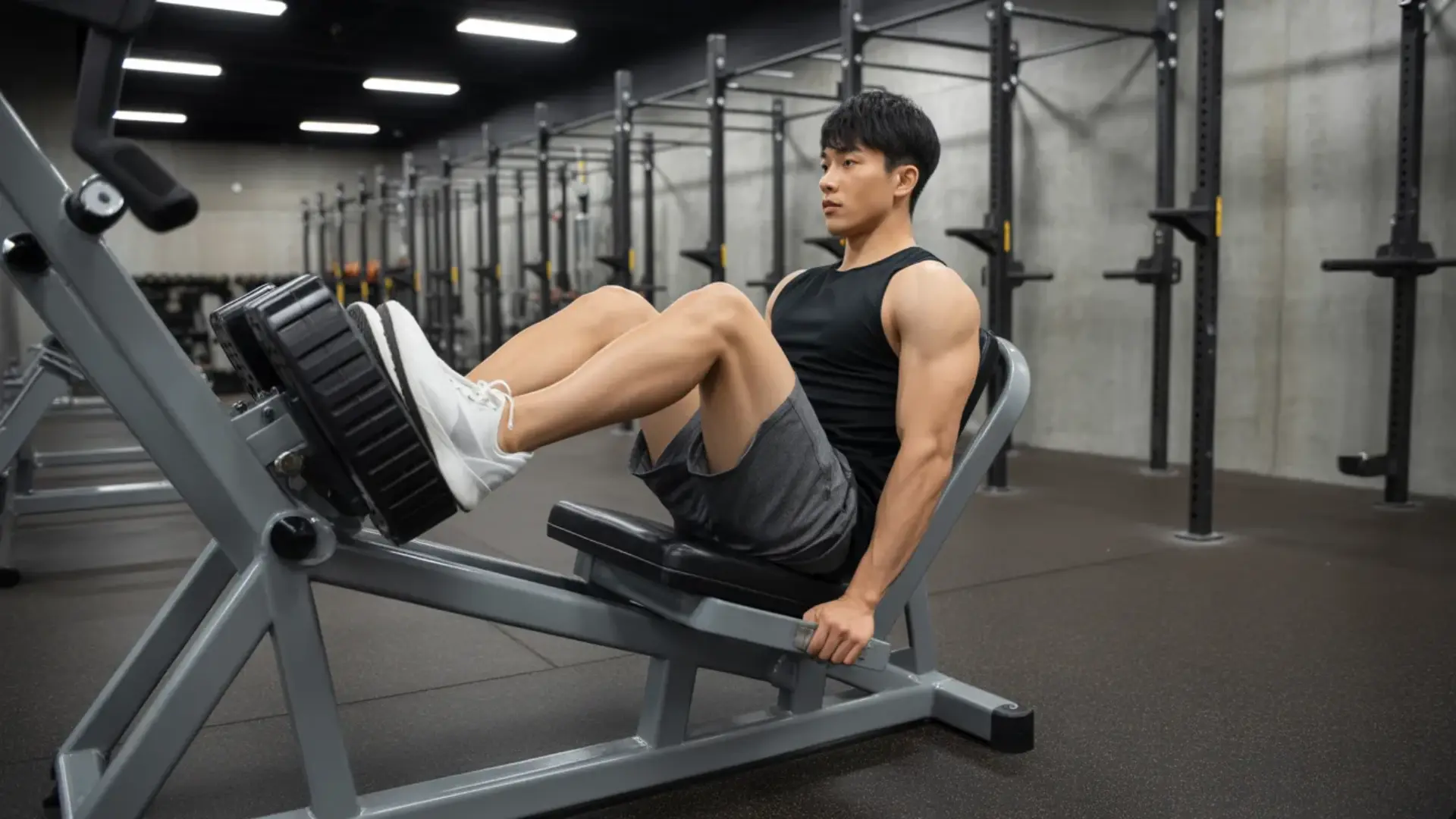
A leg press workout builds lower-body strength by pushing a weighted platform with your legs while your back stays supported. This reduces strain on your spine compared to squats and helps you focus on controlled movement.
The movement primarily engages the quadriceps, with support from the hamstrings, glutes, and calves, making it an effective compound exercise for the entire lower body.
Foot placement can shift the emphasis: a higher position targets the glutes and hamstrings, while a lower position loads the quads more directly.
Setup matters. Adjust the seat so your knees start at about 90 degrees, keep your lower back flat, feet planted, and grip the handles.
Types of Leg Press Machines
Not all leg press machines work the same way. Choosing the right one depends on your experience level and fitness goals. Here is a breakdown of the three main types and what sets them apart:
| Machine Type | Description | Best For | Difficulty Level | Spinal Stress |
|---|---|---|---|---|
| 45-Degree Leg Press | An angled platform allows heavy loading and a strong range of motion. | Intermediate to advanced lifters | Moderate | Low to Moderate |
| Horizontal / Seated Leg Press | Seat and platform are parallel, offering a more upright position. | Beginners or rehab | Easy | Low |
| Vertical Leg Press | The platform is pressed straight up overhead while lying flat. | Advanced lifters | High | High |
Each machine offers a unique training experience suited to different needs. Starting with the horizontal machine is a smart choice if you are new to leg training.
Leg Press Exercises for Stronger, Bigger Legs
These leg press exercises are designed to challenge your muscles from new angles, fix weak points, and keep your workouts from going stale.
1. Standard Leg Press
Target Muscles: Quads, hamstrings, glutes
The standard leg press is a foundational lower-body movement that builds overall strength by evenly targeting the quads, glutes, and hamstrings through a stable and controlled range of motion.
Steps to follow:
- Start by sitting on the machine with your back fully supported and your feet placed hip-width apart in the center of the platform.
- Keep your toes slightly turned out and grip the handles for stability throughout the movement.
Press the platform away through your heels until your legs are nearly straight, avoiding locking your knees at the top. - Slowly lower the sled back down in a controlled manner until your knees reach about a 90-degree angle.
- Repeat with a steady tempo and controlled breathing.
Foot placement: Mid-platform, hip-width, toes slightly out. Rep range by goal: 10–12 for hypertrophy, 6–8 for strength, 15–20 for endurance.
Breathing cue: Exhale as you press. Inhale as you lower.
2. Single-Leg Press
Target Muscles: Quads, glutes, hamstrings (unilateral)
The single-leg press is an effective unilateral exercise that helps correct strength imbalances, improves coordination, and ensures both legs develop evenly without compensation from the stronger side.
Steps to follow:
- Sit on the machine and position one foot firmly in the center of the platform while keeping the other foot off to the side.
- Keep your hips level and your lower back pressed against the pad throughout the exercise.
- Push the platform away using only one leg, maintaining control and proper alignment.
- Slowly lower the weight back down, ensuring your knee stays stable and does not collapse inward.
- Complete all repetitions on one side before switching.
Breathing cue: Exhale on the press. Inhale on the way down. Don’t rush the lowering phase; that’s where the real work happens.
Sets & Reps: 3 sets of 8–10 reps per leg
3. Narrow Stance Leg Press
Target Muscles: Outer quads, hip abductors
The narrow stance leg press places greater emphasis on the outer quadriceps, helping improve leg definition and creating a more balanced look in the lower body.
Steps to follow:
- Position your feet close together in the middle of the platform, keeping them about 4–6 inches apart.
- Keep your toes pointing forward or slightly outward while maintaining a strong and stable base.
- Hold the handles and engage your core to maintain balance during the movement.
- Press the platform upward while keeping your knees aligned with your toes.
- Lower the sled slowly and with control to maintain constant muscle tension.
Foot placement: Feet 4–6 inches apart, mid-platform. Breathing cue: Exhale through the press. Inhale on the way back.
Sets & Reps: 3 sets of 10–12 reps
4. Wide Stance Leg Press
Target Muscles: Inner thighs, hip adductors, glutes
The wide-stance leg press targets the inner thighs and hip adductors, helping improve hip stability, mobility, and overall lower-body strength through a deeper, more controlled movement pattern.
Steps to follow:
- Place your feet wider than shoulder-width apart on the platform, with your toes angled outward at about 45 degrees.
- Keep your back flat against the pad and hold the handles for added support.
- Press the platform away while driving through your heels and keeping your knees tracking over your toes.
- Lower the sled slowly to feel a deep stretch in your inner thighs.
- Repeat with controlled movement and proper alignment.
Foot placement: About 1.5x shoulder-width, toes at 45 degrees, mid-platform. Breathing cue: Exhale as you press out. Inhale as you lower.
Sets & Reps: 3 sets of 10–15 reps
5. High Foot Placement Leg Press
Target Muscles: Glutes, hamstrings
The high foot placement leg press shifts the focus toward the glutes and hamstrings, making it ideal for building posterior chain strength and improving hip-driven movement patterns.
Steps to follow:
- Position your feet higher on the platform, around the upper third, while keeping them hip-width apart.
- Keep your toes slightly turned outward and your back firmly pressed into the pad.
- Drive through your heels to push the platform upward, emphasizing glute engagement.
- Lower the sled slowly while maintaining control and allowing your knees to bend deeply.
- Repeat while focusing on consistent tension in the posterior chain.
Foot placement: Upper third of the platform, hip-width, toes slightly out. Note: Most lifters can handle more weight here than in the standard position. Your glutes and hamstrings are strong. Don’t be surprised if you load 10–20% more on these sets.
Breathing cue: Exhale on the press, inhale on the slow lower.
Sets & Reps: 3–4 sets of 12–15 reps
6. Banded Leg Press
Target Muscles: Glutes, hip abductors, quads
The banded leg press improves glute activation by adding resistance that forces your knees outward, improving stability, alignment, and muscle engagement throughout the entire movement.
Steps to follow:
- Secure a resistance band around the machine and position it just above your knees before starting.
- Sit on the machine and place your feet in a standard mid-platform position.
- As you press the platform away, actively push your knees outward against the band’s resistance.
- Control the movement as you lower the sled, maintaining outward pressure the entire time.
- Repeat while keeping constant tension on the band.
Band tension: Light to medium resistance band. Heavy bands make it a fight against the band rather than a training stimulus.
Breathing cue: Exhale through the press while actively driving knees out. Inhale on the return
Sets & Reps: 3 sets of 10–12 reps
7. Calf Press on the Leg Press Machine
The calf press on the leg press machine isolates the calf muscles, helping build strength, endurance, and definition through a controlled ankle-driven movement.
Steps to follow:
- Place the balls of your feet on the bottom edge of the platform, allowing your heels to hang off.
- Keep a slight bend in your knees and hold the handles to stay stable.
- Push the platform upward by extending your ankles and rising onto your toes.
- Pause briefly at the top to fully contract your calves.
- Slowly lower your heels back down below platform level and repeat.
Safety note: Keep your foot secure on the platform edge and use the machine’s safety stops. This is a “be smart” variation; don’t let your foot slip mid-rep under load.
Weight: Keep it light. Your calves are smaller muscles and fatigue faster than your quads or glutes. Breathing cue: Exhale as you press up onto your toes. Inhale as you lower.
Sets & Reps: 3 sets of 15–20 reps
8. Sumo Leg Press
The sumo leg press emphasizes the inner thighs and hips by using an exaggerated wide stance, allowing for a deeper stretch and greater activation of the adductors.
Steps to follow:
- Position your feet at the outer edges of the platform with your toes turned outward at about 45 degrees.
- Keep your back flat against the pad and maintain a firm grip on the handles.
- Press the platform upward while ensuring your knees stay aligned with your toes.
- Lower the sled slowly to achieve a deep stretch through your inner thighs.
- Repeat with controlled and steady movement.
The practical difference: Use a wide stance for general inner thigh volume. Use sumo when you want a more intense adductor stretch and deeper hip activation.
Keep your knees tracking over your toes throughout the movement to avoid joint strain.
Breathing cue: Exhale as you press. Inhale as you lower slowly through the full range.
Sets & Reps: 3 sets of 12–15 reps
9. Pyramid Leg Press
The pyramid leg press method combines strength and hypertrophy by gradually increasing and then decreasing weight, allowing you to challenge your muscles through varying intensities and rep ranges.
Steps to follow:
- Start with a lighter weight and perform more repetitions as a warm-up.
- Gradually increase the weight with each set while reducing the number of reps.
- Continue progressing until you reach your heaviest set with lower reps.
- Once completed, begin decreasing the weight step by step.
- Finish by returning to higher reps with lighter loads.
Breathing cue: Same throughout, exhale on the press, inhale on the lower. As fatigue builds on the descending sets, you’ll be tempted to rush. Don’t.
Sets & Reps: 5–6 sets (15, 12, 10, 8, 6, then reverse)
10. Paused Leg Press
The paused leg press builds strength and control by removing momentum, forcing your muscles to generate power from a complete stop at the bottom of the movement.
Steps to follow:
- Set up in a standard leg press position with your feet placed hip-width apart on the platform.
- Lower the sled slowly until your knees reach about 90 degrees or slightly deeper.
- Pause at the bottom for 2–3 seconds while maintaining tension.
- Press the platform back up with control, avoiding any bouncing.
- Repeat while keeping your movement steady and controlled.
Breathing cue: Inhale as you lower, hold your breath lightly during the pause to maintain intra-abdominal pressure, then exhale as you drive up.
Sets & Reps: 3–4 sets of 6–8 reps
11. Slow Eccentric Leg Press
Target Muscles: Quads, hamstrings, glutes
The slow eccentric leg press increases time under tension by focusing on a controlled lowering phase, which plays a key role in stimulating muscle growth and improving strength.
Steps to follow:
- Begin in a standard position with your feet placed firmly on the platform.
- Press the sled upward in a controlled but natural tempo.
- Slowly lower the weight over 4–5 seconds, maintaining full control throughout.
- Avoid bouncing at the bottom and keep your muscles engaged.
- Repeat each rep with the same slow and consistent lowering phase.
Tempo: 1 second up, 4–5 seconds down. No momentum, no bouncing at the bottom.
Breathing cue: Exhale as you press up. Inhale slowly and steadily through the entire lowering phase.
Sets & Reps: 3 sets of 8 reps
Sample Weekly Schedule
To keep things simple, here is an easy weekly workout schedule that balances strength, variation, and recovery for steady lower-body progress.
| Day | Focus | Recommended Exercises | Suggested Time |
|---|---|---|---|
| Day 1 | Foundation Strength | Start with Standard Leg Press for controlled reps. Finish with Paused Leg Press to build bottom-range strength and control. | 20–25 mins |
| Day 2 | Rest or Active Recovery | Light walking, stretching, or foam rolling. Optional mobility work for hips, knees, and ankles. | Optional 10–15 mins |
| Day 3 | Unilateral & Quad Focus | Perform the Single-Leg Press to correct imbalances. Add Narrow Stance Leg Press for outer quad emphasis. | 20–25 mins |
| Day 4 | Glute & Posterior Chain | Focus on High Foot Placement Leg Press. Add a Sumo Leg Press for deeper inner-thigh and glute activation. | 20–25 mins |
| Day 5 | Volume & Intensity | Begin with Wide Stance Leg Press, then move to Banded Leg Press. Finish with Pyramid Leg Press for full muscle fatigue. | 25–30 mins |
| Weekend (Optional) | Control & Recovery | Add Slow Eccentric Leg Press for time-under-tension training, or perform Calf Press on the Leg Press Machine, or take full rest if needed. | As needed |
Where does the leg press fit in your session?
- After squats: Use it as a volume finisher. Your legs are primed, push higher reps with moderate weight.
- Before squats: Use it as a pre-fatigue tool or warm-up for the quads if you’re targeting hypertrophy.
- Leg press only day: Go heavier. Without the fatigue of squats beforehand, you can push more total volume through the exercises above
Pros and Cons of the Leg Press
Like any exercise, the leg press comes with its own set of strengths and limitations. Understanding both sides helps you make smarter decisions about how and when to include it in your training.
| Aspect | Pros | Cons |
|---|---|---|
| Safety & Support | Machine guides movement, reducing injury risk | A fixed path may not suit everyone’s joint alignment |
| Back Support | More spinal support compared to free-weight squats | Does not train stabilizer muscles like squats do |
| Progressive Overload | Easy to adjust weight precisely and track progress | Can create a false sense of strength outside the machine |
| Accessibility | Beginner-friendly and easy to learn quickly | Limited to lower-body isolation, less functional carry-over |
| Joint Health | Helps strengthen and stabilize the knee and hip joints | Poor form or excessive depth can still stress the knees |
| Hypertrophy | Allows training closer to failure with less recovery cost | Less full-body hormonal response compared to heavy squats |
When used consistently and with proper form, the leg press can become one of the most reliable tools in your routine for building stronger, more defined legs.
Common Leg Press Mistakes to Avoid
I’ve noticed that small form mistakes on the leg press can quickly reduce results and increase joint stress, so paying attention to technique really matters.
- Locking your knees at the top removes tension and stresses joints.
- Letting your hips lift off the pad increases your risk of lower back injury.
- Going too shallow limits muscle activation and growth potential.
- Dropping the weight too fast reduces control and raises injury risk.
- Placing feet too low can put unnecessary stress on the knees.
- Using too much weight often leads to poor form and reduced effectiveness.
Fixing these common mistakes can instantly improve the quality of your workout, help you build strength safely, and protect your knees and lower back.
Leg Press or Squat: Which Should You Do?
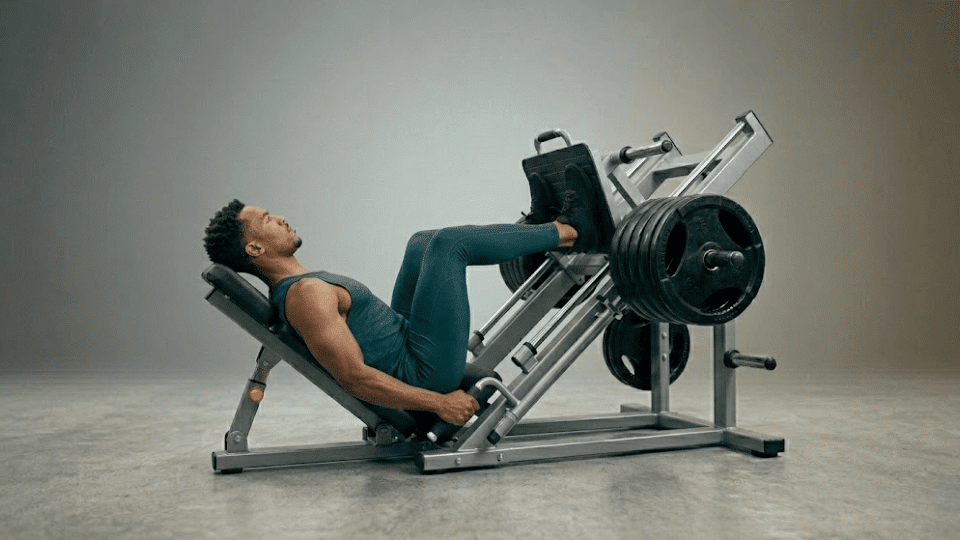
The squat demands more full-body coordination, core stability, and athletic carryover. The leg press lets you hammer your legs with high volume and consistent tension without the same full-body fatigue.
Choosing between the two comes down to your goals, experience, and physical condition. If building functional strength and improving athletic performance is the priority, squats are hard to beat.
If you are dealing with lower back issues, are newer to training, or simply want to add more leg volume without excessive recovery demand, the leg press is a smart choice.
For most people, the best approach is using both: squat for strength and movement quality, and leg press for targeted volume and muscle development.
Final Thoughts
Now you’ve got everything you need to make your leg press workout actually work for you.
From setting up the machine correctly to choosing the right foot position for your goals, small tweaks can make a huge difference in your results. I always say, it’s not about how much weight is on the sled, it’s about how well you control it.
If you’re focused on building mass, targeting your glutes, or just getting comfortable with the machine as a beginner, the leg press is a tool that fits every goal and every level. Start with the basics, be consistent, and build from there.
Ready to crush your next leg day? Save this guide, hit the gym, and let those legs do the talking.