| Exercise Type | Strength and Hypertrophy |
| Muscles Targeted | Pectoralis major (clavicular and sternocostal heads), anterior deltoid, triceps brachii, serratus anterior |
| Difficulty | Beginner to Advanced |
| Equipment | Dumbbells; adjustable bench (optional for most variations) |
| Best For | Building chest size and pressing strength, correcting side-to-side muscle imbalances, home or gym training |
| Avoid If | Unmanaged shoulder impingement or recent rotator cuff injury, consult a physiotherapist before loading overhead |
Chest day gets skipped more than any other session, and after 8 years working as a certified strength and conditioning specialist, I can tell you why: most people are either bored with their routine or convinced they need a full gym to see results. Both assumptions are wrong.
A well-structured dumbbell chest workout delivers real size and strength regardless of where you train. I have covered the most effective exercises, a beginner-friendly routine, and practical strategies for fitness motivation grounded in exercise science.
Whether you train at home or in a commercial gym, everything you need to build a stronger chest starts here.
| Disclaimer: This article is for informational and educational purposes only. It does not constitute medical advice. Always consult a qualified healthcare provider before starting a new exercise or fitness program. |
What Makes a Dumbbell Chest Workout So Effective?
A dumbbell chest workout delivers real size and strength at any fitness level, and after 8 years working as a certified strength and conditioning specialist, I can tell you that most people underestimate what dumbbells can do for the chest.
The main mechanical advantage is simple: each arm works independently, so your dominant side cannot compensate for a weaker one. That forces balanced muscle development over time and corrects the side-to-side imbalances that quietly accumulate over years of barbell pressing.
There is also a range-of-motion benefit that barbells cannot match. When I program flat dumbbell presses for clients, they consistently feel a deeper stretch at the bottom of the movement than they ever got from a barbell, and that stretch under load is one of the strongest signals for muscle growth. Dumbbells also allow the pressing path to follow each person’s natural shoulder mechanics rather than a fixed bar path, which reduces anterior shoulder strain considerably.
The flexibility matters for consistency, too. You can train at home, adjust the bench angle without changing equipment, and move between exercises without waiting. Whether you train with a full rack or a single pair of adjustable dumbbells on a bedroom floor, the dumbbell chest workout options in this guide produce results when applied with good form and the same exercise principles that govern every effective training program.
Chest Anatomy: What You Are Actually Training
Knowing chest anatomy helps you understand which muscles each dumbbell exercise targets and why different pressing angles matter.
- Pectoralis major: The large fan-shaped chest muscle that creates the most visible chest size and shape.
- Clavicular head: The upper chest portion near the collarbone, trained most by incline presses and low-to-high fly movements.
- Sternocostal head: The mid and lower chest portion, trained most by flat presses, decline presses, and standard fly movements.
- Pectoralis minor: A smaller muscle under the pec major that helps with shoulder blade movement during pressing exercises.
- Serratus anterior: The ribcage muscle trained during pullovers, helping with shoulder stability and chest expansion.
A complete dumbbell chest workout should include multiple angles, using presses and flys to train the upper, mid, lower, and inner chest.
Best Dumbbell Chest Exercises to Build Muscle and Stay Motivated
These eleven movements cover the upper, lower, and inner chest, as well as home-friendly options. They appear repeatedly across fitness research, strength coaching resources, and community discussions because they consistently produce results when performed with proper form.
1. Flat Dumbbell Bench Press
Muscles targeted: Pectoralis major (sternocostal head), anterior deltoid, triceps brachii
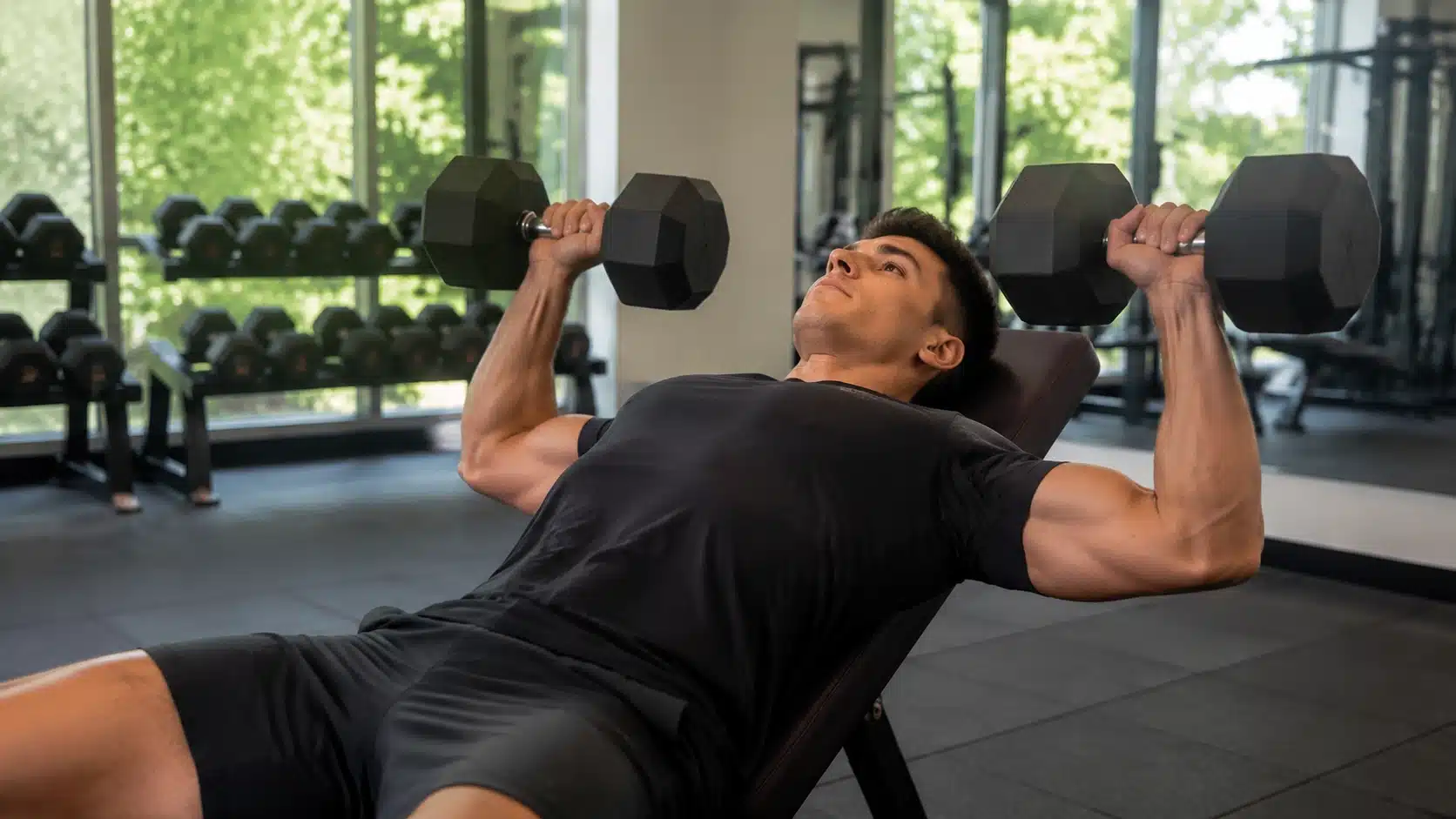
The flat dumbbell bench press is the foundation of any dumbbell chest workout. It builds overall chest mass and pressing strength while allowing a deeper stretch at the bottom than the barbell version. In my own training, I always start chest day here because it allows the heaviest load and the fullest range of motion before fatigue sets in.
How to do it:
- Sit on a flat bench with a dumbbell on each knee. Rock back and bring both weights to chest level as you lie down.
- Plant your feet flat on the floor. Retract your shoulder blades by pulling them together and slightly downward. This is the single most important setup cue for chest activation.
- Hold the dumbbells with a neutral-to-pronated grip at chest level, elbows at roughly 45 to 60 degrees from your torso (not flared to 90 degrees).
- Press the dumbbells upward and slightly inward until your arms are fully extended without locking the elbows.
- Lower slowly over 2 to 3 seconds until you feel a full stretch in the pecs. The dumbbells should reach chest level or just below.
Sets and reps: 3 to 4 sets of 8 to 12 reps. Rest 90 seconds between sets.
| Trainer Tip: Keep the elbows tucked at about 45 degrees, not flared wide. Flared elbows shift load onto the anterior deltoids and increase the risk of impingement. Tucked elbows keep tension where it belongs — across the sternal fibers of the pec major. The same controlled slow-lowering phase that protects knee joints in lower-body training applies directly here: the descent is where most of the growth stimulus lives. |
2. Incline Dumbbell Press
Muscles targeted: Pectoralis major (clavicular head), anterior deltoid, triceps brachii
The incline dumbbell press is the exercise I hear about most consistently in conversations with experienced lifters who feel their upper chest is underdeveloped. Set the bench between 30 and 45 degrees; higher than 45 degrees shifts the load onto the anterior deltoids rather than the clavicular head of the pec.
How to do it:
- Set the bench to a 30 to 45-degree incline. Sit with a dumbbell on each knee, then rock back to the inclined position.
- Retract your shoulder blades against the pad. Keep your feet planted and your lower back in its natural curve.
- Position the dumbbells at upper chest level with elbows slightly below the bench pad.
- Press upward and slightly inward. Do not let the dumbbells drift too far over your face; keep the press path above your upper chest.
- Lower over 2 to 3 seconds to a full stretch. The top of the dumbbell should reach approximately chin height at the bottom of the rep.
Sets and reps: 3 to 4 sets of 8 to 12 reps. Rest 90 seconds between sets.
3. Decline Dumbbell Press
Muscles targeted: Pectoralis major (sternocostal and abdominal head), triceps brachii
The decline angle reduces shoulder stress while targeting the lower chest directly. I program this for clients who experience anterior shoulder discomfort on flat pressing and for anyone whose lower chest development lags behind their upper chest.
How to do it:
- Set the bench to a 15 to 30-degree decline. Lock your feet under the ankle pad.
- Hold the dumbbells at lower chest level with elbows at 45 degrees from the torso.
- Press straight up over the lower chest, not over the face or mid-chest.
- Lower slowly and under control without bouncing the weights off your chest.
Sets and reps: 3 sets of 10 to 12 reps. Rest 90 seconds between sets.
4. Dumbbell Chest Fly
Muscles targeted: Pectoralis major (full width), anterior deltoid
The fly is an isolation movement; its purpose is stretch and contraction quality, not heavy loading. When I see people using the same weight on flies as they do on presses, I know they are missing the point. Lighter weights with a controlled arc produce far better chest activation than ego weight with a shortened range.
How to do it:
- Lie on a flat bench. Hold the dumbbells over your chest with palms facing each other and a soft bend in the elbows — maintain that bend throughout.
- Open your arms in a wide arc, lowering the dumbbells down and out to the sides. Lower until you feel a deep stretch across the chest.
- Drive the dumbbells back together along the same arc, squeezing the pecs at the top. Do not press them together at the top — this converts the fly into a press and removes the isolation benefit.
Sets and reps: 3 sets of 12 to 15 reps. Rest 60 seconds between sets.
5. Incline Dumbbell Fly
Muscles targeted: Pectoralis major (clavicular head), anterior deltoid
The incline version brings the upper chest into the stretch position in a way that pressing movements cannot fully replicate. Use a 30-degree incline and treat the lowering phase as the working phase, not just the reset between reps.
How to do it:
- Set the bench to 30 degrees. Hold the dumbbells over the upper chest with a soft elbow bend.
- Lower in a wide arc to the sides, pausing briefly at the bottom of the stretch.
- Bring the dumbbells back together with control, maintaining the elbow angle throughout.
Sets and reps: 3 sets of 12 to 15 reps. Rest 60 seconds between sets.
6. Dumbbell Floor Press
Muscles targeted: Pectoralis major, triceps brachii, anterior deltoid
The floor press is the most practical option for home training with no bench. The reduced range of motion limits the chest stretch compared to a bench press, but it also makes the movement more shoulder-friendly, particularly for people who have had anterior shoulder issues.
Students who struggle with shoulder discomfort on the bench press often find the floor press the better starting point. Muscular strength is one of the five health-related fitness components that drive long-term physical health, and floor pressing builds exactly that without the joint stress of a full bench range.
How to do it:
- Lie flat on the floor with knees bent and feet planted. Hold a dumbbell in each hand at chest level.
- Tuck your elbows to approximately 45 degrees from your torso.
- Press the dumbbells upward until your arms are fully extended.
- Lower until both elbows make light contact with the floor. Pause briefly; do not use the floor to bounce the weight up.
- Press again from the paused position.
Sets and reps: 3 to 4 sets of 10 to 12 reps. Rest 90 seconds between sets.
7. Neutral Grip Dumbbell Press
Muscles targeted: Pectoralis major, triceps brachii
The neutral grip, palms facing each other throughout the press, keeps the humerus in a more internally neutral position and reduces rotator cuff stress. I use this variation with clients who experience impingement-type discomfort on pronated presses. It is an effective long-term substitution, not just a temporary workaround.
How to do it:
- Set up on a flat bench as you would for a standard press, but hold the dumbbells with palms facing each other.
- Keep the palms-in position throughout — do not rotate the wrists at any point during the rep.
- Press and lower with the same controlled tempo as the standard flat press.
Sets and reps: 3 sets of 10 to 12 reps. Rest 90 seconds between sets.
8. Dumbbell Pullover
Muscles targeted: Pectoralis major, latissimus dorsi, serratus anterior
The pullover trains the chest and upper back through a long arc of motion that no other exercise in this list replicates. It also directly loads the serratus anterior, which supports shoulder blade stability and improves the visual appearance of the chest-to-ribcage transition. I use it as a finisher when I want to add training volume without taxing the triceps or shoulders further.
How to do it:
- Lie perpendicular across a bench so only your shoulders and upper back are supported. Keep your feet flat on the floor and hips level or slightly below bench height.
- Hold one dumbbell with both hands cupped around the inner plate. Extend your arms over your chest with a soft elbow bend.
- Lower the dumbbell slowly behind your head in a controlled arc. Lower until your arms are roughly parallel to the floor or you feel a full chest and lat stretch.
- Pull the dumbbell back over the chest along the same arc. Do not use momentum.
Sets and reps: 3 sets of 12 to 15 reps. Rest 60 seconds between sets.
9. Standing Dumbbell Chest Press
Muscles targeted: Pectoralis major, anterior deltoid, core stabilizers
The standing version eliminates bench support, which forces the core and stabilizing muscles to work harder throughout every rep. It is useful for home training where bench space is limited and for building functional pressing strength. Keep the core braced from start to finish, if you feel your lower back arching under load, the weight is too heavy.
How to do it:
- Stand with feet shoulder-width apart. Hold a dumbbell in each hand at chest level with elbows bent and pointing back.
- Brace your core and press both dumbbells straight forward at chest height until your arms are nearly extended.
- Retract the dumbbells to chest level with control. Avoid leaning backward as you press.
Sets and reps: 3 sets of 12 to 15 reps. Rest 60 seconds between sets.
10. Single-Arm Dumbbell Chest Press
Muscles targeted: Pectoralis major, triceps brachii, core (anti-rotation)
The single-arm press exposes strength differences between sides that standard bilateral pressing hides. If one arm is notably harder to control or fatigues earlier, that side needs priority attention. When I program this for clients, I always start with the weaker side and match the reps on the stronger side — never the other way around.
How to do it:
- Lie on a flat bench. Hold one dumbbell at chest level. Place the free hand lightly on your abdomen to monitor core tension.
- Brace hard through your core and obliques to resist rotation as you press.
- Press the dumbbell straight up and lower slowly. Prevent your torso from twisting or shifting toward the working side.
- Complete all reps on one side before switching.
Sets and reps: 3 sets of 10 reps per side. Rest 60 seconds between sets.
11. Dumbbell Squeeze Press
Muscles targeted: Pectoralis major (inner fibers), triceps brachii
The squeeze press creates constant inner chest tension by keeping the dumbbells pressed together throughout the movement. It is not a heavy exercise; the sustained isometric squeeze is where the work happens. Use it as a finisher at the end of your session when the pressing muscles are already fatigued, and lighter loads produce sufficient stimulus.
How to do it:
- Lie on a flat bench. Press two dumbbells together over your chest with palms facing each other.
- Squeeze the dumbbells against each other as forcefully as possible throughout the entire set — this is the active cue, not an afterthought.
- Lower the dumbbells together toward the chest while maintaining the squeeze. Press back up. Never let the dumbbells separate.
Sets and reps: 2 to 3 sets of 15 to 20 reps. Rest 45 seconds between sets.
How to Program a Dumbbell Chest Workout: Progressions by Level
Exercise selection matters less than consistent progressive overload over time. Here is how I structure dumbbell chest training across three experience levels, based on what I have seen work reliably with clients over 8 years of programming.
1. Beginner (0 to 6 months of consistent training)
At this stage, the goal is movement quality, not loading. The nervous system is still learning how to recruit the pectoralis major efficiently, which means technique improvements will drive progress faster than weight increases. Aim for two chest sessions per week with at least 48 hours of recovery between them.
| Exercise | Sets | Reps | Rest |
| Dumbbell Floor Press | 3 | 10 to 12 | 90 sec |
| Incline Dumbbell Press | 3 | 10 to 12 | 90 sec |
| Dumbbell Chest Fly | 3 | 12 to 15 | 60 sec |
| Dumbbell Pullover | 2 | 12 | 60 sec |
The progression criteria here are specific: add one rep per set each week until you reach the top of the rep range across all sets. Once you can complete all sets at the top of the range with good form, increase the weight by the smallest available increment — typically 2 to 4 lbs on each dumbbell. Do not increase weight until the rep target is fully achieved.
Intermediate (6 months to 2 years of consistent training)
At this stage, you can handle more total volume and begin prioritizing the incline press as the primary movement to develop upper chest thickness. Add the flat press back as a second pressing exercise and use fly variations for isolation work.
| Exercise | Sets | Reps | Rest |
| Incline Dumbbell Press (primary) | 4 | 8 to 10 | 2 min |
| Flat Dumbbell Bench Press | 3 | 10 to 12 | 90 sec |
| Incline Dumbbell Fly | 3 | 12 to 15 | 60 sec |
| Single-Arm Dumbbell Press | 3 | 10 per side | 60 sec |
| Dumbbell Squeeze Press (finisher) | 2 | 15 to 20 | 45 sec |
Advance to this level when you can complete the beginner routine with consistent form for 8 to 10 consecutive weeks without technique breakdown on the last set. If form deteriorates before the final rep, the volume increase is premature.
Advanced (2+ years of consistent training)
At the advanced level, the challenge is maintaining progressive overload when the weight increases slowly. Techniques like tempo manipulation (3 to 4 second negatives), paused reps at the bottom of the range, and reduced rest periods all extend the stimulus beyond simple load increases.
A typical advanced dumbbell chest session runs 5 to 6 exercises across 16 to 20 total working sets, split across two sessions per week. The structure remains the same: compound presses first, incline movements prioritized for upper chest development, fly variations for isolation volume, and a finisher like the squeeze press or pullover for final fiber recruitment.
The difference at this level is execution quality, slower reps, deeper stretch, and closer proximity to failure on working sets.
What Communities Say About Chest Training and Fitness Motivation
Fitness forums and communities tend to surface honest patterns that structured guides often miss. Certain themes appear consistently enough to warrant attention.
What Reddit Users Say About Dumbbell Chest Workouts

Reddit discussions around dumbbell chest workouts show that many lifters still build impressive chest size and strength without complicated machines or commercial gym equipment. Most comments focus on consistency, exercise quality, and progressive overload rather than fancy setups.
- Dumbbells Work Well: Consistent training still effectively builds chest size and pressing strength.
- Incline Press Stands Out: Many users credit incline presses for better upper chest growth.
- Home Training Helps: Dumbbells fit smaller spaces and support effective home chest workouts.
- Shoulders Feel Better: Dumbbell pressing often feels smoother than fixed machine movements.
- Consistency Matters Most: Repeating core exercises regularly produces better long-term chest progress.
- Visible Progress Motivates: Strength and chest improvements help maintain workout consistency over time.
The overall discussion showed that simple dumbbell chest workouts still work extremely well when paired with patience, proper form, and realistic training expectations. Most experienced users agreed that consistency usually matters more than having access to advanced gym equipment.
What Reddit Users Say About Fitness Motivation

Reddit discussions about workout motivation show that most people struggle with consistency at some point. The conversations usually focus less on perfect routines and more on building manageable habits that realistically fit daily life.
- Habits Beat Motivation: Many users said routines matter more than waiting for motivation.
- Start Small First: Short workouts often feel easier to maintain consistently over time.
- Enjoyable Workouts Help: People stay active longer when workouts actually feel enjoyable.
- Convenience Matters: Closer gyms and home workouts significantly improve long-term consistency.
- Tracking Progress Helps: Apps, notebooks, and photos help maintain workout accountability.
- Showing Up Counts: Many users focus on simply getting through the gym door.
- Community Improves Consistency: Classes, workout partners, and gym friendships improve accountability and routine consistency.
- Health Goals Stay Important: Better energy, posture, and mental health motivate long-term training.
Most Reddit users agreed that consistency becomes easier once exercise feels like a normal part of daily life. Small routines, realistic expectations, and enjoyable workouts were repeatedly mentioned in discussions about maintaining long-term fitness habits.
The Psychology Behind Fitness Motivation
Staying consistent with your chest workouts comes down to understanding how motivation actually works in the brain.
According to the American Psychological Association, exercise produces measurable psychological benefits that reinforce the habit of training over time, making consistency easier the longer you stick with it.
When your brain begins associating workouts with positive feelings, intrinsic motivation naturally builds, a phenomenon research consistently links to stronger long-term adherence than appearance-based goals alone.
Habit formation, not willpower, is the real driver behind showing up regularly. Once training feels automatic, it requires far less mental effort to begin.
Practical steps like tracking small strength gains, choosing enjoyable movements, and setting process-based goals rather than outcome-based ones directly support this psychological process, making your dumbbell chest routine something your brain genuinely wants to return to each week.
Fitness Motivation Tips to Stay Consistent
Motivation fluctuates for everyone, especially after the initial excitement fades. Building reliable habits that carry your training forward during low-energy periods matters far more than waiting to feel inspired. Here are some simple tips:
- Focus on Small Weekly Improvements: Adding 1 rep or a slight increase in weight each week shows your training is working before visible changes appear.
- Stop Comparing Progress to Others: Genetics, sleep, and training history all influence results differently. Someone progressing faster is simply working from a different baseline.
- Track Strength, Not Only Appearance: Strength gains show up in numbers within weeks. Tracking both prevents early discouragement from relying solely on the mirror.
- Make Workouts Easy to Start: Lay out equipment the night before and keep a written plan ready. Most sessions are lost between deciding and actually starting.
- Use Home Workouts When Motivation Is Low: Removing the commute eliminates a major barrier. An imperfect home session beats a perfect workout that never happens.
- Build a Routine You Actually Enjoy: Movements you find satisfying are far easier to repeat consistently week after week.
- Celebrate Consistency, Not Perfection: One missed session changes nothing. The pattern that builds over weeks and months is what drives real progress.
Consistency rarely comes from peak motivation; it comes from systems, realistic expectations, and workouts that fit your actual life. Build those foundations, and long-term chest development will follow naturally.
Common Mistakes to Avoid
Many chest workout problems come from small training mistakes repeated consistently over time. Correcting form, recovery habits, and exercise selection usually improves chest activation, strength progression, and overall workout quality much faster. Here are some mistakes you should definitely avoid:
| Common Mistake | What Happens | Better Approach |
| Using Too Much Weight | Shoulders and triceps take over pressing movements | Use lighter weight with controlled repetitions |
| Poor Shoulder Positioning | Chest engagement decreases during pressing exercises | Retract shoulder blades before every set |
| Rushing Reps | Momentum reduces muscle tension and control | Lower weights slowly during each repetition |
| Limited Range of Motion | Chest muscles receive less stretch and activation | Lower dumbbells until the chest stretch feels natural |
| Skipping Warm-Ups | Joint stiffness and injury risk increase | Perform light warm-up sets before heavy pressing |
| Training Chest Daily | Recovery decreases, and strength progress slows | Allow 48 hours between chest training sessions |
| Copying Advanced Programs | Excessive volume affects recovery and form | Build strength gradually with beginner-friendly routines |
Better chest development usually comes from improving consistency, recovery, and movement quality rather than constantly changing workouts. Slower repetitions, realistic training volume, and steady progression help support long-term chest strength while reducing unnecessary joint stress and workout frustration.
FAQs
Is it possible to build chest muscle with light dumbbells only?
Yes. Lighter dumbbells with controlled reps, slower tempos, and higher volume still create enough muscle tension to drive meaningful chest growth over time.
How many chest workouts per week is ideal for beginners?
Two sessions per week, with at least 48 hours between them, provide beginners with sufficient training stimulus while allowing adequate recovery for consistent muscle development.
Does body position affect how much the chest activates during dumbbell pressing?
Yes. Retracting the shoulder blades, keeping the feet flat, and maintaining a slight arch significantly improve chest engagement compared to a flat, unsupported pressing position.
Should beginners train chest and shoulders on the same day?
It is generally better to separate them. Chest pressing already loads the front shoulders, so training both together increases fatigue and reduces performance quality for each muscle group.
Final Thoughts
Building a strong chest with dumbbells is straightforward when the right exercises, structure, and habits are in place. As a CSCS with over 8 years in exercise science, I have seen consistent effort with simple tools outperform complicated programs every time.
The dumbbell chest workout options covered here work at any fitness level when applied with patience and proper form. Fitness motivation will fluctuate; that is normal, but the systems and habits outlined in this guide will carry you through low-energy periods.
Track your progress, show up regularly, and trust the process. Sustainable results come from training you can repeat, not training you have to survive. Drop a comment below if you feel motivated to do some hardcore dumbbell chest workouts.