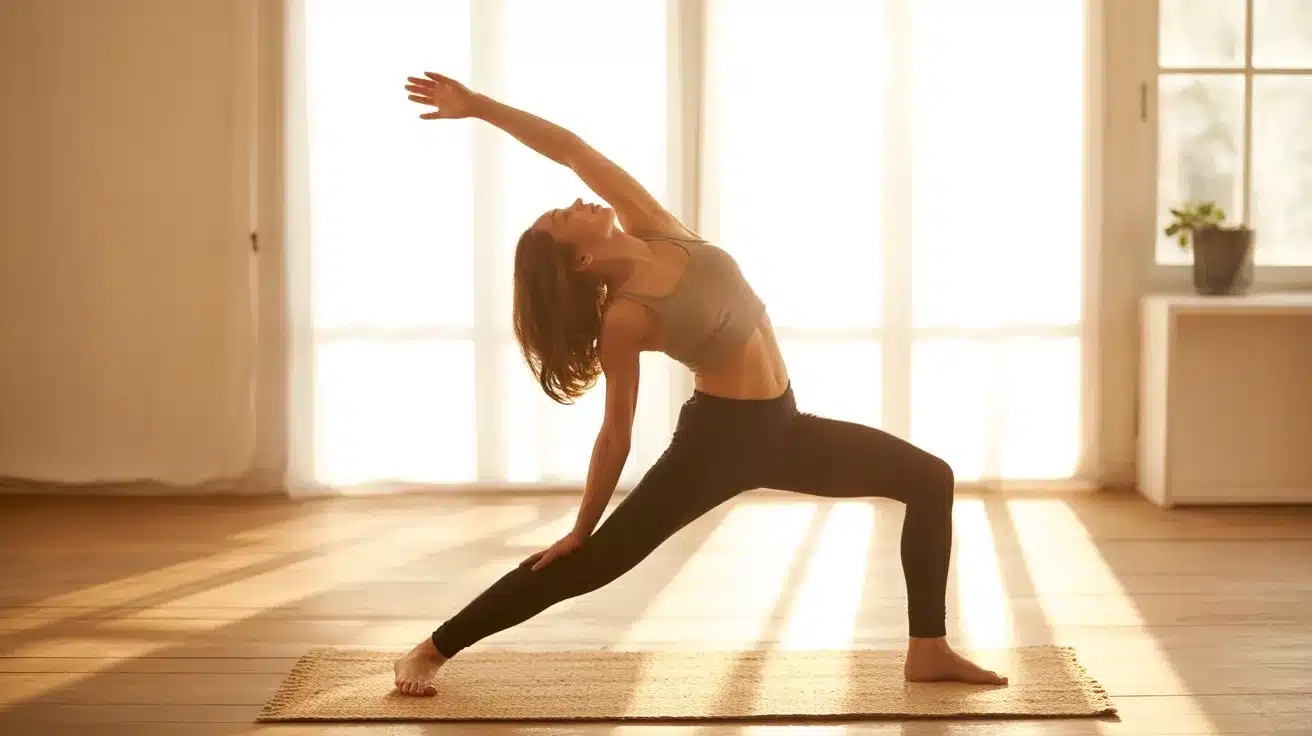
Reverse Warrior Pose is more than just another yoga pose; it’s a powerful side bend that can upgrade your practice.
If you’ve been rushing through it without focusing on the mechanics, you’re likely missing out on its true benefits. I’ve seen firsthand how attention to alignment and breath makes a huge difference.
You’ll learn the meaning behind Reverse Warrior, its benefits, step-by-step instructions, and common mistakes to avoid.
You’ll also find modifications to suit all levels and ways to incorporate them seamlessly into your practice. Let’s dive in and make Reverse Warrior a pose you truly feel in your body.
Understanding Reverse Warrior Pose
Reverse Warrior Pose, or Viparita Virabhadrasana, is a standing side bend that builds on Warrior II. “Viparita” means “reversed,” and “Virabhadra” refers to a fierce warrior created by the god Shiva.
The name indicates the shift in arm and torso direction from Warrior II. Other names for the pose include Peaceful Warrior and Exalted Warrior, but the posture remains the same in modern yoga.
It’s important to note that Reverse Warrior is a side bend, not a backbend. The torso moves laterally over the back leg, not into spinal extension. Mistaking it for a backbend can lead to collapsing in the lower back, which undermines the pose’s purpose of lengthening through the side body.
History and Significance of Reverse Warrior Pose

The Warrior poses stem from the myth of Virabhadra, a powerful warrior born from Shiva’s grief after the death of his wife, Sati.
The three Warrior poses represent different moments in that myth, each with distinct physical and philosophical qualities. Reverse Warrior adds a layer of symbolism with its “reversed” nature.
Where Warrior II projects energy outward, Reverse Warrior shifts that energy upward. The front arm reaches skyward, while the back hand rests on the thigh.
This combination of rooted strength and expansive openness is what gives Reverse Warrior its other name: Peaceful Warrior. It represents the balance between stability in the legs and space in the chest and side body.
Benefits of Reverse Warrior
This pose works on strength and flexibility at the same time, asking the lower body to stay loaded while the upper body stretches. That combination is precisely what makes it worth holding rather than rushing through.
- Quadriceps endurance: The front thigh holds a sustained bend throughout, building muscular endurance with regular practice.
- Glute and back-leg stability: The extended back leg stays active, engaging the glute to anchor the stance and keep the hips level.
- Core engagement: The obliques and deep abdominals contract to control the side bend and protect the lower spine.
- Side-body stretch: The obliques and intercostal muscles lengthen with every inhale.
- Hip flexor lengthening: The wide stance creates a passive stretch through the hip flexors of the back leg, especially useful for those who sit for long hours.
- Shoulder and chest opening: The lifted arm opens the front shoulder and upper chest, adding a mild chest-opening quality to the posture.
- Spinal mobility: The lateral movement of the torso promotes healthy range of motion along the spine, particularly through the thoracic region, which tends to stiffen in desk workers.
- Improved circulation: Holding the pose increases blood flow through the legs and torso, which can reduce fatigue and support energy levels throughout practice.
These benefits compound over time. The more consistently you hold the pose with good alignment, the more the legs strengthen, and the side body opens, making each visit to the posture feel noticeably different from the last.
In my teaching of Hatha and Vinyasa, I’ve found that students who struggle with lower back tightness get surprisingly fast relief from this pose, faster than from most dedicated back stretches, because it combines lateral lengthening with active leg engagement rather than passive hanging.
Warm-Up Poses for Reverse Warrior
Going into Reverse Warrior cold increases the risk of strain in the hip flexors and lower back. These preparatory poses prime the body well:
- Low Lunge: opens the hip flexors and warms the front thigh
- Crescent Lunge: builds stability in the standing leg
- Warrior I: activates the glutes and prepares the wide stance
- Warrior II: the direct entry point into Reverse Warrior
How to Do Reverse Warrior Pose Step by Step
Getting the foundation right before moving the arms is what separates a strong Reverse Warrior from a sloppy one. Every element of the pose depends on the quality of the stance underneath it.
Step 1: Start in Warrior Two

Begin in a standing position, stepping your left foot back approximately 4 to 5 feet and rotating the back heel flat. The back toes should angle in at roughly 45 degrees. Bend into the front knee, aligning it directly over the front ankle, with the front shin perpendicular to the floor.
Stretch both arms out wide into Warrior II, pressing down firmly through the four corners of your front foot for a strong base. Line your front heel up with the arch of your back foot to ensure proper hip alignment from the start.
Step 2: Flip Your Palm and Position Your Hands

From Warrior Two, flip your front palm upward while letting your back hand rest lightly on your back leg. This hand placement is a guide only.
Keep your core engaged and your front foot grounded throughout this transition.
Step 3: Scoop the Front Arm Up and Back

Begin to raise and pull back your front arm, letting your gaze follow the hand as it reaches behind you. Your back hand slides gently down the back leg.
Keep both arms long and straight, avoid curving the arm overhead, as full extension gives the pose its proper length and opening.
A cue I use constantly in class: think “lift first, then lean.” Reach the arm straight toward the ceiling before you allow the side bend to happen. Students who skip this step tend to collapse directly into their lower back instead of creating length first.
Step 4: Adjust Your Gaze for Comfort and Stability

Looking up toward the raised hand gives you a full-frontal view of the body, but if that strains your neck, shift your gaze down to the back foot instead. Both options are completely valid.
Neck comfort matters; forcing the gaze upward when it doesn’t feel right reduces stability and unnecessarily increases tension.
Step 5: Inhale and Then Return to Warrior Two

Hold the position and take a full inhale to lengthen through the raised arm and side body. On the exhale, bring your arms back out wide and return to Warrior Two.
Repeat the full sequence on the opposite side, mirroring every step for balanced strength and hip opening on both sides.
For more details, refer to the video below.
Breathing in Reverse Warrior
Breath is not secondary in this pose; it directly shapes both the quality of the stretch and the stability of the hold. Holding the breath, which many practitioners do unconsciously when a pose becomes demanding, causes the shoulders to rise, the side body to tighten, and the lower back to compress.
Enter on an inhale, lifting the front arm and creating length before any depth. As the exhale releases, allow the side bend to deepen slightly without forcing it past a comfortable range.
During the hold, each inhale is an opportunity to lengthen the side body further; each exhale re-engages the core lightly and keeps the lower back from over-arching. Exit on an inhale, rising back to Warrior II with full length restored before moving to the next shape.
Key Alignment Cues for Reverse Warrior Pose
Strong alignment helps you get the full stretch in Reverse Warrior Pose while protecting your knees, spine, and shoulders.
- Make sure your front knee stays directly above your ankle and does not collapse inward or push past your toes.
- Lift through your ribs and lengthen your spine rather than leaning heavily into your lower back.
- Lightly activate your abdominal muscles to support your torso and prevent unnecessary strain during the backbend.
- Reach up and back through your fingertips while keeping space between your ribs and hips for a clean stretch.
- Anchor the outer edge of your back foot firmly into the mat. A lifted back heel destabilizes the entire stance and forces the front knee to compensate.
- Keep the shoulder blades gently drawn together at the back. This prevents the chest from collapsing forward when the arm lifts overhead.
Focusing on these cues helps you practice safely and build strength with better control over time.
Common Mistakes to Avoid
Avoid straightening the front leg during Reverse Warrior Pose. Keeping the front knee bent and stacked over the ankle maintains strength and stability in the pose.
Do not dump weight into the back hand. The back hand should rest lightly on the leg without pressing down or supporting your body weight.
Avoid overarching the lower back as you lean back. Focus on lengthening through the side body instead of compressing the spine.
Losing shoulder alignment is another common issue. Keep your shoulders relaxed and stacked, keeping your chest open without twisting excessively.
Forgetting to engage the back leg is also common. I see this constantly in group classes: the back leg goes passive the moment the arm lifts, and the whole pose loses its foundation. Keep the back glute lightly active and press through the outer back foot throughout the hold
Modifications for Beginners
This pose is genuinely accessible with small adjustments, and there is no loss of value in making those adjustments. The following options cover the most practical adjustments by need:
- Short stance: Reduce the distance between the feet to lower the intensity on the front thigh and improve balance for newer practitioners.
- Hand on the hip: Keep the top arm on the waist instead of reaching overhead to remove shoulder demand and simplify the shape without losing the side-bend quality.
- Block under the back hand: Placing a yoga block on the back thigh or shin provides a resting surface for the back hand without encouraging weight-bearing through the arm.
- Gaze forward: Looking up strains some necks. Keeping the gaze forward removes that tension entirely with no impact on the rest of the posture.
For a more advanced option, moving directly from Reverse Warrior into Extended Side Angle, by dropping the front forearm to the front thigh, creates a natural progression that deepens the hip and side-body opening within the same standing sequence.
Follow-Up Poses After Reverse Warrior
Reverse Warrior naturally opens the door to several deeper shapes. Use these to continue or close out a standing sequence:
| Follow-Up Pose | Description |
|---|---|
| Triangle Pose | Extends the side-body stretch with a straight front leg. |
| Extended Side Angle | Drops the front arm down, increasing lateral load on the hip and inner thigh. |
| Half Moon Pose | Challenges balance after the legs are warmed. |
| Warrior III | Builds on the single-leg strength developed in the stance. |
| Wide-Legged Forward Fold | Provides a counter-stretch to reset the spine. |
In my Vinyasa sequences, I almost always follow Reverse Warrior with Extended Side Angle on the same side before switching. The transition is seamless, and students feel an immediate deepening without any additional instruction needed.
Contraindications and Safety Tips
Understanding safety considerations before practicing Reverse Warrior Pose helps reduce injury risk and supports a safer, more controlled experience.
- Lower Back Sensitivity: Avoid leaning too far back. Use a shorter stance, reduce arm height, and avoid any lean if you feel pinching.
- Knee Pain Considerations: If you have existing knee pain, use a shorter stance and avoid pushing the front knee past the toes.
- Neck Issues: Keep your gaze forward instead of upward if turning your head causes discomfort or strain.
- Pregnancy Modifications: Shorten your stance and reduce the depth of the backbend to maintain balance and comfort throughout the pose.
- High or Low Blood Pressure: Avoid this pose or practice it only with a qualified instructor’s guidance, as the arm overhead and the wide stance can affect circulation.
- Recent Hip, Shoulder, or Spinal Injury: Skip this pose until cleared by a healthcare provider. The combination of a loaded stance and lateral spinal movement places real demand on all three areas simultaneously.
Practicing mindfully and adjusting as needed allows you to gain benefits while protecting your joints and muscles.
Final Thoughts
Reverse Warrior Pose is a powerful addition to your yoga practice, balancing strength and flexibility.
By focusing on proper alignment, breath, and muscle engagement, you can enhance its benefits, like strengthening your legs and opening your side body.
If you’re just starting or a seasoned yogi, practicing Reverse Warrior with awareness will deepen your practice. With patience and attention to detail, you’ll experience improved endurance, flexibility, and stability.
I’d love to hear how Reverse Warrior has impacted your practice, share your thoughts, or any challenges you’ve faced. Ready to give it a try? Take it into your next session and let me know how it feels.